
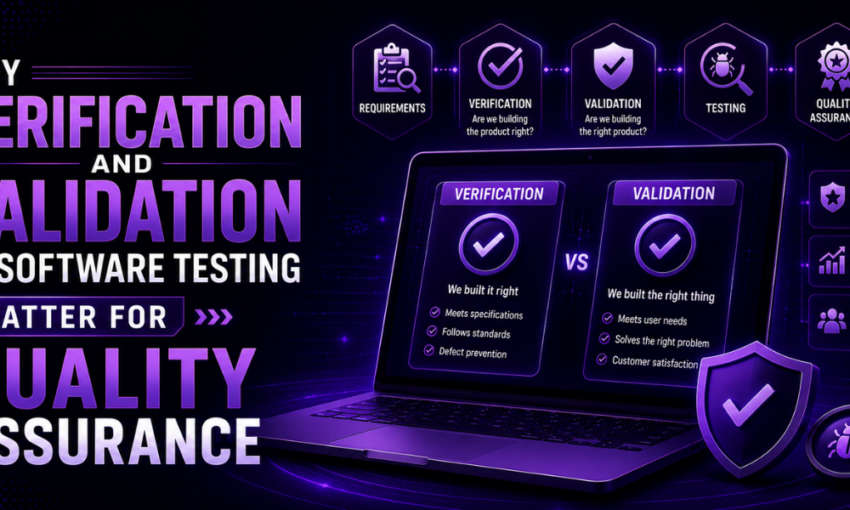
Clear requirements start the process, design and development continue it, and testing and review prove it. That’s why verification and validation in software testing are important in quality assurance. Some teams spend a lot of energy on end-of-development testing, but it can result in late surprises, high costs and frustrated customers. Verification is used to determine if the team builds the software properly. Whereas validation is used to determine if the team builds the right software for the user. These practices collectively contribute to software reliability, risk mitigation, and high performance in the field. However, both practices are crucial in today’s QA, as quality is more than bug finding. Quality also means that defects are avoided, that requirements are confirmed and the team produces a final product that meets business goals. That’s the true purpose of verification and validation in software testing.
What Are Verification and Validation in Software Testing?
Understanding Verification in Software Development
Verification is the process to identify if the software product is developed according to the design documents and specifications. It addresses “Are we building the product right?”.
Understanding Validation in Software Testing
Validation has an important role in the software development process in the software testing. It verifies the final software system matches the user’s requirements and expectations.
Why Both Processes Are Essential
The verification and validation process is essential because the software system can meet all the technical design specifications perfectly. But it doesn’t solve the problem the user faces, and that was supposed to be solved in some cases.
Verification and Validation Within Quality Assurance
Verification and validation are the basis of SQA (Software Quality Assurance) as they serve as the link between market and development.
Why Verification and Validation Matter for Software Quality
Preventing Defects Early in Development
Finding defects early reduces costs and time when compared to fixing defects once the system is released. Verification finds defective requirements, design and code and resolves them before they become major problems.
Ensuring Software Meets User Expectations
Product validation proves that it behaves as expected by users in a real-life context. It is important as technically correct software does not necessarily fulfill the correct requirements.
Reducing Rework and Development Costs
Detecting problems late requires redesign, recode, and retest. It also needs numerous approvals. Hence, good verification and validation will allow these issues to be found so that rework and costs can be minimized, both in terms of time and monetary savings.
Improving Reliability and Performance
The well-verified and well-validated product will be able to sustain its performance more accurately in a real-life environment and is less likely to malfunction, thus fostering more confidence in users.
Software Verification and Validation Explained
What Does Verification Aim to Achieve?
Verification seeks to verify the accuracy of each of the following results (deliverables) based on the requirements and design standards stated. For example, when we ask whether the right intermediate products are produced and whether the right process is being followed.
What Does Validation Aim to Achieve?
Validation seeks to verify if the software is delivering value in terms of software quality to end users and all interested persons, ie whether the product really does that it was supposed to do
The Relationship Between Verification and Validation
Verification and validation overlap, though do not become identical. Verification instills confidence that the program is correct as it is being developed, whereas validation ascertains that it is of business value following development.
How They Work Together Throughout Development
Verification and validation processes are closely knit so as to achieve the required quality control in software testing. Verification refers to building the software right and helps in detecting the bugs early. Whereas validation is applied to check whether it is the right software that is being built to solve the problems of the user. If either of the two stages is skipped, risks can arise. Verification ensures the correct product and validation ensures the right product is being built.
Verification vs Validation Testing – Key Differences
Verification vs Validation Comparison Table
| Factors | Verification | Validation |
| Definition | Verification refers to the set of activities that ensure software correctly implements the specific function | Validation refers to the set of activities that ensure that the software that has been built is traceable to customer requirements. |
| Focus | It includes checking documents, designs, codes, and programs. | It includes testing and validating the actual product. |
| Type of Testing | Verification is the Static testing. | Validation is Dynamic testing. |
| Execution | It does not include the execution of the code. | It includes the execution of the code. |
| Methods Used | Methods used in verification are reviews, walkthroughs, inspections and desk-checking. | Methods used in validation are Black Box Testing, White Box Testing and Non-Functional testing. |
Difference Between Verification and Validation in Practice
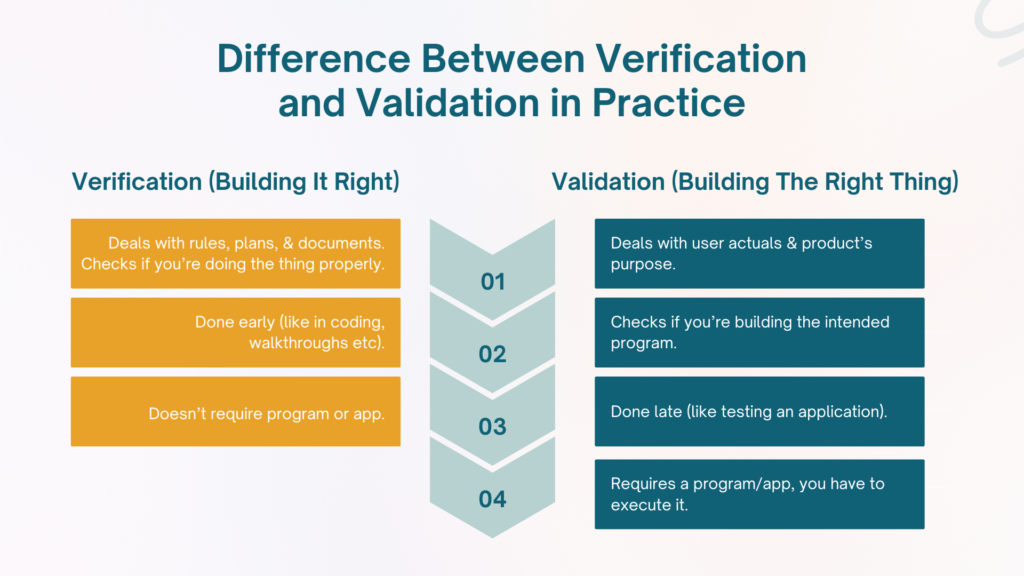
Validation Testing in Software Engineering
- While testing features: When releasing a new feature, validation will check if it is solving the problem that it was designed for. It will consider a technical point of view, but from the user point of view as well.
- Just before release: Validation is your last chance to make sure that the software meets the business needs and user requirements; if not, you need to go back to the previous stage.
- When business needs change: When project scope is modified, you can perform validation to ensure the software is still meeting the business needs and user requirements.
- User feedback: You want to ensure that the software provided to the user meets the user needs. Validation should confirm that there are no discrepancies between user needs and system services.
- When it comes to the real world: Validation would ensure that the application performs correctly under real-world use conditions. Testing in a restricted environment can differ slightly compared to real-world use.
Common Verification Methods Used by QA Teams
- Code Reviews: A process by which developers examine code that another developer has written. Often performed to find bugs, security flaws, and coding standard violations. It generally makes sure the code is correct before merging it into the main branch of the code repository.
- Design Walkthroughs: It takes a phase-by-phase presentation of system architecture and design decisions for colleagues in order to make sure the approach works. Furthermore, it meets the needs of the requirements and catches some early potential problems.
- Formal Inspections: A structured examination by a small group, typically trained QA engineers, of documents, specification and code in order to find defect against check lists, norms or criterion for the documents, specification and code.
- Static Analysis: An analysis of computer software performs without actually executing the program. Such analysis may reveal errors, security vulnerabilities, code smells and coding standard violations of the code.
Common Validation Testing Methods
- Unit Testing: Testing an individual component or module for function correctness. According to research from JetBrains, 63% of projects worldwide, adopts unit testing by making it the top type of test.
- Integration Testing: The testing of modules or systems to determine that the application develops properly, thereby ensuring smooth data integration flow and communication between all functional components (modules, web services etc.).
- System Testing: In the case of system tests, it checks the complete and installed software version. It checks development of the given requirements. Also, it checks whether any errors, system malfunctions and missing pieces are occuring.
- User Acceptance Testing (UAT): Undergoing a test run and performed under real-time working environment in the case of real or typical use cases, it’s an important software development cycle. UAT confirms whether business requirements or expectations meets within in specific software under consideration.
- Performance Testing: It ensures the functionality and operational capacity to perform all actions during peak hour load and normal conditions. Under the given loads, it verifies and validates whether the product meets the performance measure requirements and when it is under severe test.
Verification and Validation Within the Software Quality Assurance Process
The QA Plan defines what teams will do to both avoid defects and to measure what has occurred as good (correct/valid). High quality verification and validation in software testing must be part of this plan and is not something that needs to be in addition to the plan. Verification ensures standards are adhered to during software testing, and validation ensures software is “good” once it has finished. When verification and validation in software testing are incorporated in the plan, the whole team owns quality.
Real-World Examples of Verification and Validation
Scenario 1: Developing a New Online Shopping Application
Verification Testing Example
- Requirement Review: Reviewing requirements, the team verifies that the user login functionality satisfies the specification, such as passwords should not be easy to guess.
- Code Inspection: Perform code inspection on user login implementation to ensure it adheres to the design and follows best coding practices.
Validation Testing Example
- UAT (User Acceptance Testing): End user testing the feature of user login after implementation to verify that it behave as expected
- Application is sent to final testers: The application developed by the team is delivered to the final users (beta tester). They evaluate the login procedure.
Summary
Verification Testing assures that the developers have correctly developed the user login feature according to specification and design. Whereas Validation Testing confirms that it satisfies real end-user expectations.
Scenario 2: Creating a New Mobile Banking App Test
Verification Testing Example
- Design Review: Team analyses the design doc to understand the logic of showing the transaction history.
- Unit Testing: Test transaction processing logic, to ensure the unit’s functionality and it meets the requirement of the unit’s functional spec doc.
Validation Testing
- System Testing: Test the system and ensure the transaction history of balance checking feature satisfy the user expectations.
- User Feedback: After the launch the feature in live to gather feedback from actual user regarding it is useful for their financial management.
Summary
Verification testing checks if the team build mobile banking application features in the right way with correct design requirements.
Benefits of Effective Verification and Validation
| Aspect | Benefits of Effective Verification | Benefits of Effective Validation |
| Early Issue Detection | Detects and Identifies Defects Early: Finding defects during the early stages of development significantly reduces the time, effort, and cost required to fix them. Early debugging helps developers resolve issues before they spread across the project. | Detects Real-World Problems: Validation involves real users or stakeholders who identify missing features, confusing workflows, or functionality issues that may not appear during development. |
| Standards & Compliance | Ensures Standards Compliance: Confirms that the software follows coding standards, architectural guidelines, and industry regulations such as those required in healthcare and finance. | Validates Business Value: Ensures the software delivers the intended business outcomes and solves real user problems instead of only meeting technical specifications. |
| Quality Improvement | Improves Code Quality: Regular code reviews, static analysis, and inspections encourage better coding practices, reduce technical debt, and produce cleaner, more maintainable code. | Ensures Customer Satisfaction: Verifies that the software meets user expectations, fulfills business requirements, and provides a positive user experience. |
| Collaboration & Risk Reduction | Promotes Knowledge Sharing: Activities such as peer reviews and walkthroughs help team members exchange knowledge, improve collaboration, and reduce dependency on individual developers. | Prevents Post-Launch Failures: Identifies usability issues, functional gaps, and performance concerns before deployment. Thereby reducing production risks and protecting the organization’s reputation. |
Verification and Validation in Agile Development
Verification in Agile
This step is to check if the code implements the design and the technical rules. The process is static since you do not need to execute the feature in the design and the technical rules are defined.
- Code Reviews: A teammate will review your code and check if there is any error.
- Unit Tests: Small tests are created in order to provide that code chunks run the way they are supposed to.
- Static Analysis Tools: Automatic programs can be used to discover any mistake or stylistic error in the code.
Validation in Agile
This step is to check whether the software fulfill the needs of the user. The process is dynamic as the running software has to be used in order to prove that it implements the required feature.
- Acceptance Criteria: Acceptance Criteria indicate what the feature is supposed to do before the implementation begins.
- User Acceptance Testing (UAT): In each sprint review, the users of the software or the relevant stakeholders test the features developed in the sprint.
- Exploratory Testing: Testers explore the running software unrestrictedly.
Common Challenges Teams Face
1. Clarifying ambiguous requirement
Problem: Ambiguous or incomplete requirements do not allow testers to test the requirements well.
Solution: Collaborating with stakeholders in early stage, writing requirement checklists, and working together with developer and analyst to fill out the missing part.
2. Short amount of testing time
Problem: The development stage runs over budget and tight testing timeframe.
Solution: Prioritizing the testing by risk, using automated tool to avoid repeating boring work and dividing the testing work into sprint.
3. Test Data management
Problem: It takes a lot of time to create realistic test data.
Solution: Using test data generating tool for big data, data masking to handle secure data safely and having a standard and reusable dataset.
4. Testing with different devices and platform
Problem: Testing compatibility of different devices and platforms cannot do easily in large teams.
Solution: Using cross-platform testing tool, targeting common devices and platforms first and using automated testing for compatibility.
Best Practices for Verification and Validation Success
- Let the documentation be your starting point to gain visibility.
- Make sure to carry on the validation as a constant activity.
- Validate using simulated as-designed and as-is workflows.
- You can automate the entire test suite across devices and applications.
- Ensure a wide range of functional validation alongside non-functional as well.
- Apply them across all device production phases.
- Refine the V and V processes as you grow.
Common Misconceptions About Verification and Validation
Misconception 1: Verification is before coding
In truth, the whole phase needs verifying, right from requirements to testing(through code review, for instance).
Misconception 2: Validation means UAT
In truth, there are a lot of validation points other than UAT (such as testing or design review).
Misconception 3: Automation replaces verification
In truth, automation helps validate stuff, not verify it. You still need design and warranty review to verify nothing is wrong.
Misconception 4: Agile implies we don’t review documentation
In truth, in agile you review documents on an extremely regular basis, embedded in your workflow. It removes the review part simply because you have Agile.
Measuring the Effectiveness of Verification and Validation
To demonstrate whether a V&V activity has worked, you will need a metric or some measurements. These would include, among other:
- Requirement Traceability: This will measure and indicate how well and to what extent the different parts of the system and functions of the system can be trace up to the origin of requirements and vice versa.
- Requirement Coverage: This would show the ratio or proportion of considered confirmed/validated requirements by tests, analysis, inspection or review.
- Defect Density: This measures observation on how many defects/problems in correlation to some measure of system size, complexity or functionality.
- Defect Resolution: This will measure and indicate the rate and the way of resolution for all problems/defects uncovered during the V&V process.
- User Satisfaction: This demonstrates and confirms whether the future end-users or stakeholders are satisfied and accepting towards the developed system.
Future Trends in Verification and Validation
AI-Powered Testing Tools
AI is disrupting both validation and verification. As per research by McKinsey, 88% of organizations have adopted or are adopting AI in at least one business function, and testing is a large area of use. AI-powered testing tools now perform intelligent test generation, predictive defect detection, and self-healing test execution.
Continuous Testing in DevOps
Verification and validation are now a part of the accepted and standardized verification strategy of CI/CD pipelines. Over 80% of DevOps orgs perform continuous testing; this means that bugs and validation detects near real-time as you deploy your code into pipelines.
Behavior-Driven Development (BDD)
BDD frameworks connect verification and validation together. Instead, test scenarios are written in natural language to ensure tests address business-centric and technical team-specific criteria. In 2024, more than 60% of agile teams implemented BDD to foster better collaboration between their teams and stakeholders.
Conclusion
Verification and validation in software testing are not just terminology. These are real-life quality practices that enable teams to create the right product in the right way. By making verification and validation part of the complete software QA lifecycle, organizations minimize defects, satisfy users and deliver software confidently. Verification is for checking documents, design and code early and protects the process. Validation ensures the result by having the teams validate the end product for real business and user needs. Thereby, both practices are important in the current rapid rate of development to ensure quality. Those teams that consistently use them produce safer, stronger, and more practical software that has a greater probability of success in the real world.
FAQs
Q1. What are verification and validation in software testing?
A software development team verifies the software is developed as per specification and validates that the right software is developed that meets the needs of the user.
Q2. What is the difference between verification and validation?
During verification, the team verifies plans, documents, and code without actually running them; during validation, the team validates the actual product with users.
Q3. Why are verification and validation important?
The company understands the importance of verification and validation and how it will benefit their product. This helps them to make sure that the product is built correctly according to technical rules. Also, they check that they are actually able to meet the needs of real-world users.
Q4. What are common verification methods?
Inspection, testing, and analysis are common ways to verify whether a system or identity complies with specified rules.
Q5. How do Agile teams perform verification and validation?
CI, automated tests, and regular feedback from the stakeholder are practices implemented in an Agile manner so they execute the verification & validation activity on an iterative basis each sprint.