

Quality Assurance is the key to successful software development, and the principles of software testing are the building blocks that lead to quality in software development. If there are no definite test principles, then the organizations are in danger of releasing a buggy product. This will irritate the users and bring down the reputation of the organization. The principles of testing offer a well-defined structure that enable the testers to work smarter, not harder and to find out the critical defects before they get into the production.
In today’s digital world, businesses can lose millions and the trust of their customers due to software failures. By understanding and applying testing principles, you can ensure your QA process is efficient, effective, and aligned with business goals. This blog explains the importance of testing principles, how to apply them and why they are essential for success in quality assurance in different development environments.
What Are Testing Principles in Software Engineering?
Testing Principles Explained in Simple Terms
When a software program is tested by evaluators to check that functions are as designed as per the requirements. It contains no errors or bugs. Furthermore, it provides a reliable software product.
Why Testing Principles Matter in QA
Testing principles help the QA team use these resources to maximize defect detection and encourage a proactive approach to testing rather than a mechanical checklist. They establish realistic expectations and direct engineers to be mindful of what matters.
Role of Testing Principles in Software Quality Assurance
Testing principles offer a roadmap to help develop the most efficient, risk-aware validation strategies that are objective-based in Software Quality Assurance (SQA). Instead of random testing or a reactive bug-hunting cycle, SQA professionals use these principles and standards established by governing bodies such as ISTQB*. It establishes realistic client expectations budget software development projects. Thereby, producing high quality software products.
*ISTQB means International Software Testing Qualifications Board
The 7 Principles of Software Testing
1. Testing shows Presence of Defects: It can only show the presence of defects, never the absence of defects. That is, testing will detect issues, but no software is completely fault-free. Initially, testing can find faults in the software. Embracing qa testing best practices can help predict remaining software errors.
2. Exhaustive Testing is Impossible: It is impractical and impossible to test every scenario, situation, and course as there are too many diversifications and combinations. Instead, testers should consider the objective of threat analysis and concentrate on testing efforts. It will identify the most impactful and important parts of the software. Identify and target the most vulnerable areas for testers to focus on and optimize their performance and effectiveness.
3. Early Testing: Testers ought to test as early in the software development lifecycle as possible. The shift-left approach creates an environment that detects defects early. They are cheaper and more readily corrected than those found later. The testing from the ground up approach will assist teams to locate issues on the ground, and save effort and expense making the fix.
4. Defect Clustering: Maximum defects can cluster in a small set of a wide range of modules. It is an “illness clustering” phenomenon, which reveals that if there are defects, they do not scatter frivolously throughout the software program. Those higher risk areas can choose the tests they wish to run. It applies the best tests to the parts of the software program system where they are most likely to find specific faults.
5. Pesticide Paradox: Over time repeating tests will have no reward as there will be no new defects. This phenomenon is the Pesticide Paradox. So it is imperative that the testers check on the test cases on a regular basis and update them when necessary. They make tests authored. Furthermore, they are different ones to test different parts of the software. This way, testing keeps finding the defects and becomes effective.
6. Testing is Context Dependent: Select testing approaches, techniques, and tools as per the context of the software. A medical device or a flight system, for example, is tested in a way that is very different from how a simple e-commerce site is tested. Testers can use the best methods to make sure the software works as planned and meets all the requirements if they are knowledgeable about the subject.
7. Absence-of-Errors Fallacy: Although there are no defects, it doesn’t imply that the software program is beneficial or meets user requirements. But sometimes, finding and fixing it is insufficient. The software must fulfill the user’s needs and include value. The software should be easy to use, functional and meet the expectations of its users.
Importance of Testing Principles in Quality Assurance
- Setting Expectations: Teams make sure that everyone involved knows that testing is not a magic bullet for making sure that a product doesn’t have any bugs, but it is a great way to lower the chances that this will happen. This creates a reasonable view of quality assurance.
- Resource Optimization: Teams can work on high-risk areas and make the most of a limited time and budget; it is suitable for agile development requirements.
- Continuous Improvement: Concepts such as the Pesticide Paradox help the teams keep their testing strategies dynamic, thus ensuring that they keep in step with the software and maintain relevance in the constantly evolving and dynamic environment.
- Integration in SDLC: Make sure to identify issues in the requirements stage. It saves the teams the costly rework later and gains collaboration between development and testing teams.
Testing Fundamentals in Software Engineering
Difference Between QA and Testing
| Factor | Quality Assurance (QA) | Software Testing |
| Core Goal | Prevent bugs from ever being introduced. | Find and report bugs in the built product. |
| Primary Focus | The software development process. | The actual software product. |
| Nature | Proactive and preventative. | Reactive and corrective. |
| Scope | Covers the entire lifecycle (SDLC). | A specific phase nested within the lifecycle. |
| Typical Activities | Process audits, tool selection, code reviews. | Writing test cases, executing tests, filing bugs. |
| Orientation | Managerial and organizational. | Operational and technical. |
Verification vs Validation in Testing Fundamentals in Software Engineering
| Features | Verification | Validation |
| Definition | Ensures work products conform to specified requirements | Ensures the final product meets user and stakeholder needs |
| Focus | Requirements, design, and implementation correctness | Functional behavior and intended use |
| Nature | Often analytical and review-based | Typically evaluation- and execution-based |
| Execution | May or may not involve executing software | Usually involves executing the software |
| Methods Used | Methods used in verification are reviews, walkthroughs, inspections and desk-checking. | Functional testing, system testing, acceptance testing |
| Purpose | It checks whether the software conforms to specifications or not. | It checks whether the software meets the requirements and expectations of a customer or not. |
| Bug | Helps detect defects early by checking conformance to requirements and standards. | Detects defects during execution, including functional, usability, and integration issues. |
| Goal | The goal of verification is application and software architecture and specification. | The goal of validation is an actual product. |
| Responsibility | Involves developers, reviewers, QA, and engineers | Involves testers, users, QA teams, and stakeholders. |
| Timing | Performed throughout the software development lifecycle. | Performed throughout the lifecycle when the system or components are executable. |
| Lifecycle | Applied continuously across all lifecycle phases. | Applied iteratively as the system evolves and becomes usable. |
| Error Focus | Verification is for prevention of errors. | Validation is for detection of errors. |
| Stability | Based on defined criteria, standards, and expert judgment. | Based on observed system behavior and acceptance criteria. |
Manual Testing vs Automation Testing
| Parameter | Manual Testing | Automation Testing |
| Definition | Test cases are executed manually by testers. | Test cases are executed using automation tools and scripts. |
| Processing Time | Time-consuming | Faster execution |
| Resource Requirement | Requires human testers | Requires tools and skilled professionals |
| Exploratory Testing | Possible | Not ideal (limited support) |
| Framework Requirement | No framework required | Uses frameworks (Data-Driven, Keyword-Driven, etc.) |
| Reliability | Prone to human errors | More reliable and consistent |
| Investment | Investment in human resources | Investment in tools and automation engineers |
| Test Results | Recorded manually (e.g., Excel) | Automatically generated reports/dashboards |
| Human Intervention | High | Minimal |
| Performance Testing | Not suitable for load/stress testing | Suitable (e.g., using JMeter) |
| Batch Testing | Not possible | Multiple tests can run together |
| Programming Knowledge | Not required | Required |
| Documentation | Limited documentation | Scripts act as documentation |
| Best Used For | Exploratory, Usability, Ad-hoc testing | Regression, Load, Performance testing |
Software Testing Lifecycle and Testing Principles
1. Requirement Analysis Phase: The testing team talks to people who have a stake in the project to find out what standards can be tested, what acceptable criteria are needed, and how to prioritize test cases based on the project’s goals.
2. Test Planning Phase: The test manager will develop a detailed test plan that includes the testing strategy, scope, objectives, resources, schedules, and deliverables, and will also determine the risks and mitigation measures.
3. Test Case Development Phase: The team develops elaborate test cases according to the requirements. Then test plan, both in terms of its inputs and results, as well as the test data preparation.
4.Test Environment Setup: The team has setup the test environment as close to the production environment as possible to get accurate results in the test. This includes installing servers, software and conducting smoke tests of the environment.
5. Test Execution Phase: The testing team performs all the test cases, validates defects and retests and regression tests to test the fixes and documentation of results through quality evaluation.
6. Result Analysis: The team examines the results of the implemented test cases to test the quality of the developed software, measures test results, and prioritizes defects to address.
7. Test Closure: The team does a review of the completion criteria at the end of the testing process. Generate a closure report of the testing efforts and use the artifacts for reference.
How Testing Principles Improve the Software Quality Assurance Process
1. The term “Software Quality Assurance” (SQA) recognizes that testing does not guarantee that the system is bug-free; it only says that bugs or other problems can take place. Such understanding leads to a culture of constant testing and improvement, which helps to avoid complacency upon a successful test.
2. Early testing focuses on a cost-efficient methodology, and teams detect defects sooner in the requirements or design process. It is much cheaper to correct defects detected at an earlier stage compared to when detected after launching the product. This aligns with the principle of shift left that developers will embed continuous testing early in the Software Development Life Cycle (SDLC).
3. The risk-based testing by teams enables teams to focus on high impact areas and optimize their time and budget, as exhaustive testing can be impractical due to time constraints.
4. Clustering of defects suggests that some few modules tend to contain most of the bugs. SQA processes promote teams to focus on these risky areas testing to make efficiency.
5. The pesticide paradox points out that repeated testing on the same test cases results in decreasing returns of bug discovery. As such, SQA requires teams to constantly revise and construct new tests in the process of further enhancement.
6. Context-dependent testing is a strategy that guarantees that QA strategies are specific to the needs and risks of various domains (e.g., e-commerce and medical devices) that meets special compliance requirements and priorities.
Common Mistakes Teams Make While Applying Testing Principles
1. Presence of Defects
Challenges: The insufficient coverage of the tests and a false sense of safety of passing tests may make teams socialize to ignore the defects.
Mitigation: Teams ought to generate detailed test cases, update regularly and include the use of defect tracking tools to analyze the test cases.
2. No Exhaustive Testing.
Challenges: Limited time and the complexity of prioritization may not allow teams to conduct extensive testing.
Mitigation: Teams are to apply risk-based testing, employ equivalence partitioning, and to automate repetitive tests.
3. Early Testing
Challenges: When the team conducts early testing, it becomes complicated by cultural resistance and incomplete requirements.
Mitigation: The teams are to encourage shift-left testing, participate in collaborating requirement development, and promote unit testing.
4. Defect Clustering
Challenges: Knowledge of hotspots of defects and distribution of resources can cause teams to lose other aspects.
Mitigation: The teams analyze the previous data along with refinement of focus on high-risk areas and conduct the root cause analysis.
5. Pesticide Paradox
Challenges: Focusing on the number of test cases and the resource requirements to maintain them can lower the effectiveness of teams.
Mitigation: Perform frequent analysis of test cases. Adopt exploratory testing and automation of test cases.
6. Testing is Context Dependent
Challenges: The inability to standardize and lack of knowledge of domains may be impediments to effective testing by teams.
Mitigation: Teams ought to come up with contextual testing policies, invest in training as well as involve the stakeholders.
7. Absence-of-Errors Fallacy
Challenges: Inconsistent goals and inconsidered user needs may destroy the quality of teams.
Mitigation: Do user acceptance and usability testing on teams and testing goals should be aligned to the business objectives.
Real-World Examples of Testing Principles in Action
1. Testing shows the presence of defects
Now, pretend that you are testing a banking app. If you enter the correct username and password, the feature ‘Login’ is functioning properly. It may operate this way in one situation, but the program may encounter other issues such as Network Timeouts, Currency Converter errors, Login failures, etc., depending on the device and network conditions. The effectiveness of the test has not focused on perfection; it only proves the system works under the test conditions.
2. It is not possible to test exhaustively.
Let’s take a large e-commerce business as an example. If all the products, the different filters, and all the shipping options are available for users, testing can become impossible. In cases like these, the test team focuses on key features such as the checkout and payment flows and mobile responsiveness, as these are most important to the user experience and business functions.
3. Testing early saves time and money.
For instance, a company like Startup Rabbit makes a new social media website. At design time, the testing team identifies a problem with loading the images in the performance. Addressing this when the UI design and initial functionality are just ready for developing the app, and users have already accepted it.
4. Defects cluster together
To sum up, during game development, the character customization screen encountered various problems, including rendering inaccuracies and a flawed UI. The investigation of the same game enables testers to focus their testing efforts on the modules most likely to have problems.
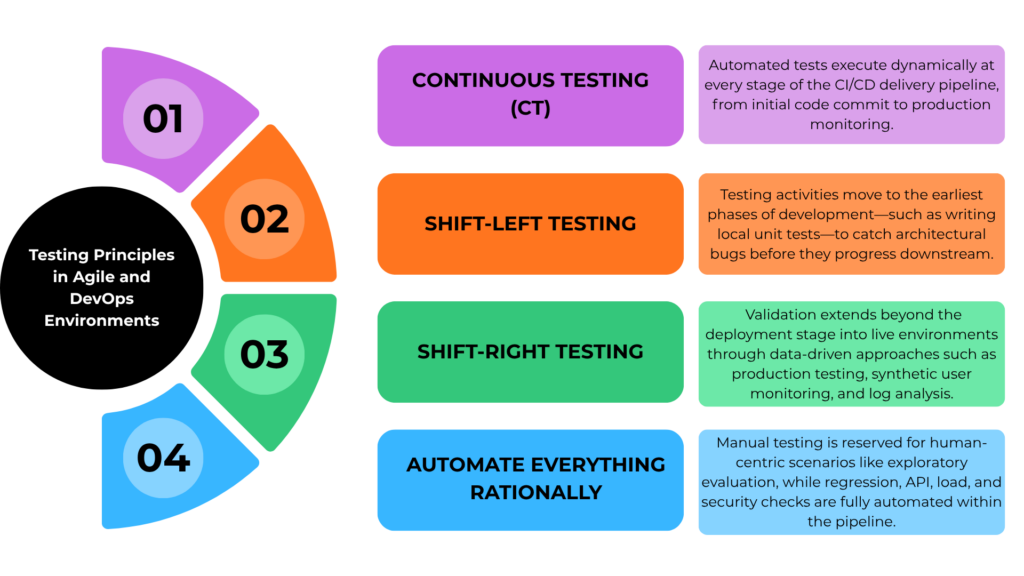
Testing Principles in Agile and DevOps Environments
Future Trends in Software Testing and QA
1. IoT Testing
Industries such as automotive, healthcare and many others require rigorous test rigor for reliability and security, especially in the context of IoT, fueled by 5G. Tools such as Postman and Wireshark determine communication and security problems.
2. Codeless Automation
Being able to automate without coding, using visual interfaces and drag and drop makes automation accessible to non-technical users and makes test creation faster.
3. Blockchain
Blockchain is gaining traction as a safe data exchange system and is slowly entering other sectors, creating transparency while fostering security and scalability challenges.
4. Big Data
The challenge faced by organizations is understanding how to manage vast quantities of data. Testing assure the accuracy and speed of the data. This will aid in decision-making.
5. Performance Engineering
Performance engineering is about improving the user experience, monitoring and optimizing continuously during SDLC, and is not just about traditional test and testing methods.
6. Infrastructure as Code (IaC)
IaC is the method that leverages code to help manage cloud infrastructure, which helps to make it more efficient, among others tools like Docker and Terraform.
7. Chatbots
Chatbots have become popular after COVID-19, as they offer 24/7 support across the industries. Chatbots need to undergo continuous testing for performance and accuracy.
8. Test Automation in Agile
These will help to improve testing efficiency in Agile settings, quicker feedback and better cooperation.
9. Test Automation with ML and AI
These technologies not only simplify testing steps but also maximize testing accuracy, detect defects, and save time and the testing costs.
Conclusion
The key principles of testing are crucial for the success of quality assurance as they form a foundation of effective testing. From early testing to context dependency, the seven testing principles will help QA teams deliver better results. Firms that adopt a principle of testing tend to have fewer production bugs, lower costs and a more satisfied customer base. In short, these principles transform testing from bug hunting to quality assurance. When teams follow these principles, they use resources better, deliver software that meets user needs, and focus on important issues. Testing principles are essential; they are the foundation of QA success in any development environment. Start using software testing principles today to change your quality assurance approach.
FAQs
Q1. What are the 7 principles of software testing?
The International Software Testing Qualifications Board (ISTQB) identified 7 principles of software testing as fundamental principles for software testers to build effective software test strategies and expand their test resources.
Q2. Why are testing principles important in QA?
Testing is a compass and QA teams offer a foundational compass based on testing principles.
Q3. How do testing principles improve software quality?
Testing principles lay the foundation for a disciplined approach to testing that makes teams more push towards defect prevention.
Q4. What is the role of testing principles in Agile development?
Agile development takes the principles of tests from the beginning to guarantee software quality.
Q5. What are the fundamentals of software testing?
In software testing, the systematic evaluation process ensures the application fulfills the company’s needs, performs at its expected level, and contains no critical defects.