
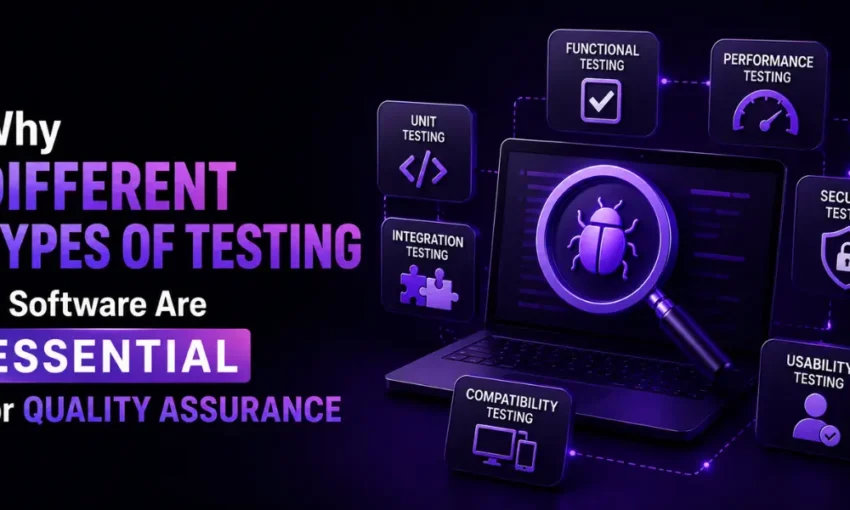
Services like banking, healthcare that are critical to the modern economy is dependent on software, so ensuring the quality of software is very important. Quality Assurance (QA) is fundamental in creating reliable software. It can face failures if tests are not applied effectively. Different types of tests can reveal flaws, increase performance and guarantee that users have a smooth experience. In this article, we look at some types of software testing, their appropriate use, challenges, future trends, and the relevance to today’s quality assurance practices, in simple terms and in practical senerios. Whether it is an app for mobile devices or software for the enterprises; understanding types of testing in software are vital for the success of any software project.
What Are Types of Testing in Software?
Software Testing Explained in Simple Terms
Software testing is the phase of the SDLC in which developers build software applications that work correctly and fulfill the user’s needs. This can find defects and can enhance the overall quality, reliability and the performance of the software application.
Why Different Testing Types Are Necessary
Different types of software testing are necessary because a single test cannot evaluate an entire software application. All of the testing is supposed to test different aspect of the application, testing a code from logic checking, user requirement, high traffic and load testing. So that the whole team develops a user-friendly, secure and scalable application before it releases it in the market.
Role of Testing in Software Quality Assurance
Software testing is the functional and technical execution engine of Software Quality Assurance (SQA). It is used to see to it that developer develops a product that works. It is because it will identify any defect in the product prior to its release. Although SQA sets down high-level process blueprints, compliance metrics, and preventive strategies, the software test is a practical validation step that puts the guidance to the test.
Types of Software Testing Every QA Team Should Know
Manual Testing
This refers to performing the tests by configuring the testing environment manually. It interacts with humans, leading to additional costs and errors. But manual testing is very flexible and useful for exploratory testing, ad-hoc testing, and usability testing.
Automated Testing
Scripts run the test cases as part of automated testing, which speeds up and improves the quality of the testing while lowering the amount of manual work. This helps in focusing on the essential matters for testers. The use of automated testing together with manual testing is not the best strategy to develop a QA plan in some cases. Once effectively implemented, testers will identify the right QA testing tools.
Functional Testing
This kind of testing ensures that the application operates as expected. Functional testing falls under black box testing. Since it is concerned with functionality of software application but not the performance. Unit testing and integration testing differ significantly from functional testing because the latter assesses software from a consumer standpoint.
Non-functional Testing
This refers to examining the external qualities of the software, such as its speed, reliability, scalability, and performance. Non-functional testing helps determine whether the software meets quality standards besides functionality. Such testing comes after functional testing to assess system efficiency.
Types of Functional and Non Functional Testing Explained
Types of Functional Testing
Unit Testing
This testing revolves around testing the behavior of the individual parts or functions within the software code. Once it proves that a certain input leads to the desired result, the unit test is an important part of integrating software.
Integration Testing
It complements unit testing by ensuring the correct behavior of individual modules after their integration into a software package. Integration testing is especially important when developing software based on microservices. It is because the services need to communicate effectively with one another.
System Testing
It is a process of examining the software package in terms of its general functionality. The method is also referred to as end-to-end testing. Testers check whether the application satisfies all the requirements defined at the beginning by testing its overall performance.
Acceptance Testing
This validates that the software works according to customer expectations. The most widely recognized types of acceptance testing include: UAT (User Acceptance Testing) and beta testing. After releasing the product, it gathers their feedback on aspects of its performance.
Types of Non-Functional Testing
Performance Testing
This includes conducting an analysis of the performance of software in order to determine and resolve problems associated with loading speed, stability, scalability, and reliability. It is vital to define expectations in advance to determine whether the testing process will succeed.
Load Testing
This is another form of performance testing that focuses on how a system performs under heavy user load. This testing ensures that an application functions efficiently under both typical and heavy traffic conditions.
Security Testing
This testing assesses an application’s level of protection against security threats and attempts at intrusion by hackers. It will help identify weak spots in the application and provide aid in securing it against attackers.
Usability Testing
This is very important as it helps determine whether the system is easy to use and accessible to the users. About 97 percent of users prioritize user-friendliness as the most important aspect in a mobile app, which makes usability testing crucial for businesses.
Software Testing Methods Used in Modern Development
White Box Testing
It tests the code, logical operations, and architecture of the software under test. This test type involves developers who must have programming skills. Tests errors in the code, including loops, conditions, and data flow, among other things.
Black Box Testing
It tests the functions of the software without testing its internal code. The focus of testing is on inputs and outputs. Black box testing is unskilled in terms of programming. It validates requirements for the user.
Gray Box Testing
It is a blend of both white box testing and black box testing. It tests the system partially, using some knowledge of the code, within the user’s capacity.
Exploratory Testing
This is a more informal approach to testing where a tester learns the application while testing and uses his own experience. It also uses creativity to discover defects in the application that conventional methods could miss.
Manual vs Automation Testing
| Parameter | Manual Testing | Automation Testing |
| Definition | Test cases are executed manually by testers. | Test cases are executed using automation tools and scripts. |
| Processing Time | Time-consuming | Faster execution |
| Resource Requirement | Requires human testers | Requires tools and skilled professionals |
| Exploratory Testing | Possible | Not ideal (limited support) |
| Framework Requirement | No framework required | Uses frameworks (Data-Driven, Keyword-Driven, etc.) |
| Reliability | Prone to human errors | More reliable and consistent |
| Investment | Investment in human resources | Investment in tools and automation engineers |
| Test Results | Recorded manually (e.g., Excel) | Automatically generated reports/dashboards |
| Human Intervention | High | Minimal |
| Performance Testing | Not suitable for load/stress testing | Suitable (e.g., using JMeter) |
| Batch Testing | Not possible | Multiple tests can run together |
| Programming Knowledge | Not required | Required |
| Documentation | Limited documentation | Scripts act as documentation |
| Best Used For | Exploratory, Usability, Ad-hoc testing | Regression, Load, Performance testing |
When to Use Manual or Automated Testing
In manual testing, human judgments and intuitions assess the quality of the software. But in automated testing, the scripts and tools execute the planned test cases in a defined sequence. Mix both methods according to test frequency, test complexity, test budget, and achieve good quality of the software.
Hybrid Testing Approaches
A hybrid testing approach optimizes the software quality by strategically integrating manual testing and automation testing as a single coherent test strategy. Instead of treating them as alternative options, teams integrate machine speed with human intellect in the present day QA’s.
QA Testing Techniques That Improve Software Quality
Risk-Based Testing
Regression testing performs after code changes to ensure the new code has not affected the existing functionality. It is crucial to sustain the integrity of the software as it evolves.
Regression Testing Strategies
RBT is a test execution approach that ranks test executions based on the likelihood of a system failure and its impact on business. It attempts to use restricted test resources by focusing on areas where risks are high and likely to cause significant business impact.
Smoke and Sanity Testing
Sanity Testing: Sanity testing is a subset of regression testing focused on verifying specific functionalities after minor changes to the code. It ensures that the changes have yet to introduce new bugs in the system.
Smoke Testing: Smoke testing, often called “build verification testing,” is a preliminary test that checks which software application’s major functions work. It performs before intense rigorous testing. It ensures the software is stable enough for further testing.
Continuous Testing in Agile Development
Continuous Testing (CT) in Agile means performing automated quality checks at every stage of the software delivery pipeline. Instead of just one last check before a release like in traditional testing, CT works closely with CI/CD processes so that developers can get instant feedback on business risks and code quality.
Software Testing Lifecycle and QA Process
1. Requirement Analysis
During requirement analysis phase in STLC, Testers understand the user’s needs, prioritize test scenarios and prepare RTM (Requirement Traceability Matrix) linking test cases with requirements. BRD & SRD should provide entry criteria and the team should get RTM signoff and signoff the Test Automation Feasibility report from the client.
2. Test Planning
During Test Planning phase, the team decides and defines the testing strategy. The team estimates resource, cost and effort and identifies the risk involved. The detailed test plan will cover the selection of testing tools, test execution assignment and test execution scheduling and it is a fluid phase which can alter during the course of the project. Requirement documents, RTM should provide entry criteria and the team should get signoff for the test plan and effort estimation documents.
3. Test Case Development
During the Test Case Development, testers design the test cases based on the test plan and cover maximum requirements by verifying the it on RTM. Several iterations of the executed test cases during its development ensure accuracy and thoroughness of test cases. RTM, test plan should provide as entry criteria and test cases signoff and baselined for test execution.
4. Test Environment Setup
During the Test Environment Setup phase, testers creates a specific environment for testing. The QA team is not directly involved in the setting up of the environment. But they should ensure the availability and check its readiness by performing smoke tests. Test cases, validated environment should provide as entry criteria and the smoke test report signoff should produce and approve environment.
5. Test Execution
During the test execution phase, the testers executes test cases developed in the previous phase. They are responsible for fixing logging defects by developers and conducting regression tests to check whether the fixings have introduced any new defects. Test execution, testing environment and tools, test data should be ready and signed off. Document updated RTM, and test results.
6. Test Closure
During Test Closure phase, the testing team analyzes the whole test process and identify the improved areas. The key deliverables at this stage are the test summary report detailing test case execution, defects found, etc. Completion of all the testing cycles and defect analysis report should provide the entry criteria and all final reports and analysis of test metrics.
Importance of Software Quality Assurance Testing
1. Quality Maintenance: By providing comprehensive defect identification and prevention through QA processes, the end product gains reliability and stability and is free from defects with the optimum function.
2. Security Guarantee: QA contributes to providing security features to detect potential flaws, to protect company data from internal or external security threats. It also includes testing of security features after the development.
3. Usability & Accessibility Improvement: QA testers help to improve the application by performing the usability testing using techniques like cognitive walkthrough and testing of the application. It also improves accessibility for users with disabilities, and working with developers to provide necessary fixes for improvement.
4. Performance Testing: Quality assurance involves the process of performing tests that would verify how the application is able to stand the test of heavy load.
5. Customer Satisfaction: QA process results in the delivery of products to clients and customers. It ensure that they meet their requirements and all the specified features work fine, which in turn results in customer satisfaction.
6. Reputation Safeguard: A quality application provides a good reputation for the company and customers satisfied with the product may also provide a good reputation to the organization. A robust QA process helps to uphold this reputation by ensuring product is secure, works properly, and rich with feature.
Types of Testing in Agile and DevOps Environments
Continuous Integration and Continuous Testing
Continuous Integration (CI): CI automatically sends code changes to a build server where test cases run automatically. Thus detecting bugs earlier and ensuring higher quality of the developed software.
Continuous Monitoring: After successful deployment of an application, monitoring of its performance, possible errors, resource consumption, and users’ opinions becomes a continuous process.
Shift-Left Testing Approach
Shifting left in testing is a practice where software engineering organizations embed activities that test and validate the software earlier (further to the left) in the SDLC, rather than a last verification process before a deployment. Instead of viewing testing as a checkpoint before release, it is CI into the planning, requirements gathering, design, and coding steps.
Automated Regression Testing in DevOps
In a DevOps context, automated regression testing in an automated manner checks that there are no breaking changes to the current software after changes to the new code, bug fixes, or updates to a system and this becomes a quality gate in CI/CD pipeline on each code commit and/or pull request. The entire development process grinds to a halt without this automation, because you cannot test manually fast enough to keep up with today’s daily deployments.
Role of QA in Agile Sprints
QA in Agile serves as a continuous and collaborative process instead of an final phase of development. QA engineers partner with developers to prevent defects. They ensure that the implemented feature works as specified by the business requirement. Furthermore, they meet the DoD before it is deployed to production.
Common Challenges in Software Testing
1. Disregarding Edge Cases
Error: When the boundary conditions are not taken into account, it can crash an application or even result in the loss of precious data.
To prevent the error: Find test cases to think about the abnormal cases, boundary conditions and odd behavior of the users.
2. Over Relying on Manual Testing
Error: Excessive manual testing may result in inaccurate testing.
To prevent the error: Combine automated and manual techniques for accurate testing.
3. Poor Design of the Test Cases
Error: When employing poorly designed test cases, it will be difficult to detect any defects.
To prevent this error: Design test cases correctly, taking into account, the steps, expected results, acceptance criteria.
4. Failure To Conduct Regression Testing
Error: Ignoring aspects of regression testing, bugs may return to the application.
To prevent this error: While testing any functionality, you need to perform regression testing each time on the modified application.
Best Practices for Choosing the Right Testing Type
1. What type of software, for instance finance or healthcare, developers are using influences the design techniques. The nature of the application, such as a web or mobile one, may also determine which design techniques to employ.
2. Globally recognized regulatory guidelines define the test techniques that the IT industry is supposed to follow.
3. Customers decide on test techniques. If requirements are unclear, the team may decide on using experience-based test techniques.
4. Assessing how great a threat quality analysis is to use aids in what quality testing techniques to use, such as a deficiency in requirements or equipment.
5. Test objectives clarify the nature of the selected testing activities. This helps in selecting suitable test techniques.
6. The availability of test documents such as requirement documents or analysis reports helps in selection of suitable test techniques.
7. Level of skill and knowledge of the test team contributes to selection of suitable test techniques like experience-based methods.
8. Project managers will decide on suitable design techniques on the basis of the duration of the project as well as financial aspects.
9. Different phases of the application development life cycle will require specific test techniques to follow.
10. Previous defect experiences help a test team select appropriate test techniques that may be useful in future testing activities.
Future Trends in Software Testing
1. IoT Testing
As with 5G, industries like automotive, healthcare and so on demand rigorous test rigor for reliability and security. Using tools like Postman and Wireshark to identify communication and security issues.
2. Codeless Automation
Because it’s automated without code, and you’re able to use visual interfaces and drag and drop. Automation is accessible to non-technical users and the creation of tests accelerates in time.
3. Blockchain
Blockchain is slowly making its way into other fields and has become the standard way to securely share data, but it also poses problems with security and openness.
4. Big Data
The challenge faced by organizations is understanding how to manage vast quantities of data. Testing assure the accuracy and speed of the data. This will aid in decision-making.
5. Performance Engineering
Performance engineering is about enhancing the user experience, constantly tracking and tuning throughout SDLC. It is not only test or test methods.
6. Infrastructure as Code (IaC)
IaC is the method that leverages code to help manage cloud infrastructure. This helps to make it more efficient, among others tools like Docker and Terraform.
Conclusion
These types of testing in software are a multifaceted practice with multiple supplementary activities which serve as foundation for quality assurance. Functional tests check the working of software, and non-functional tests measure aspects like the performance. Manual tests involve human analysis, while automated tests increase speed and scale. Using the right mix of tests allows Agile and DevOps teams to reduce risk, improve the user experience and release software faster and more confidently. As the complexity of the software continues to increase, having different testing methods is even more vital. By investing in tests you have ensured software the users will not fail.
FAQs
Q1. What are the main types of testing in software?
Testing is generally classified into two functional categories of software testing: what the system is doing (Functional testing) and how it is doing it (Non-functional testing).
Q2. What is the difference between functional and non-functional testing?
When comparing the two, Functional Testing helps ensure that the software is doing what it is supposed to do, while Non-Functional Testing checks how well it does it.
Q3. Manual vs automation testing: which is better?
Neither method is superior to the other, as human testing can emphasize human-centric aspects such as look and feel, usability, design, and exploratory testing. Whereas automated testing would prefer repetitive, large-scale testing.
Q4. Why is software testing important in QA?
QA relies on software testing to validate software functions. It fulfills the business and technical standards and offers a reliable and bug-free user experience.
Q5. What is the software testing lifecycle?
QA teams present with a method/step-by-step process called the Software Testing Life Cycle.