
Why Testing Has Different Levels
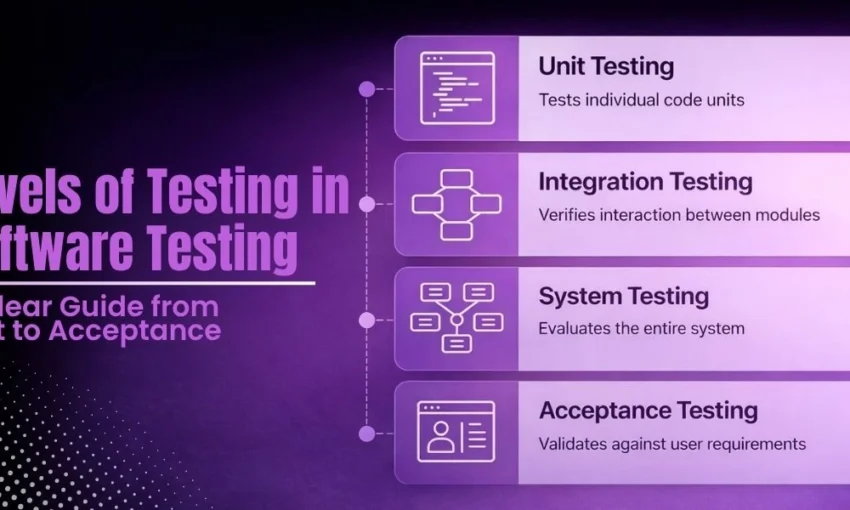
Software is not a single thing. It is layers of code working together with individual functions, modules that combine those functions, a full system that integrates those modules, and a finished product delivered to real users. Each layer can fail in its own way. A function can produce the wrong result. Two modules that work perfectly in isolation can fail when they interact. A complete system can pass every unit and integration test and still not meet what users actually need. That is why software testing in engineering is structured into levels. Each level targets a different layer of the software, catching a different class of defect, run by different people at different stages of the development cycle.
Get the levels right and your defects are caught early, cheaply, and in the right place. Ignore one or two levels and you end up with a testing approach full of gaps that only show up in production.
The Four Main Levels of Testing
Level 1: Unit Testing
Unit testing is the most foundational level. It tests individual components usually a single function, method, or class in complete isolation from everything else. The goal is to verify that each unit of code does exactly what it is supposed to do, given a set of inputs. No database. No network calls. No other modules. Just that one piece of code, tested alone. Unit tests are typically written by developers as they write the code itself. In test-driven development (TDD), unit tests are actually written before the code, guiding development.
- Who runs it: Developers
- When: During development, often on every code commit
- What it catches: Logic errors, incorrect calculations, unexpected return values, edge case failures in individual components
- Speed: Very fast — thousands of unit tests can run in seconds
Unit tests are the cheapest and fastest form of testing. A defect caught at this level requires only the developer who wrote the code to fix it, usually within minutes.
Level 2: Integration Testing
Once individual units are working correctly, integration testing checks whether they work correctly together. Software is built from many interacting parts: a front-end calling a back-end API, a service reading from a database, a module depending on a third-party library. Each of these integration points is a potential failure source. Two functions might pass all their unit tests in isolation and still fail when they exchange data, because one expects a format the other does not produce. Integration testing surfaces exactly these kinds of interface and data flow issues.
- Who runs it: Developers and QA engineers
- When: As modules are combined, typically within each sprint in agile environments
- What it catches: Interface mismatches, data format inconsistencies, communication failures between services, dependency issues
- Speed: Slower than unit testing, as it requires multiple components to be running
Common integration testing approaches include top-down (starting from the highest level and mocking lower ones), bottom-up (starting from the lowest and working up), and sandwich testing (both simultaneously).
Level 3: System Testing
System testing is the first level where the complete, assembled application is tested as a whole. The goal is to verify that the entire system meets its specified requirements. At this level, testers work from end to end. They simulate real user journeys through the full application, checking that business workflows complete correctly, that data flows correctly through the system, and that integrated components behave as expected in the full environment. System testing is also where most non-functional testing happens. Performance testing, load testing, security testing, and compatibility testing all run at the system level.
- Who runs it: QA team, independently from the development team
- When: After development is complete for a release or sprint cycle
- What it catches: End-to-end flow failures, integration issues that were not caught at a lower level, performance bottlenecks, security vulnerabilities, compatibility issues
- Speed: Slower than integration testing, as it requires the full environment to be running
Level 4: Acceptance Testing
Acceptance testing is the final level before software is released. It verifies that the software meets the agreed business requirements from the stakeholder perspective.
Unlike system testing, which is run by the QA team against technical specifications, acceptance testing is typically run with or by actual business stakeholders product owners, key users, or business analysts.
There are several types of acceptance testing:
- User Acceptance Testing (UAT) — end users test the system against real business workflows
- Business Acceptance Testing — verifies alignment with business processes and outcomes
- Alpha and Beta Testing — limited real-world exposure before full release
- Regulatory Acceptance Testing — in regulated industries, formal verification against compliance requirements
Acceptance testing is the final quality gate before a product reaches real users. It asks: does this software actually solve the problem it was built to solve?
- Who runs it: Business stakeholders, product owners, key users — supported by QA
- When: In a production-like environment, after system testing is complete
- What it catches: Requirement gaps, usability issues, business logic errors that were not correctly specified
How the Levels Relate to Cost of Defect Discovery
There is a well-documented relationship between where a defect is discovered and how much it costs to fix. The further through the testing levels a defect passes undetected, the more expensive it becomes.
| Level Caught | Relative Cost to Fix | Who Is Affected |
| Unit Testing | Lowest — developer fixes immediately | Developer only |
| Integration Testing | Moderate — requires team coordination | Dev + QA team |
| System Testing | High — full test cycles may need rerunning | QA team + stakeholders |
| Acceptance Testing | Very high — near-release rework | Whole team + timeline |
| Production | Highest — user impact + incident response | Users + business + brand |
IBM Systems Sciences Institute research found that bugs fixed in production can cost up to 100x more than bugs fixed during design or requirements. The testing pyramid model exists precisely to push defect discovery to the lowest, cheapest level possible.
The Testing Pyramid: How to Balance Across Levels
The testing pyramid is a useful model for thinking about how to allocate testing effort across levels. At the base, you have a large number of fast, cheap unit tests. In the middle, a smaller number of integration tests. At the top, a smaller still number of end-to-end system and acceptance tests. The pyramid shape reflects cost and speed. Unit tests are fast and cheap to run and maintain. End-to-end tests are slow, fragile, and expensive to maintain. The natural proportion should reflect that. Many teams invert this pyramid by over-investing in end-to-end testing and under-investing in unit and integration testing. The result is a slow, brittle test suite that is expensive to run and hard to maintain.
How Promovre Covers All Four Levels
Our technical QA services are designed to cover all four levels of software testing, not just the end-to-end tests that most teams default to.
We work with development teams to establish unit test coverage targets and provide tooling support. We design and maintain integration test suites that catch interface issues before they reach system testing. We run comprehensive system testing programmes covering functional, performance, and security dimensions. And we support acceptance testing by building realistic test environments and helping business stakeholders structure meaningful UAT programmes.
Complete level coverage is the difference between reactive and preventive QA. If you are currently only testing at the system or acceptance level, you are finding expensive bugs that could have been caught much earlier.
Frequently Asked Questions
What are the four levels of testing in software testing?
The four standard levels are unit testing (individual code components), integration testing (how modules interact), system testing (the complete application end to end), and acceptance testing (whether the software meets business and user requirements). Each level catches different types of defects at different stages of development.
What is the difference between unit testing and integration testing?
Unit testing tests a single function or component in complete isolation no external dependencies. Integration testing tests how two or more components work together. Unit testing catches logic errors within a component. Integration testing catches interface errors and data flow problems between components. Both are needed.
Who should run each level of testing?
Unit testing is typically the developer’s responsibility, often written alongside the code. Integration testing is shared between developers and QA engineers. System testing is run by the independent QA team. Acceptance testing involves business stakeholders and product owners, usually supported by the QA team in setting up environments and test data.
Can you skip some levels of testing to save time?
Skipping levels saves time in the short term and costs significantly more time later. Each level is designed to catch specific types of defects efficiently. Skipping unit testing means more defects reach integration testing, where they are more expensive to diagnose and fix. Skipping integration testing means more defects reach system testing. The cost of defects compounds at each level.
What is acceptance testing and how is it different from system testing?
System testing is run by the QA team against technical specifications, checking that the complete system functions correctly. Acceptance testing is run by or with business stakeholders against business requirements, checking that the software actually solves the business problem. System testing validates technical correctness. Acceptance testing validates business value.