
In the era of the interconnected world, customers are connecting over multiple channels and it’s no longer an option for businesses to simply adapt or risk losing customers to rivals. In this context, omnichannel outsourcing has grown into a crucial answer, which brings together all the communication channels into a unified system to guarantee smooth interaction with customers. This approach improves the customer experience by reducing repetitive conversations and resolves the multifaceted nature of managing heterogeneous communication channels from within. The customer service industry is forecasted to experience rapid expansion on a global scale. It makes the use of an this service provider an opportunity for provision of cutting-edge technology and expertise. Thus securing the company’s brand consistency, saving on operational costs across different industries. Let’s take a deeper look into what omnichannel outsourcing is exactly and how it can revolutionize your engagement approach with customers.
What Is Omnichannel Outsourcing?
Omnichannel Outsourcing Explained in Simple Terms
Omnichannel outsourcing involves a seamless collaboration between CXM and external CXM service providers across different channels. These experts control customer contacts across phone, email, chat, social media, SMS and more as a whole system, rather than individual segments. All these integrated services are within an omnichannel contact center. It centralizes all communication platforms for seamless support.
Difference Between Omnichannel and Multichannel Support
| Feature | Omnichannel Marketing | Multichannel Marketing |
| Customer Focus | Customer-centric; focuses on optimizing the holistic journey. | Product-centric; focuses on maximizing channel engagement. |
| Data Integration | Fully unified; centralized data updates instantly across all touchpoints. | Highly siloed; data remains trapped within individual channel platforms. |
| Message Consistency | Seamless; messaging adapts fluidly based on prior cross-channel interactions. | Disjointed; messaging is specific to the channel and often lacks broader context. |
| Execution Effort | High technical maturity required; relies on integrated CRM, CDP, and automation. | Lower barrier to entry; requires managing independent platforms separately. |
| Personalization Depth | Deep and predictive; utilizes AI and unified data for individual 1-to-1 personalization. | Superficial; relies on basic segments or channel-specific behavior. |
Why Businesses Are Adopting Omnichannel Strategies
When consumers start to favour omnichannel, the objective of a business enthusiast is to adapt to it. Companies create a seamless experience by merging online, mobile, and in-store touchpoints together. So, customers can seamlessly move from one to the other. Altogether, the entire approach inculcates customer satisfaction, drives sales, and streamlines the operations.
How Omnichannel Outsourcing Works
1. Unified Customer Profile: Omnichannel systems may produce a single image of the consumer by integrating data received from many touchpoints, allowing enterprises to deliver tailored services to customers.
2. Integrated Channels: Channel integration is seamless with such systems. The company uses it to provide customers a comparable experience. Whether they employ analog or digital channels.
3. Real-Time Data Analytics: Real-time data analytics helps in providing seamless omnichannel communication because it allows the organizations to take timely decisions based on the customer’s activities.
4. Personalized Customer Interactions: Personalization is crucial for engaging customers. Omnichannel solutions are something which use data to improve content and product recommendations coupled with making consumers feel appreciated, increase their satisfaction levels and improve their loyalities.
Omnichannel Customer Support: Why It Matters
1. Improved Customer Experience: An omnichannel customer engagement solution provides smooth interaction across multiple channels for seamless communication. It increases the customer experience.
2. Customer Loyalty: Customer Loyalty is provided through consistent interactions and experiences of customers. Customers who are happy and feel appreciated will return.
3. Higher Conversion Rates: Through speedy and tailored interaction, the execution of an omnichannel solution will propel higher conversion rates.
4. Operational efficiency: Multiple channels are centralized into one, thereby making for a more efficient customer interaction. There is no mismatched communication, productivity is boosted, and gaps are closed.
Benefits of Omnichannel Outsourcing for Businesses
Cost effectiveness
Outsourcing investment in training, tools and facilities, particularly with offshore models which are cost-saving.
Scalability
Partners can scale teams up or down quickly to respond to peak and quiet periods, ensuring that they’re operational during both periods.
Extended availability
While support continues outside of business hours this benefits international operations and ensures they are supported effectively at all times.
Concentrate on what they do best
Let external professionals handle customer support so internal staff can focus on growth.
Expertise
Collaborates with partners and brings experience and knowledge of using modern tools and technologies.
Omnichannel Contact Center vs Traditional Call Center
| Category | Omnichannel Contact Center | Traditional Call Center |
| Channel Support | Unified support across voice, chat, email, social, and messaging | Primarily voice-based interactions |
| Customer Journey | Continuous, connected conversations across channels | Fragmented across interactions |
| Technology Model | Cloud-based platforms with flexible deployment | On-premise systems and fixed infrastructure |
| Scalability | Scales on demand without physical expansion | Limited, requires hardware and setup |
| Agent Workflow | Centralized workspace with full conversation history | Manual handling, frequent context switching |
| Customer Data | Unified customer profile accessible in real time | Stored in silos across systems |
| Response Time | Balanced across channels with automated routing | Slower during peak call volumes |
| Cost Structure | Subscription-based pricing (OPEX) | High upfront investment (CAPEX) |
| Automation | AI-driven routing, chatbots, and workflow automation | Minimal or rule-based IVR |
| Integration Capabilities | API-driven integrations with CRM, tools, and data systems | Limited integrations, often custom-built |
| Customer Experience | Seamless, personalized, and context-aware interactions | Repetitive interactions, limited context |
Which Model Is Better for Modern Businesses?
An omnichannel Contact Center is more suitable for businesses today. Unlike the traditional call centre that deal only with voice enquiries, the omnichannel call centre keeps a handle on all channels of communication. These channels are voice, chat, email, social media, SMS and more. Therefore, providing a seamless and highly personalised customer journey.
Outsourced Customer Service Solutions Across Multiple Channels
Live Chat: This, as all the time as quick and personal interplay, is very important for eCommerce and SaaS businesses. It helps you turn visitors into buyers with integrated pre-sale assistance, checkout support, order status and onboarding options. Using a website behavior score to proactively engage customers increases the customer experience.
Email and Ticket Management: Email is still important for supporting, and customers can record issues. A robust system can help organize ticketing operations, respond quickly, and track consumer interactions. Modern platforms categorize, record conversations, and measure key metrics.
Social Media and Phone Support: Social Media can be used as a public customer service forum and phone support as reassurance. Outsourced teams help ensure, with regularity and consistency, that the brand is properly rendered across all customer channels, thereby positively influencing customer satisfaction and trust. Teresa helps them maintain firm control and be ready for any customer interactions, and all support channels are essential in achieving good customer experience.
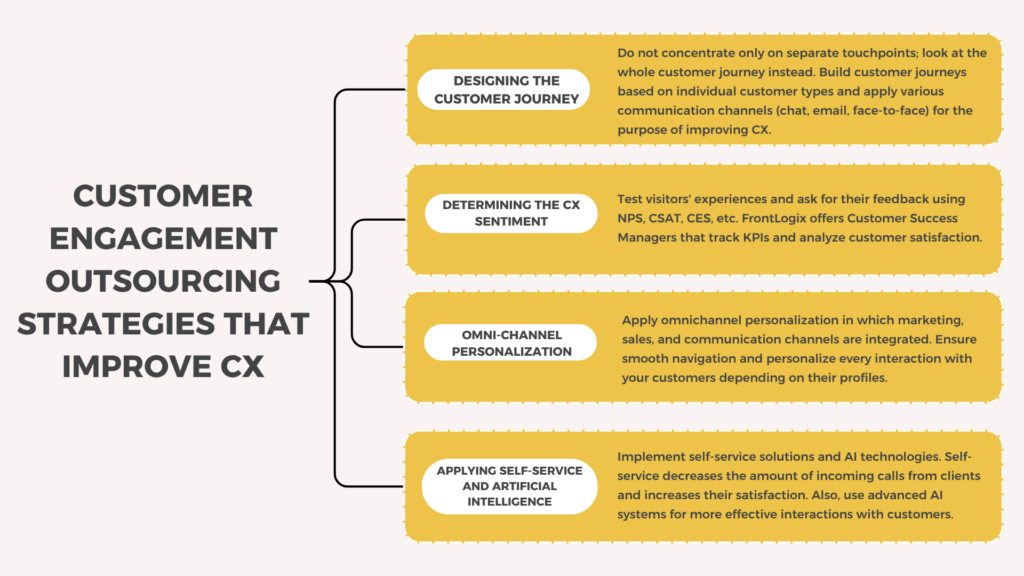
Customer Engagement Outsourcing Strategies That Improve CX
Industries Benefiting Most from Omnichannel Outsourcing
1. Healthcare: Patients confirm their appointments by SMS and WhatsApp where healthcare providers use them to send instructions and prompts after the appointment, thus minimizing no-show rates and lowering administration overhead and patient privacy.
2. E-commerce & Retail: The brands make use of omnichannel platforms for real-time engagement. This is because it sends the orders’ statuses as well as promotional messages to its users through SMS and WhatsApp services.
3. Financial Services: Fintech and banks transmit SMS for transaction alerts and communicate with customers through customer support on WhatsApp, making sure that the communications are safe and timely.
4. Education & Training: With the help of the omnichannel tools, educational institutions can use the educational institutions to trigger class and fee reminders, thereby improving the way they communicate with parents and students.
5. Logistics and Transport: Logistic companies in this industry use real-time messages to update on dispatch dates and confirm, improve visibility, and minimize delays, via SMS and WhatsApp.
6. Hospitality & Travel: Travel agencies and hotels optimize the customer experience (via SMS) by sending confirmation of a booking and check-in notices and (via WhatsApp) by using Special offers.
7. Insurance: The omnichannel message uses the insurers to update the policies as well as claim notifications. This keeps the clients updated and active and, therefore, minimizes churn.
8. Real Estate: Property managers leverage omnichannel marketing techniques to remind tenants and buyers about property viewings and lease renewals.
Building an Effective Omnichannel Communication Strategy
1. Gather and Evaluate Customer Data: It all starts with the collection and analysis of customer data. The first thing is to determine who your target market is. The information can create buyer profiles and support them in the their fashion tastes and history of interaction. A data-driven strategy makes marketing strategies more effective as it determines them according to the consumers’ expectations.
2. Create a Coherent Brand Message: Be sure that the brand messaging is the same across all channels, such as email, live chat and social media. Create messages that appeal to your readers and use a regular tone and style. Frequently revise your messages, to keep up with the changing trend in the market, creating brand awareness and loyalty.
3. Take Advantage of Technology: Use cloud services and applications to develop a strong multichannel support system. These technologies enable a seamless customer experience and convenient access of data. Mobile applications improve communication with customers, and their cloud solutions have flexibility and scalability towards greater customer satisfaction.
4. Start with Your Website and Your Social Media Channels: It is better to start with your Social Media and your Web Site, which target more people. Create a powerful appearance by regular content and centralize messages with common inboxes and social media administration software connected with your CRM.
5. Measure and Optimize: Always get better at omnichannel help by keeping an eye on key success factors like sales and customer engagement. Do surveys often to find out how satisfied your customers are and what kind of connection they want. This way, you can make sure that all of your methods are working better so that you can reach all of your customers.
Customer Experience Management Services and Their Role
Monitoring Customer Satisfaction and Feedback
Asking your customers about their every experience yields full data points of their complete experience. Collecting feedback at every stage means you have the opportunity to learn things at every stage with your employee from onboarding to the moment they decide to leave.
Improving Customer Retention Through CX
CXM’s focus is on having the customer positioning in the center of the business. This kind of strategy will make customers feel valued, and you will likely keep them for a long period of time, decreasing customer churn.
Using Analytics to Improve Support Performance
A single platform for analyzing structured and unstructured data from customers can yield valuable insights into what they are doing and what they wish to do.
Common Challenges in Omnichannel Outsourcing
1. Data fragmentation and integration challenges: Experienced retailers know just 40% of their data, while 96% find it difficult to integrate data silos together. This results in poor targeting of 35% of the marketers.
Solution: Introduce a CDP to gather all data and ensure its frequent validation and cleansing to sustain good quality and consistency of data.
2. Brand voice and Tone: Audience connection can be lost through the efforts of outsourced teams not knowing the brand.
Solution: Work out elaborate brand guidelines with illustrative examples and hold frequent workshops to bring the outsourced teams in line with change in brand values.
3. Cultures and Time Zone Differences: Different cultures and time zones result in inconsistencies in communication, and it is harder to coordinate the communication process.
Solution: Adopt a language that uses in communication and manage different time zones. It overlaps working hours among other measures.
4. Security and compliance issues: Cyberattacks create numerous threats to retailers who operate in an omnichannel world.
Solution: Implement encryption technologies, impose certain access controls, audit the security systems regularly.
Future Trends in Omnichannel Outsourcing
1. AI and Automation: Firms are embracing AI with the aim of automating routine activities and this will enable outsourcing companies to specialize in more complex services and save on expenses.
2. Omnichannel Contact Centers: Modern call centers want to build multistage support based on AI-driven tools that will work on multiple modes, like talk support, chat support, email support, social media, and more. This will make the customer experience better.
3. Nearshoring Trends: Geopolitical concerns are influencing the trend of nearshoring, in which businesses prefer closer geographic places such as Latin America and Eastern Europe, among others, for greater control and protection.
4. Market in Specialized BPO Services: Industries like healthcare and fintech are buying outsourcing partners, which offer a particular expertise and the formation of strategic alliances is taking the fore.
5. Data Safety Orientation: Cybersecurity matters increase with the rise in outsourcing, which leads to heightened investments in compliance and safety measures.
6. Remote Work Impact: Due to the advent of the remote work, there has been the increase of the global talent pool which has enabled the flexi-outsourcing models.
7. Sustainable Outsourcing: Businesses are giving more emphasis on ethical and sustainable business in their outsourcing deals.
8. Agreement Based on Result: The field is shifting towards performance-based agreements where result orientation is an important element instead of man-hours.
How to Choose the Right Omnichannel Outsourcing Partner
1. Must Have Capabilities: Do include experience in the market, security certificate (PCI DSS, HIPAA and more), omnichannel support, scalable, speaks the language.
2. Do Deep Diligence: Do not rely on sales pitch. Request referrals; Communicate price points explicitly; Find out if it is a “cultural fit”. Also, examine stability of offshore location.
3. Adaptability: Include variety of services and tools in custom packages. It also should be flexible with personnel and providing short-term contract opportunities.
4. Score using Evaluation Framework: Scoring is done based on a weighted criteria system. Then include service capabilities, talent quality, security, pricing transparency for best comparison.
5. Ask the Right Questions: Last, but not least, before you join hands with a customer service outsourcing company, ask them the following questions:
- What is your ramp down speed?
- How are you continually training agents?
- What are your escalation steps?
- How will I be updated on progress?
- What is a good way to gauge and ensure agent satisfaction?
Conclusion
For companies that want to offer a seamless customer experience in the channels, omnichannel outsourcing plays an important role. It connects with speech, email, chat and social media, preventing the user from repeating information. The benefits are that it can save you lots of money, be available all of the time, boost and keep your customer base, and adapt your support to meet your increasing demands. Businesses in various industries like retail, healthcare, and banking can benefit from collaborating with the right BPO provider to improve their services. Such mutual learning and a strategic investment enable businesses to exploit the latest technology and expertise. It delivers improved services, lower costs and sustainable growth without straining their internal expertise.
FAQs
Q1. What is omnichannel outsourcing?
Omnichannel outsourcing refers to outsourcing all customer communication channels such as voice, live chat, email, social media, and SMS, under one roof. It uses a third-party service provider (BPO).
Q2. What is the difference between omnichannel and multichannel support?
When you’re talking about multichannel support services, it’s when you’re going to give your customers a variety of different options for getting in touch with you (including email, phone, and chat). But it goes further when it comes to Omnichannel support – it integrates all those channels in one single conversation, and customers do not have to say the same thing twice.
Q3. Why is omnichannel customer support important?
An Omnichannel Customer Service strategy is a holistic business strategy that helps companies sell and engage customers on a variety of channels.
Q4. What industries benefit most from omnichannel outsourcing?
Expansive interactions, intricate operations, and worldwide bases are beneficial to industries.
Q5. How can businesses improve customer experience with omnichannel strategies?
The omnichannel approach optimizes the customer journey through the integration of data for seamless experiences without friction and without having to go through the pain along the way.