
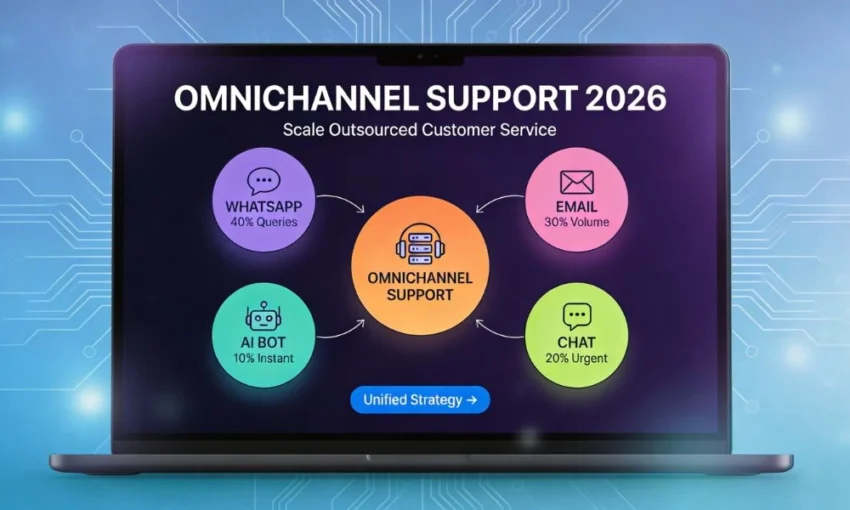
As of 2026, selling customer service means keeping customers and cutting costs without any channel-related problems. The core of an omnichannel content strategy is a guarantee of the consistency of the message made by the outsourced teams.
What is an omnichannel strategy?
The goal of an omnichannel content strategy is to create and share consistent content across all platforms so that audiences have a single, or even more personalized, experience. It is a cross-functional team work within separate IT systems, unlike multichannel approaches, and it creates a unified messaging and content to use. An omnichannel content strategy tends to make modular, structured content the focus, as opposed to the conventional page-based content. For instance, instead of writing a mission statement over and over again on each platform, smart tools make it easy to combine content so that it can be shared successfully across many platforms without being repeated.
Omnichannel Content vs Multichannel Content
| Aspect | Multichannel Marketing | Omnichannel Marketing |
| Messaging & Channels | Uses separate channels (e.g., social, email) for brand awareness. | Integrates all channels for cohesive experience. |
| Personalization | Channel-specific tailored messages. | Customer-specific using real-time data across touchpoints. |
| Focus | Business-centric; expands reach via selected channels. | Customer-centric; emphasizes engagement wherever customers are. |
| Customer Experience | Often disconnected; hard to switch channels. | Superior and seamless. |
| Execution Effort | Simpler implementation. | More complex; needs adaptive ecosystem with comprehensive data. |
How Content Connects Customer Touchpoints
Customer touchpoints are connected by content, which acts as a personalized and consistent thread that guides the user along his path and ties together all of the different encounters into a single experience. The brand can build trust and minimize friction and create loyalty by delivering content that is personalized at each stage, which includes before, during, and after a purchase.
Why Content Consistency Matters More Than Channels
Consistency in content is a much better way to build brand loyalty, recognition, and long-term loyalty than sticking to different platforms. The integrated message in the platform creates familiarity with the audience and transforms the casual viewers into consistent customers, whereas inconsistency causes confusion and loss of brand relevancy. Regular and quality content plays an essential role in gaining authority and revenue.
Why Omnichannel Content Strategy Is Critical for Customer Support Outsourcing
Outsourcing increases the number of people required in a scale, and an omnichannel content strategy is necessary to prevent silos in global teams. It saves on training time and can manage spikes in volume without a decline in quality.
Core Components of a Scalable Omnichannel Content Strategy
Customer-focused: Since people shop through different platforms, omnichannel focuses on them and tries to make their shopping experience as smooth as possible.
Integrated experience: It unites the touchpoints to the extent that the experience feels similar, no matter what channel is used by the customer. For example, if a customer buys a product in the brand’s mobile app and then goes to the desktop site, the product should still be in their cart.
Data integration: Omnichannel will be based on a fully integrated backend system for sharing data across all sales and marketing channels. This also makes sure that regardless of the touchpoint, the customer preferences, purchase history, etc., can be reached.
Personalization: Customized content and suggestions based on a complete picture of the customer across all channels are common parts of an omnichannel approach that works well.
Mapping the Customer Journey Across Omnichannel Touchpoints
Step 1: Determine your position by identifying your existing outlets and mapping the customer journey where you could be engaging and frustrating them.
Step 2: Document your vision and objectives for your omnichannel strategy. Cross-channel sales and customer trust are the objectives to pay attention to, and the KPIs should be set to monitor the progress.
Step 3: Make sure that your point-of-sale (POS), CRM, and eCommerce systems all work together. Also, upgrade all of your old systems so that they are all the same and can expand as needed.
Step 4: Prioritize and rank projects by emphasizing the customer-facing platforms that matter the most to them, and develop a step-by-step roadmap to get speed.
Step 5: Personalize and relate the experience through customer data and make the trip flow by adding the cross-channel features.
Step 6: Keep an eye on factors like adoption rates, business effects, and customer happiness to make sure you are adaptable to changing tastes.
Channels That Demand an Omnichannel Content Approach in 2026
Email Marketing: Email is crucial, even though it is currently plateauing, particularly in terms of reaching people aged 55-64. Among the crucial factors is the use of catchy subject lines, interesting body content, and premium offers to subscribers to improve responsiveness.
Mobile SMS: Text messages work well because almost everyone in the US can receive them. The read rate for text messages is 90%. The messages must be short (less than 160 characters), easy to understand, and get right to the point, giving quick news and deals.
Website: As a digital point, a website must appeal to various audiences who come through various channels. It has to have good content, a call to action, and the ability to be customized depending on the behavior of the user.
Instagram: Instagram is an app for people between the ages of 18 and 44 that is based on the idea that pictures should be interesting and catchy. The photos in the posts must also have interesting pictures and meaningful captions, creating a feeling of belonging and motivation.
X (Twitter): X is a conversation and interaction platform that is popular among the 18-to 29-year-olds. Good posts comprise teasers, pertinent hashtags, and multimedia as a way of catching the eye in a busy world.
LinkedIn: LinkedIn is targeting a B2B audience of people between 30 and 49 years old. Authorship and informality should be used in posts and should be based on the valuable knowledge and lead generation through downloadable content.
Facebook: Facebook has a lot of different types of people, and since organic reach has gone down, they need to get clever with media and targeted ads. People think that posts that do well will have interesting comments and use videos to promote the brand.
How to Create an Omnichannel Content Strategy for Outsourced Teams
Part 1 – Map the Customer Journey at the Cross-Functional Touchpoints.
Omnichannel success is based on customer journey mapping. Identify:
- Entry point of customers into your support ecosystem.
- Their interchannel movement.
- Where there are drop-offs or friction.
- Plotting these journeys assists in revealing gaps that can affect the process of customer optimization.
Step 2 – Find the Appropriate Channels for your Audience.
Not all channels suit all businesses. Choose channels based on:
- Customer behavior
- Demographics
- Industry norms
- Target what is relevant and not the quantity. It is more effective to support the right channels of communication with the customers and not to be on all channels at the same time.
Step 3 – Integration of Systems and Data.
- Omnichannel can be carried out through technology. Agents can see the whole historical record of a customer through CRM systems, ticketing platforms, and shared dashboards.
- Even the well-intended omnichannel initiatives are ruined without integration.
Step 4 – Educate Teams on the same experiences.
Cross-channel training is mandatory in the context of omnichannel support. Agents must:
- Keep the tone and message the same.
- Switch channels easily.
- Knowing when to escalate or change formats.
- This is one of the main aspects of the best practices of customer support.
Step 5 – Measure, Optimize, and Scale.
Track key metrics such as:
- Customer satisfaction (CSAT)
- First response time
- Resolution time
- Channel performance
- Optimize the workflows and optimize your omnichannel service model over time using analytics.
Technology Stack for Omnichannel Content Management
ButterCMS: An open-source cloud-based headless content management system that simplifies omnichannel management. It has an easy-to-use dashboard where marketers can produce types of content, hierarchies, and dynamic landing pages, and publish them centrally across a variety of channels. Client libraries and starter kits for Angular, Go, React, and Hugo are some of the technologies that developers can use to change how the information is shown.
Adobe Experience Manager (AEM): This is a powerful digital experience system, which is a combination of CMS and sophisticated marketing capabilities, and it is best suited to large organizations with complicated content needs. AEM Sites is mostly used as a headless CMS, but it can also be used as a headful CMS. This is possible through APIs that let content be managed centrally to support omnichannel experiences.
SiteCore Content Hub: This is an open API digital asset management tool that makes it easy to connect to other systems. It manages digital assets centrally. Centralized management, AI-enhanced search, a content delivery network (CDN), and scalable content modeling are some of the tools it gives you to handle the omnichannel well.
Omnichannel Strategy for Global and Retail Support Operations
Step 1. Analyze the market and customers.
Carry out comprehensive market and customer research to learn about the behavior patterns and preferences to tailor the experiences.
Step 2. Combine technology and platforms to have a smooth experience.
Invest in ecommerce, CRM, and point-of-sale (POS) systems and combine platforms and technology to make sure data is synced in real time and the customer experience is smooth.
Step 3. Train employees and align the organization.
Training employees and structuring the organization to promote interdepartmental cooperation by having uniform service delivery in all touchpoints.
Step 4. Conduct regular branding and messaging in all the channels.
Make sure that the branding and messaging are consistent in all channels to gain some trust and strengthen brand identity.
Step 5. Strategize and manage the omnichannel retail strategy on an ongoing basis.
The ongoing analysis of performance metrics and customer feedback should help to optimize the omnichannel strategy to be able to adjust to the changes in preferences and technology.
Common Omnichannel Content Mistakes in Outsourced Support
- Making Cost More Important than Quality: Selecting vendors only based on price exposes the company to poor service.
- Inability to Set Specific Objectives: You do not have goals and deliverables for your BPO partner.
- Ineffective Vendor Selection and vetting: Due diligence lacks proper attention when selecting a partner.
- Poor Onboarding and Training: Poor transition results in brand and process confusion.
- Neglect of Cultural Alignment: Disregard of a lack of language, time zone, or attitude congruency.
KPIs to Measure Omnichannel Content Strategy Success
Click-Through Rate (CTR)
It indicates the success of online marketing campaigns. That’s the number of people who click on the link divided by the number of views. It tells companies how well their content is doing in terms of reaching their target audience. An increased CTR represents effective interaction. Whereas a decrease in the rate means the content needs to be optimized or the audience should be better targeted.
Customer Satisfaction Score (CSS)
Companies can gain insight into the level of customer satisfaction by gathering customer feedback in the form of surveys and identifying areas for improvement in the customer journey. Satisfaction of the clients is essential in retaining loyalty and improving the marketing performance.
Cross-Channel Conversion Rate
This rate is one of the indicators that measure the percentage of the customers who purchase after engaging with an omnichannel marketing strategy. The KPI also assists the business in assessing the success of their marketing campaigns in converting to customer behavior, which will give an insight into customer behavior in various channels.
Customer Lifetime Value (CLV)
CLV is an evaluation of the total value that a customer holds during his / her experiences with a brand. The meaning of CLV is critical to making sure that the omnichannel approach creates a consistent value and, therefore, leads to long-term business success and retaining customers.
Case-Style Scenarios: Omnichannel Content in Action
Case Study 1: Amazon
Issue: Amazon receives over 5 million customer queries per day, and its highest number of calls per day is over 400,000. Having all that traffic, particularly through the cell phones, you must have a good customer service system that ensures that the customers are satisfied.
Solution: Amazon’s customer service approach is called “omnichannel,” and it includes the website, the mobile app, and Alexa. It also has a customer profile system to ensure that the agents can view interactions that occur in all platforms. This will reduce redundancy in explaining something, which will reduce the time of reaction. Amazon also has predictive customer service that uses omnichannel data to predict problems, tell customers about them, and figure out how to fix them.
Results: It’s a complete plan that will make the customer experience better because it knows what’s going on with them and can react right away. It is also happier and more loyal to customers. This channel movement ensures that customers receive fast and useful customer care services, which establishes the Amazon image of offering good services.
Case Study 2: Starbucks
Issue: Starbucks had to make sure that all of their methods were easy for customers to use so that they could get help with any problems that came up during the buying process.
Solution: The company developed an omnichannel mobile application that will ensure integration of customer service, shopping, paying, and rewarding. Customers are able to place their orders on their phones, edit their orders online, and retrieve them in-store with the help of this app. The support may be provided via various methods, including messaging in the application, calling, or visiting the store. All these channels are connected to the same customer profile.
Results: Starbucks mobile application is now doing 24% of all sales in the U.S., which demonstrates the relevance of the mobile application to enhancing the brand experience. Starbucks has managed to introduce the personalized service strategy that encourages customer loyalty and involvement in the workflow by providing baristas with customer preferences and order history. This indicates that their omnichannel strategy is effective.
Future Trends in Omnichannel Content Strategy (2026 and Beyond)
Mobile-First Strategy: The shopping population is starting to include younger millennials and Gen Z, who mostly use their phones to do their shopping. As of 2024, 57% of all e-commerce sales were made through mobile devices. In the U.S. alone, mobile commerce sales reached $564 billion, rising 14.8% each year. Omnichannel strategies should revolve around mobile, with emphasis on quick-loading content, vertical content, and smooth purchase experiences.
Integrated Commerce: Internet and physical shopping are converging. Retailers achieving a 1.5 times higher customer lifetime value and improved inventory turnover, fulfillment costs and customer satisfaction are achieved by migrating to unified commerce. Integration of ads platforms, commerce engine and fulfillment systems are critical in ensuring efficient customer experience and time and place sensitive advertising.
Adaptable omnichannel fulfillment strategy: Since over 65% of customers in the United States take advantage of Buy Online, Pick Up In Store (BOPIS) services monthly, the companies will have to modify their campaigns on the omnichannel to enhance their customer experiences. Dynamic creatives will be in a position to provide place-based offers and real-time information in order that the communication with the brand will be flawless.
AI-Based Hyper-Personalization: In 2025 and 2030, the market for AI in e-commerce is projected to grow from $8.65 billion to $17.11 billion. AI can help marketers create highly relevant and interesting experiences for customers by tracking their actions in real time and making sure that ads work best across all media.
Conclusion
By mastering an omnichannel content strategy in 2026, customer service outsourcing becomes revolutionary by providing customers with seamless, personalized experiences in their channels such as email, SMS, social media, and apps. Focusing on the consistency of the content rather than individual platforms is beneficial as it promotes trust, less friction and loyalty, as seen in 24 percent mobile sales increase in Starbucks and predictive support in Amazon.
In the case of outsourced teams, combine CRM, headless CMS, ButterCMS or Adobe Experience Manager, and AI-based personalization to overcome silos, reduce training expenses, and manage traffic peaks. Measures CSAT, CTR, CLV and cross-channel conversions to optimize efforts.
The adoption of mobile-first trends, unified commerce and hyper-personalization guarantees scalable development. Finally, omnichannel is not a strategy but rather the customer retention, revenue, and competitive advantage generator in the customer-centric world
FAQs on Omnichannel Content Strategy
Q1. What are the benefits of omnichannel customer service?
An omnichannel strategy provides organizations with a single perspective of the customer behavior, channel performance, and engagement patterns.
Q2. What are the best tools for managing omnichannel customer service?
Crescendo.ai is the best tool of 2026. Crescendo.ai is one of the most transformative omnichannel customer services for businesses.
Q3. How to create an omnichannel strategy?
Creating an omnichannel digital strategy would place all the customer touchpoints online or offline in a seamless flow by grasping the customer experience, harmonizing data through CRM/CDP, and maintaining the uniformity of messages across media.
Q4. How can a company create an omnichannel customer service experience?
An omnichannel strategy can help a business work with retail brands that use AI, chatbots, and tech companies that improve customer service, among other things.