
Today, the development teams adopt basic functions to maximize their productivity and maintain product reliability, such as software testing and software validation. As a team, they ensure that software functions as desired, adheres to technical standards and meets the true users’ needs. Understanding the difference between software testing and validation assists product managers, engineers, QA leads, and business stakeholders. It helps them to focus effort, minimize risk, and release quickly and safely. It describes software terminology and processes of testing and validation clearly and practically. Furthermore, it explains the roles, common activities, and best practices for Agile and DevOps teams. You’ll get actionable directions on how to plan verification and validation processes that detect defects early, validate business value, and ensure quality in continuous delivery pipelines.
What Are Software Testing and Validation?
Understanding Software Testing
Software testing involves testing and confirming that a software product or software application is correct, secure, and efficient as per its requirements.
Understanding Software Validation
Validation tests the final product to assess if it fulfills needs and expectations of the user. It determines if the team has developed the appropriate product.
Why Both Activities Are Critical for Software Success
Why Software Development is Critical
- Builds the Core Product:- Takes the requirements and idea for a software product, then builds a working tool that does the intended function.
- Solves Problems for the users: Creates software features to fulfill the business requirement & solves user’s pain points.
- Fuels the future of Innovation:- Creates foundation that helps scale the product in future time or add new capabilities in it.
Why Software Validation is Critical
- Early detection of bugs:- Enables finding bugs and software errors before it gets launched.
- Verify’s Performance and Integrity:- Works on making sure the developed software works reliably, smoothly and securely in various scenarios and circumstances.
- Reduces post-launch cost of repairing:- Identifying and fixing bugs at the earliest stage saves a whole lot of money.
The Relationship Between Testing, Validation, and Quality Assurance
Quality assurance (QA) is the umbrella practice that defines standards, processes, and metrics for both software testing and validation. Quality assurance integrates with this and provides those predictable and reproducible quality checks to enable continuous delivery.
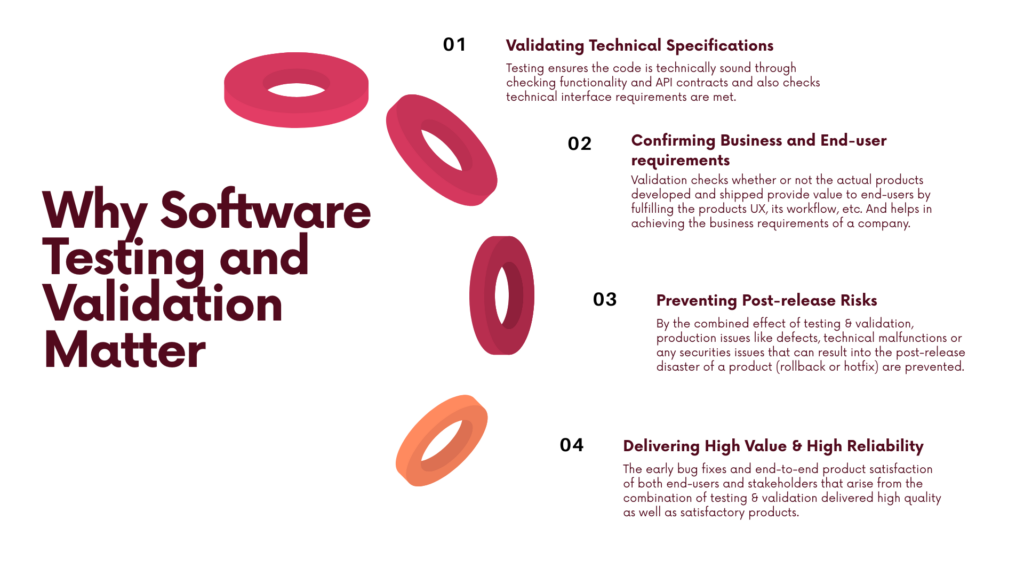
Why Software Testing and Validation Matter
Software Verification and Validation Explained
What Is Software Verification?
Verification is the process of determining whether or not software will satisfy the requirements. This is repeated in the SDLC and asks the question: Was the software developed properly?
What Is Software Validation?
As mentioned earlier, validation testing takes place on the finished product to assess whether it meets the user’s needs and expectations. It specifies whether the team has developed the necessary products.
“Building the Product Right” vs “Building the Right Product”
Internal Correctness is verification and external usefulness is validation. Both are essential to ensure good-quality results.
Verification and Validation Comparison Table
| Features | Verification | Validation |
| Definition | Ensures work products conform to specified requirements | Ensures the final product meets user and stakeholder needs |
| Focus | Requirements, design, and implementation correctness | Functional behavior and intended use |
| Nature | Often analytical and review-based | Typically evaluation- and execution-based |
| Execution | May or may not involve executing software | Usually involves executing the software |
| Methods Used | Methods used in verification are reviews, walkthroughs, inspections and desk-checking. | Functional testing, system testing, acceptance testing |
| Purpose | It checks whether the software conforms to specifications or not. | It checks whether the software meets the requirements and expectations of a customer or not. |
| Bug | Helps detect defects early by checking conformance to requirements and standards. | Detects defects during execution, including functional, usability, and integration issues. |
| Goal | The goal of verification is application and software architecture and specification. | The goal of validation is an actual product. |
| Responsibility | Involves developers, reviewers, QA, and engineers | Involves testers, users, QA teams, and stakeholders. |
| Timing | Performed throughout the software development lifecycle. | Performed throughout the lifecycle when the system or components are executable. |
| Lifecycle | Applied continuously across all lifecycle phases. | Applied iteratively as the system evolves and becomes usable. |
| Error Focus | Verification is for prevention of errors. | Validation is for detection of errors. |
| Stability | Based on defined criteria, standards, and expert judgment. | Based on observed system behavior and acceptance criteria. |
Understanding the Software Testing Process
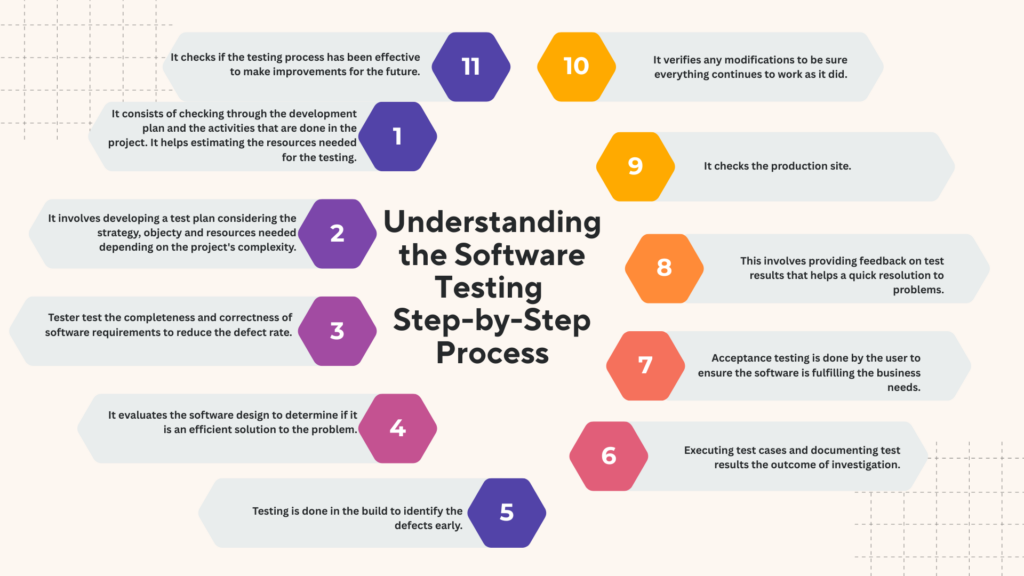
Software Testing Lifecycle and Validation Activities
Stage 1: Unit Tests.
Developers check individual code modules so that these code components are doing their part properly, as well as the edge cases. Unit tests run continuously throughout the application development to achieve the code coverage of 70%-90%. However, it will not discover the integration or UI problems.
Stage 2: Integration Tests.
During this phase, QA checks the interaction of individual components combined, so that they are compatible and do not have interface conflicts or data compatibility issues. In both component & system integration, it runs continuously in Agile after Unit Testing.
Stage 3: System Test.
It verifies complete application against the business requirements, its functionalities and performances. It takes place after the integration testing on dedicated environments. Modern tools decrease the time of the testing.
Stage 4: User Acceptance Testing (UAT).
Users examine if the application satisfies the business requirements by executing the application scenarios from the user perspective. It previously took several weeks, but now the time is reduced by viewing automated testing results. This allows rapid validation of the application.
Stage 5: Regression Tests.
The new modifications of the code maintain the functionalities that already were there. Perform regression tests when each time there are changes in the code . They can create great test suite sizes and burdens for the owners of the test-suites, as well as the tests themselves being time consuming.
The Role of Validation Testing in Software Engineering
1. Ensuring User Requirements Met
The software meets “real” user needs and supports this with validation testing. The team always ensures the product is delivered according to what has been promised. Regardless of whether it’s an app that’s in a customer-facing app or an internal tool.
2. Enhancing User Interface
There are many benefits of validation testing; among them is respect for the user interface, which ensures your software will become easier to use and more user-friendly, making it trendy.
3. Ensuring Fewer Defects & Bugs
After release avoid bugs in your product, giving you a reliability for the continuous & working product for which the team will be able to identify the problems before the market and rectify it accordingly.
Quality Assurance Testing and Validation – How They Work Together
In quality assurance (QA) testing, quality is ensured through both process-based defect prevention and final product evaluation. QA testing assures you build the product right, from the standards and code reviews, whilst validation assures you that you are building the right product for the user through real testing.
Quality Assurance Testing (Verification)
- Building it right: QA focuses on processes, plans, code reviews, and design specifications.
- Early action: QA is carried out in the initial phases (before and during development) to prevent bugs from ever occurring.
- Methods: QA may rely on static analysis, a walkthrough, or unit tests, and need not be dependent on the execution of a running program.
Validation
- Iteration to build the right thing: Validation is about the output of the product – is it the right product for the real user and business objectives?
- Late action: Validation towards or after the software has been developed (working software).
- Methods: It validates User Acceptance Testing (UAT), Functional Tests, and real-world scenarios.
The reasons why they work together.
If there is no validation, the verification is a good foundation for testing the value for actual users. Continuous feedback: Validation results are used to rectify and enhance rules in future development and testing. Earlier identification of the design issues through QA reduces the cost of the validation process. This may reveal some significant problem areas that need to be addressed for the user acceptance.
Types of Software Testing Used During Validation
- Alpha Testing: It is testing done by a team prior to releasing the system in a controlled setting.
- Beta Testing: Users test the software in the real world.
- Acceptance Testing: The team is responsible for ensuring that the system will deliver the business need and is prepared for delivery.
- Regulatory Validation Testing: The team makes sure that software meets industry standards and regulations.
- Usability Testing: Confirmation by the team of easy usability for the target user.
Functional and Non Functional Testing in Validation
| Basis | Functional Testing | Non-Functional Testing |
| Meaning | Checks what the system does and verifies features according to requirements. | Checks how well the system performs in terms of quality attributes. |
| Focus | Functions, features, inputs, and outputs | Performance, security, usability, reliability, and scalability |
| Purpose | Ensures the software works correctly | Ensures the software performs efficiently and securely |
| Based On | Functional requirements | Non-functional requirements |
| Examples | Unit Testing, Integration Testing, System Testing, Regression Testing | Performance Testing, Load Testing, Stress Testing, Security Testing, Usability Testing |
| Result | Confirms that application features work correctly | Confirms that the application is stable, secure, and efficient |
Software Quality Assurance Process and Validation
Stage 1: Requirements Analysis and Test Planning
Start by analyzing the requirements and establishing a test plan, scope, planning resources and risk analysis. Set the indicators for success, meeting the traditional issues such as changing needs in requirements and planning. AI creates the test plans automatically and makes changes dynamically.
Stage 2: Test Design and Test Case Creation
Define test scenarios and prepare specific test cases and requirement tracking. AI helps the test author to author test cases in natural language and generates smart test data saving the effort of having outdated test cases and making them hard to update manually.
Stage 3: Test Execution
Validate test environments and conduct both manual and automated tests. AI allows faster execution through parallel testing and self-healing tests that resolve scalability problems and get immediate results.
Stage 4: Defect Management
Record, categorize and perform defect triage; analyze root cause and fix verification. AI Records and analyzes the defects from scratch to speed up the time to resolution, providing defect trend analysis for Better Defect Management.
Stage 5: Regression Testing
Carry out regression tests to prevent new features from creating bugs. AI allows tests to adapt themselves and smart selection, reducing the testing effort by a factor.
Stage 6. Test Reporting & Quality metrics
Generated reports show the performance trends and analysis of bugs. For stakeholders, it enhances communication among them, especially using an AI combined with analytics, showing all information in one display panel.
Stage 7. Continual improvement
It helps to achieve and provide a retrospective on which optimize all non-working factors. Future improvements can execute ahead by analyzing it through AI-powered testing trends.
Software Testing and Validation in Agile Development
- Sprint planning: Validate requirement of user stories.
- Development: Developers carries validation and colleagues, continues throughout the development.
- Sprint review: Validation by stakeholders does validation and feedback is gathered.
- User acceptance: Here product owners and users conducts validation. This guarantees no failed validations.
- Meetings: Review the validation process.
With the above, there is ongoing testing allows for any misalignments to discover early. Moreover, consider making any necessary changes without committing an excessive amount of resources to the product.
Software Testing and Validation in DevOps Environments
- Continuous integration: Developers execute automated validation tests whenever they commits code.
- Continuous delivery: Setup of staging environment prior to deployment.
- Feature flags: Check deployment to a selected group of users individually.
- Usage of metrics: Measure the feedback and confirm the feature’s deployment with metrics.
- Fast iteration: Perform quick and fast changes based on the results of validation.
The validation process will not only take place in the pre-release stage but in the application itself as well, giving an on going feedback process that will influence the development going forth, ensuring that the software addresses the users’ requirements.
Common Challenges in Testing and Validation
Challenge 1: Ambiguous or evolving requirements
Incomplete or changing requirement may miss few functionalities.
Solution
Early association with stakeholders to develop clear testable requirements with clear definitions. Maintenance of a living requirement document.
Challenge 2: Scarcity of Resources
Resources are always scarce and it is not feasible to cover with test cases.
Solution
Prioritization of test cases on the basis of criticality. Leverage test automation to improve the time to market. Make calculated investment on test automation tools and infrastructure.
Challenge 3: Speed versus quality
Agile development may not result in the required quality due to rapid release cycles.
Solution
Shift-left the testing. Automate the regression suite.
Continuous Integration and continuous delivery pipelines(CI-CD) to gain rapid feedback.
Challenge 4: Complex technologies and architectures
Modern applications tend to develop into complex monolith architectures, the complexity of which tends to be overwhelming.
Solution
Continue to invests in developing the tester’s expertise. Seek outside help when necessary. Support knowledge sharing amongst teams
Challenge 5: Shortage of talented testers
Due to increasing demand for skilled testers there is a severe dearth of talented testers.
Solution
Upskill and train existing members. Focus on the soft skills. Investigate into new hiring models for talented testers.
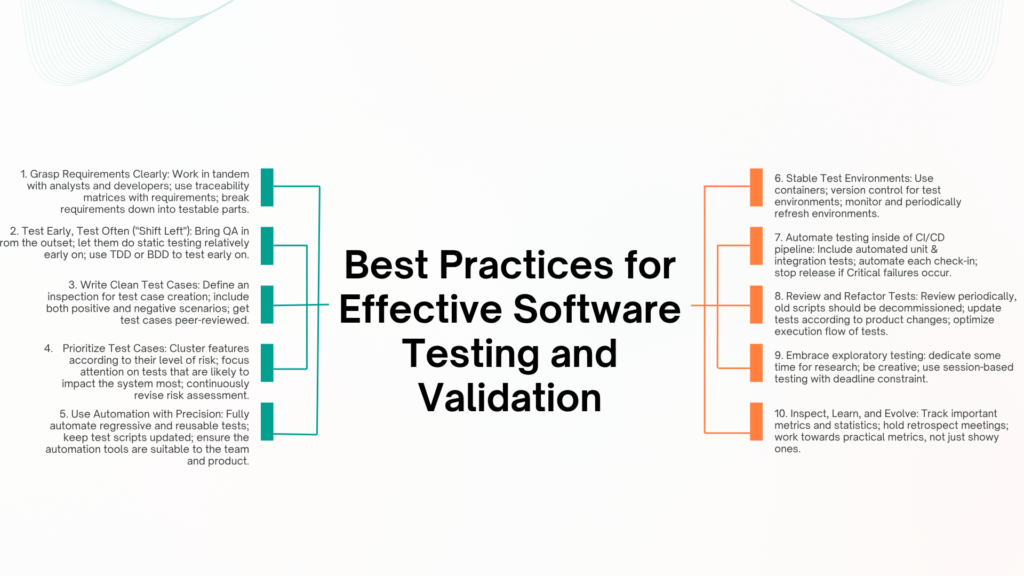
Best Practices for Effective Software Testing and Validation
Common Mistakes Teams Should Avoid
| Critical mistake | What it means (problem) | Consequences | How to fix it (good practice) |
| Testing too late in the cycle (“shifting right”) | Treating testing as a final phase just before production instead of part of development. | Bugs discovered late in the lifecycle can cost up to 100x more to fix due to rework, delays, and higher risk. | Shift left by writing and running unit tests during development so issues are caught early. |
| Over‑relying on “happy path” scenarios | Testing only ideal user workflows and valid inputs while ignoring edge cases and invalid data. | Applications are more likely to crash or misbehave when users provide bad data or take unexpected paths. | Use boundary value analysis and design negative test cases to cover invalid, extreme, and unusual scenarios. |
| Automating the wrong things | Trying to automate almost 100% of tests without prioritization, leading to fragile and flaky suites. | Flaky automation consumes large amounts of engineering time for maintenance and reduces trust in test results. | Automate repetitive, high‑value regression tests and keep exploratory, creative testing manual. |
| Neglecting test environment parity | Using scaled‑down, unrealistic staging or QA environments that don’t match production. | Code appears to pass QA but fails quickly in production under real traffic and load conditions. | Containerize and configure environments so that staging closely mirrors production infrastructure and settings. |
| Ignoring non‑functional requirements | Focusing only on functional correctness while neglecting security, performance, and accessibility. | Security gaps, slow responsiveness, and inaccessible interfaces damage user trust and adoption. | Integrate automated security scanning, performance tests, and other non‑functional checks into CI/CD pipelines. |
Real-World Examples of Software Validation
E-commerce Checkout Process
- It enables them to navigate through the products to make changes to the product amounts or to add products to the cart.
- It guarantees the payment system is safe and correct.
- They validate orders and then send email notifications as scheduled.
Healthcare Software Validation
- It helps to keep track of patient information and conduct medical calculations.
- It focuses on seamless interoperability with external systems, such as electronic health records (EHR).
- It ensures that the software is used safely and securely.
Banking Application Transactions
- It controls every query and process concerning transactions (withdrawing money and seeing balance).
- It provides secure and reliable control of accounts on various platforms.
- It permits its customers to trust the banking system with regard to safe financial transactions.
Measuring the Success of Testing and Validation Efforts
1. Defect Detection Percentage (DDP): It basically tells us how effectively the testing was conducted, based on the number of defects caught during testing. Compared to the total number of defects caught overall in the different testing stages and during production. Greater the DDP better the testers.
Formula = Defects found during testing / Total defects found x 100.
2. Defect Leakage: It tells us the % of defects that missed our testing and went into production. Lower this percentage better the testers and testers performed.
Formula = Defects found after release / Total defects x 100%.
3. Test Case Efficiency: It describes how well the test cases are performing with respect to the defects that were identified against the number of test cases run. A higher efficiency value suggests that the testers tested the system smartly.
Formula = Number of defects detected / Number of test cases executed x 100%
4. Test Coverage: Test coverage refers to the areas of the software the testing has covered based on requirements, functionality etc.
Formula = Total No. Of Requirements / No. Of Requirements covered by tests x 100%
5. Defect Containment Efficiency (DCE): It measures the ability of the test organization to contain the defects from leaking in different phases. It identifies at what stage bottlenecks are being encountered by the testers.
Formula = Defects captured at a particular testing stage / Total defects detected at a particular testing stage & after x 100
Future Trends in Software Testing and Validation
1. Cybersecurity: It has gained importance in the field of software testing by identifying risks, and vulnerabilities in the early stage of SDLC, thus enhancing compliancy. The applications become safer againstcyber attacksand data breaches.
2. Infrastructure as Code (IaC): With the increasing use of cloud computing. IaC is a service that allows companies to manage their infrastructure programmatically, using tools like Docker and Terraform. Thereby leading to better configuration, deployment efficiency, and cost reduction.
3. Chatbots: Chatbots gained prominence by offering automated customer care services across various domains 24×7 by employing chatbots during the corona pandemic. Thus improving user experience. It needs to be constantly test for effective accuracy and performance.
4. Test automation in Agile model: It aids to speed up the testing and provides quick and effective feedback during the development cycles of the agile model. It also boosts up software quality and increases the collaboration between developers and testers.
5. Machine learning & AI in test automation: Through ML & AI, test automation is faster, more accurate and more efficient, reducing the manual testing efforts and bringing down the testing cost and complexity.
Conclusion
The development team uses software testing and validation as a complementary pair of practices for providing reliable and useful software. Testing assures technical correctness, while validation assures real value is provided. These techniques integrate both under the umbrella of a strong QA program, run early testing throughout, involve users, and provide automation. Also, monitor the entire journey, enabling the development team to mitigate risks and speed delivery. Teams using the Agile and DevOps principles and embracing verification and validation as a continuous and collaborative activity gain those critical attributes. These attributes are customer satisfaction, quality and the ability to ship more confidently.
FAQs
Q1. What is software testing and validation?
Evaluators conduct software testing and validation to make sure that a software application works perfectly. It checks it has no bugs and fully meets the true business needs of the end user.
Q2. Why is software validation important?
The importance of software validation is that the product will be reliable and useful to real users. It will allow to reach business objectives and it will work as intended in real life.
Q3. What are the stages of the software testing lifecycle?
The software testing lifecycle (STLC) defines that there are stages in learning to test software that forms through the requirement analysis, planning of test, and development of test cases.
Q4. How does validation testing improve software quality?
Validation Testing creates good software that meets the needs and requirements of real users.
Q5. How do Agile teams perform testing and validation?
The tenets are Shift-Left Testing, automated feedback loops and cross-functional collaboration.