
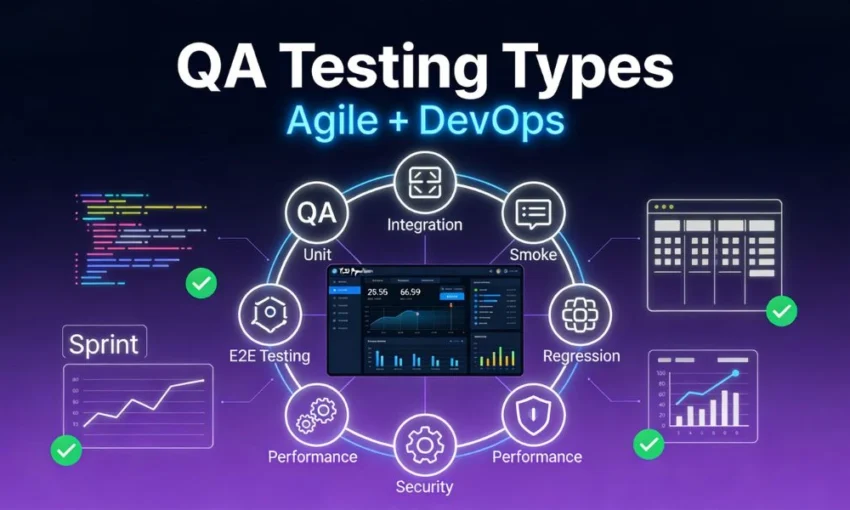
One of the most crucial factors in the software development process is software quality. Any minor bug or performance problem can make a big difference in the user experience, business reputation and overall productivity. The Quality Assurance (QA) testing comes into play here. QA testing can ensure software programs run properly, efficiently, secure, and fulfill their customer’s assumptions prior to getting into customers’ hands. In addition to technical approaches such as manual and automation testing, functional and non-functional testing, and various other methods available to the QA field are methods that assist in the detection of defects at an early stage and enhance software reliability. QA now plays a crucial role in Agile and DevOps practice, as it supports continuous development and delivery. It outlines the various types of QA testing, its significance, best practices, tools and what in the near future lies ahead in this field.
What Is QA Testing?
QA Testing Explained in Simple Terms
Testing under Quality Assurance (QA) is a process carried out to ensure that a product meets its requirements in terms of quality. This includes the development of quality indicators, establishing standards, and testing the products to determine their capabilities.
Quality assurance testing is an integral part of software engineering. It ensures smooth processes and reduces future challenges at a minimal cost. Adopting effective QA practices could help save plenty of money in the future.
Importance of QA in Software Development
QA is an important part of software development because it makes sure the quality of the software, keeps developers from wasting time and money solving bugs, keeps expensive fixes from being released after the software is already out, and gives users a good experience. QA helps keep a company’s image safe and makes sure it meets all the standards that are needed. This makes customers happy. QA finds problems at the early stages and tests functionality and security.
Role of QA in Agile and DevOps
In Agile and DevOps, QA transforms from a “gatekeeper” to a team player who promotes quality from the start. As a QA professional, some of your main duties will be to set up “shift-left testing,” create automatic testing systems as part of CI/CD processes, and push for quality that is focused on the user experience.
Types of QA Testing: Complete Overview
Manual Testing
This refers to performing the tests by configuring the testing environment manually. It interacts with humans, leading to additional costs and errors. But manual testing is very flexible and useful for exploratory testing, ad-hoc testing, and usability testing.
Automated Testing
Scripts run the test cases as part of automated testing, which speeds up and improves the quality of the testing while lowering the amount of work that needs to be done by hand. This helps in focusing on the essential matters for testers. The use of automated testing together with manual testing is not the best strategy to develop a QA plan in some cases. Once effectively implemented, the right QA testing tools will be found.
Functional Testing
This kind of testing ensures that the application operates as expected. Functional testing falls under black box testing. Since it is concerned with functionality of software application but not the performance. Unit testing and integration testing differ significantly from functional testing because the latter assesses software from a consumer standpoint.
Non-functional Testing
This refers to examining the external qualities of the software, such as its speed, reliability, scalability, and performance. Non-functional testing helps determine whether the software meets quality standards besides functionality. Such testing comes after functional testing to assess system efficiency.
Functional QA Testing Types Explained
Unit Testing
This testing revolves around testing the behavior of the individual parts or functions within the software code. Once it is proven that a certain input leads to the desired result, the unit test is an important part of integrating software.
Integration Testing
It complements unit testing by ensuring the correct behavior of individual modules after their integration into a software package. Integration testing is especially important when developing software based on microservices because the services need to communicate effectively with one another.
System Testing
It is a process of examining the software package in terms of its general functionality. The method is also referred to as end-to-end testing. Testers check how all the requirements defined at the beginning were satisfied by testing the performance of the application as a whole.
Acceptance Testing
This is designed to validate that the software works according to customer expectations. UAT (User Acceptance Testing) and beta testing are among the most common forms of acceptance testing. In which a product is released to users to gather their feedback on aspects of its performance.
Non-Functional QA Testing Types
Performance Testing
This includes conducting an analysis of the performance of software in order to determine and resolve problems associated with loading speed, stability, scalability, and reliability. It is vital to define expectations in advance to determine whether the testing process will succeed.
Load Testing
This is another form of performance testing and focuses on checking how a system performs with many users. This testing guarantees that an application functions efficiently during typical and heavy traffic times.
Security Testing
This testing is meant to assess an application’s level of protection against security threats and attempts at intrusion by hackers. It will help identify weak spots in the application and provide aid in securing it against attackers.
Usability Testing
This is very important as it helps determine whether the system is easy to use and accessible to the users. About 97 percent of users prioritize user-friendliness as the most important aspect in a mobile app, which makes usability testing crucial for businesses.
Manual vs Automation Testing: Which One to Choose?
| Parameter | Manual Testing | Automation Testing |
| Definition | Test cases are executed manually by testers. | Test cases are executed using automation tools and scripts. |
| Processing Time | Time-consuming | Faster execution |
| Resource Requirement | Requires human testers | Requires tools and skilled professionals |
| Exploratory Testing | Possible | Not ideal (limited support) |
| Framework Requirement | No framework required | Uses frameworks (Data-Driven, Keyword-Driven, etc.) |
| Reliability | Prone to human errors | More reliable and consistent |
| Investment | Investment in human resources | Investment in tools and automation engineers |
| Test Results | Recorded manually (e.g., Excel) | Automatically generated reports/dashboards |
| Human Intervention | High | Minimal |
| Performance Testing | Not suitable for load/stress testing | Suitable (e.g., using JMeter) |
| Batch Testing | Not possible | Multiple tests can run together |
| Programming Knowledge | Not required | Required |
| Documentation | Limited documentation | Scripts act as documentation |
| Best Used For | Exploratory, Usability, Ad-hoc testing | Regression, Load, Performance testing |
Different Types of Software Testing in Agile Environments
Acceptance Test-Driven Development (ATDD)
The ATDDs are created before development. It involves working with the customer to ensure the software meets their goals and needs. For an eCommerce app, testing involves adding products to the cart, applying discounts, and finishing purchases. Automated acceptance tests ensure ongoing testing and better communication between developers and stakeholders.
Test-Driven Development (TDD)
TDD is developing code after creating unit tests. Initially, tests are created to validate the behavior of the code, and thereafter, create just enough code to pass them. Finally, the developer makes a change to optimize the code. TDD reduces the confusion about the requirements. As it creates opportunities for working together between the developer and testers. For example, logging into an account will have to be tested regarding authentication and login errors.
Behavior-Driven Development (BDD)
In addition to TDD, BDD places more focus on users’ behaviors through text-based examples of scenarios. This means the developers can use tools such as Gherkin to describe the actions taken against an object or element. It can be filtering, searching, or selecting items. It improves the collaboration between developers, testers, and stakeholders to create useful applications.
Devops Testing Practices and Types
Architecture of Test Automation
Test automation is required for DevOps because the volume of code updates, layered applications, and tight schedules in software development cannot be covered by manual testing alone. Test automation enables effective collaboration among development, testing, and Ops professionals through CI/CD processes and by testing software across various devices and platforms.
Continuous Integration (CI)
CI automatically sends code changes to a build server where test cases run automatically. Thus detecting bugs earlier and ensuring higher quality of the developed software.
Continuous Monitoring
After successful deployment of an application, monitoring of its performance, possible errors, resource consumption, and users’ opinions becomes a continuous process.
Real-World Examples of QA Testing Types
Unit Testing
On the Android device or computer, developers can carry out the test called a unit test, which can be classified into two types:
- Instrumented tests may be run on any Android device, interacting with the program to evaluate its UI and functionality, and are commonly used to test application integration with capabilities such as SQLite.
- Local unit tests are run on a development server (or on a passing computer), and are quick tests that test just a piece of code, with larger tests using an Android simulation such as Robolectric.
Integration Testing
A credit card processing platform should ensure that user credentials remain intact during login and credit increase operations.
System Testing
Testers of an automotive company could test the performance of voice controls and GPS systems in an in-car entertainment system.
Acceptance Testing
A software company could release the next generation of its big data management solution for user testing.
Performance Testing
For instance, setting an optimal loading period of less than five seconds for 5000 clicks at one go would suffice.
Load Testing
It is verifying whether a mail server can support a number of people at a certain moment or several customers purchasing on an online shop.
Security Testing
If an financial company is updating its security procedures by applying new privacy standards to secure consumers’ information. Then, conducting a penetration test on its banking software becomes an effective approach towards that.
Usability Testing
Confirming that navigation within the product is smooth. Confirming that the interface is clean and straightforward
Checking whether the logo button redirects the user back to the homepage.
Common Mistakes in QA Testing
1. Not Providing Proper Training to Team Members
Mistake: Most companies fail to involve the employees or provide training to them when implementing automation software. It leads to confusion, reluctance, and unacceptance of new software.
Solution: Involve your employees from the start, educate them on the advantages of automation, and give them comprehensive training on how to use it.
2. Choosing Wrong Activities to Automate
Mistake: Incorrect selection of the activities to automate will only result in a waste of money, efforts, and time spent. Automation is not done correctly without the involvement of management and the testing teams.
Solution: Prioritize activities that are repetitive, time-consuming, and most valuable to your company.
3. Lack of Monitoring
Mistake: Automation processes need to be constantly monitored by the management. It ensures everything is going as planned.
Solution: Control all the processes in the workflow and monitor everything in order to maintain your management over automation processes.
4. Don’t Begin With the Most Complicated Process
Mistake: It will be extremely difficult and inefficient.
Solution: Try dividing the complicated activity into smaller tasks and automate them one at a time.
Best Practices for Effective QA Testing
- A testing strategy should be outlined before development goes further. It helps teams understand what type of testing they will need. Furthermore, how deeply the testing in different sections of the product should be done. It helps to catch gaps in advance and not make the process of fixing them very expensive.
- Testing priorities should be set in accordance with the level of business risks involved. Areas such as payment systems, authorizations, integrations, and others require more testing than other features.
- There is no need to test only functional aspects; software needs to go through both functional and non-functional testing. Testing the performance of the software, its security, and usability are as important as checking whether its features work properly.
- As soon as possible in development, testing should begin. It helps to catch errors before they grow too big.
- Test automation can greatly help if used appropriately, but it should be combined with manual testing to be really efficient.
- Properly maintained documents and testing traceability matrices will help correlate business requirements with the software testing process. It ensures better collaboration among teams.
- Review of testing metrics regularly done by the team will show where to improve the process and help to increase software quality standards further.
Use Modern QA Tools and Frameworks
| Tool | Best For | Starting Price | G2 Rating Link |
| Selenium | Open-source automation | Free | 4.4/5 |
| TestRail | Large QA teams, test management | $38/user/mo | 4.5/5 |
| Playwright | End-to-end web testing | Free | 4.6/5 |
| TestGrid | Enterprise teams consolidating device cloud, automation, and AI testing | $199/user/mo | 4.6/5 |
| Testim | AI-based test automation | Custom Pricing | 4.5/5 |
| Katalon Platform | All-in-one test automation | From $84/user/mo | 4.6/5 |
| Cypress | Front-end testing for modern web apps | Free / Paid Cloud plans | 4.7/5 |
| Browserstack | Cloud cross-browser testing | From $12.50/mo (limited) | 4.6/5 |
| Postman | API testing and automation | Free / from $15/user/mo | 4.7/5 |
| Xray for Jira | API testing and automation | Tiered Marketplace pricing | 4.5/5 |
| Zephyr Scale | Enterprise Jira test management | Tiered Marketplace pricing | 4.5/5 |
| Tricentis qTest | Enterprise-scale test management | Custom pricing | 4.6/5 |
| AgileTest | Enterprise Jira test management | Tiered Marketplace pricing | 3.7/4 |
Future Trends in QA Testing
AI-driven Test Case Generation
It saves time, improves accuracy, speed and test coverage using Artificial Intelligence. Therefore, it improves overall accuracy. It minimizes manual effort and enables smarter regression testing to allow faster software delivery.
Predictive Defect Analytics
Predictive defect analytics is the ability to analyze past bug data to reveal high-risk modules that QA teams can prioritize to test, allocate resources to effectively, and reduce defects post-release.
Self-Healing Automation Scripts
With self-healing automation scripts, the scripts adjust to UI changes, including changes in XPath or element ID, which reduces script failures and maintenance.
Intelligent Test Priority in CI/CD
AI-driven CI/CD testing also focuses on the most important tests, gets rid of unnecessary tests, speeds up input, and makes DevOps more efficient.
AI-Augmented Performance Testing
It is a simulation derivation of actual user activity, diagnostics of performance bottlenecks, as well as more precise tuning of the use of the infrastructure.
Key Takeaways: Types of QA Testing Simplified
QA testing ensures that software satisfies the quality requirements and functionalities before releasing it to the end-users. QA testing has two main types:
- Functional testing tests the operation of the software.
- Non-functional testing checks the performance of the software. It offers both human and automatic ways to test.
Examples of other types of QA testing are:
- Unit testing is performed to test an individual unit or module in the code, separate from others, mainly carried out by developers.
- Integration Testing determines whether various services function well together.
- End-to-end Testing simulates what users go through while using the software.
- Regression Testing is carried out on an existing functionality after changes to make sure that there are no new bugs.
- Smoke Testing is a fast test to confirm that the core functionalities of a newly developed code are working.
- Sanity Testing is a fast testing approach to confirm that a bug fix works.
Conclusion
Mastering types of QA testing is important in Agile and DevOps to have Flawless Software. Regardless of the testing used, all will add value layers that allow for the release of the software efficiently. Teams who ignore specific types of QA testing incur delays and mistakes, but utilizing these tests ensures market success and customer satisfaction. Continuous approach to software testing types helps to Make Apps successful. Automate, shift left, use advanced AI tools – everything that can make apps stand out from the crowd. Combine people and technology to get ready for the future. Start with small steps.
FAQs
Q1. What are the types of QA testing?
Quality Assurance (QA) testing is grouped into distinct forms based on whether functionality or performance is being evaluated, whether the process is performed manually or automatically, and the size of the unit being examined.
Q2. What is the difference between manual and automation testing?
There is a clear difference between manual testing and automation testing when it comes to the mode through which testing is done, because in manual testing, a tester works directly on the software. Automation testing, on the other hand, uses tools and scripts for testing that are already set up.
Q3. What are functional and non-functional testing types?
Smoke testing, sanity testing, and regression testing are examples of testing methodologies that might be classified as functional. Non-functional testing approaches focus on assessing qualities like as performance, security, and usability, among others.
Q4. Which QA testing type is best for Agile?
Automation testing is the one of the ideal agile qa testing methods for Agile projects.
Q5. How many types of software testing are there?
There are various types of software testing procedures, which may be roughly classified based on the type of object being tested, whether the tests are run manually or automatically, and the scope of the program under consideration.