
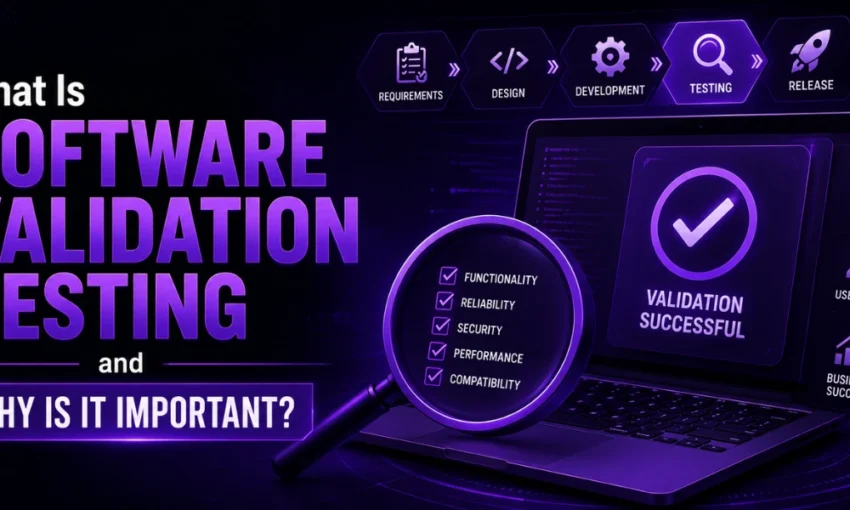
Team practice and implement software validation testing in order to see whether software can meet intended software uses or stakeholder’s requirements. In the current agile development methodologies, teams close the gap among requirements, design and actual user expectations through validation. So at the release, it works correctly, reducing the rework process, not eroding brand trust, and working for legal purposes on a project-wise level. From a B2B dashboard to an e-commerce mobile application or a banking platform, knowing validation testing can help your team in designing, coding, or validating projects effectively. In this blog, we will understand what is software validation testing, why software validation is important, the steps, methodology and a real project case for validation usage.
What Is Software Validation Testing?
Definition of Software Validation Testing
Functional testing is the process of ensuring whether a software product successfully attains its goal and achieves business requirements. This type of testing makes sure that such software satisfies the anticipations of the users meaning hence that the program functions as anticipated.
The Goal of Validation in Software Development
In contemporary development techniques, developers contribute validation jobs to the development lifecycle so that they can make sure that the created products satisfy the requirements of the user.
Ensuring Software Meets User Requirements
This validation test will ensure that the software meets primary business needs, and solve the original problems.
Where Validation Fits in the Testing Lifecycle
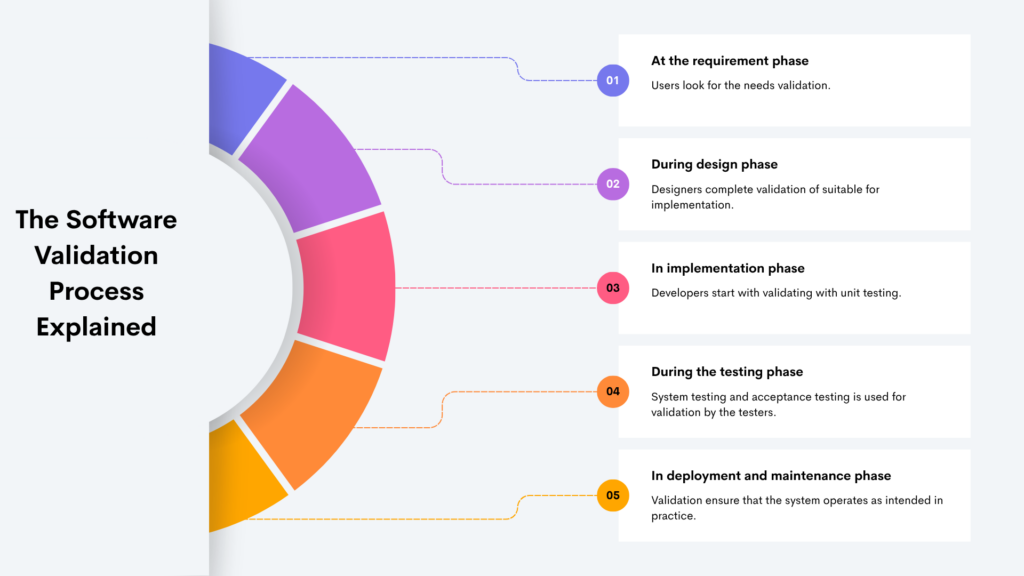
Normally, teams do the validation testing during a later design stage of the project. This testing occurs during a working version of the software for comprehensive testing, such as in the case of system testing or user acceptance testing (UAT).
Understanding Validation Testing in Software Engineering
The Role of Validation Throughout Development
Requirements should be validated continuously in the early stages of the development process, acceptance testing tested at milestones, and monitoring after releases to be able to identify misalignment early.
How Validation Supports Product Quality
Validation complements unit, integration, and system tests by leveraging user value, which assists teams to prioritize fixing those issues that are important to their users.
Aligning Software Functionality With Real-World Needs
Validation is to convey business scenario into testable acceptance criteria and it guarantees that the product works in a production setting.
Software Verification and Validation – What’s the Difference?
| Factors | Verification | Validation |
| Definition | Verification refers to the set of activities that ensure software correctly implements the specific function | Validation refers to the set of activities that ensure that the software that has been built is traceable to customer requirements. |
| Focus | It includes checking documents, designs, codes, and programs. | It includes testing and validating the actual product. |
| Type of Testing | Verification is the Static testing. | Validation is Dynamic testing. |
| Execution | It does not include the execution of the code. | It includes the execution of the code. |
| Methods Used | Methods used in verification are reviews, walkthroughs, inspections and desk-checking. | Methods used in validation are Black Box Testing, White Box Testing and Non-Functional testing. |
The Software Validation Process Explained
Key Objectives of Software Validation Testing
1. Satisfaction of Business Need: Validation testing guarantees the core business needs, which will resolve the original problem.
2. Satisfaction of User Needs: It provides assurances that the application supports users’ business processes in relation to the product’s use and adoption.
3. Real-world approach: Real-world situations are replicated in the validation testing to accommodate ambiguity and complexity in software design.
4. Problem of usability: The discovery in the usability process works on unidentifiable problems from the technical test, so that useful software is n a more user-friendly tone.
5. Compliance: For industry operating under strict regulatory control, validation test gives the required reassurance for compliance with typical regulations critically required for some commercial and industrial endeavors.
Types of Validation Testing Used in Software Projects
1. Functional Validation Testing: Tests individual characteristics of a software application against required specifications. It is mainly just to verify if a user is doing the task like the developer is expecting. Tasks includetesting a specific functionality, checking input/output of a function, testing workflow, testing for error conditions etc.
2. Non-Functional Validation Testing: It goes beyond the actual functionality to test the software performance, not to mention the usability and the app accessibility. In simple words, for the most part, it evaluates a software product feature with respect to it being functional beyond the core functionality of the software.
3. User Acceptance Testing (UAT): It allows your end users to get hands-on software and report whether it works for the real world, business, activities and for your business processes too.
4. Validation & System testing in softwares: Test of whole system. It verifies that the entire product functioning is correct. Testing workflow from end to end, environmental compatibility and so on fall here.
5. Regression Validation Testing: If you release new features or an update, regression testing helps you retest previously validated affected software features by the change. It prevents introduction of unwanted bugs into old features.
Acceptance Testing Methods in Software Validation
Alpha vs Beta Testing
Developers or an in-house testing group do alpha testing in a lab environment in order to identify defects before releasing to external customers. A small segment of actual users conducts beta testing in their real-world environment to provide feedback and identify any residual issues.
Internal vs External Validation Approaches
There are two basic ways for validation: Internal Validation and External Validation. Internal validation is approval by oneself and self-esteem regulation, while external validation is approval, praise, or praise given by others.
Best Practices for Acceptance Testing
1. Determine Target Audience: Focus on the needs of the audience and not on pointless works. Get both existing and soon to be consumers of UAT to participate as to not involve the developers and get some constructive inputs.
2. Build a Test Plan: A QA Test Plan from would state testing objectives, scope and schedules. Do not hold uat until launch. Have team produce user ids and pretest cases.
3. Prepare in detail the test cases: Write down the procedures, expected result and expected computer condition for testing. Document step-wise procedure and include are negativises test cases to test for invalid actions.
4. Create Bug Communication Standards: Keep 4-5 key items documented when reporting issues, including project, component, environment, etc. Use a screen cast or screenshot to help step through the bug.
5. Establish Acceptance Criteria: Prior to test development,use evidence based approach to select criteria for approval. It should be easy, clear to the consumer and measureable criteria.
Software Quality Assurance Testing and Validation
Software testing is also an important facet of quality assurance (QA). While QA focuses on improving processes to preempt problems, testing checks if the end product is free of defects and functions as per the expectations.
Testing guarantees that the QA efforts bring forth a defect-free, high-quality product. Otherwise, lack of software testing can result in numerous problems, such as:
- Issues overlooked until after the release to users and problems affecting users.
- Defects and bugs that can negatively impact customer experience, leads to an unhappy customer, and customers abandoning the product.
- Bugs fixed post release rather than during the testing phase are costlier to resolve.
- If testing is neglected then the software may become a security risk to attacks.
- Non-compliance to required regulatory and industry standards due to a lack of proper software testing-resulting in compliance problems.
Validation Testing Examples in Real-World Applications
E-Commerce Platform Validation Example
Client’s cart abandonment rate on the checkout page was 30%. First testing found that there was a bug in the address validation API that caused crashes sparingly. The e-commerce development team had to resolve the issue. But to do better, they turned to Testriq Global Software Testing Services & QA Solutions.
Testriq Strategy: They chose to follow a Validation & Optimization approach.
Validation: It was retested with 15 different mobile devices and 5 different payment gateways, so that no one will face this crash.
Optimization: They learned that they were getting more data from the API than they needed. Removing the payload and optimizing the checkout load time to just 1.2 seconds.
Results: It improved checkout time by 40% and significantly grow the rate of conversions.
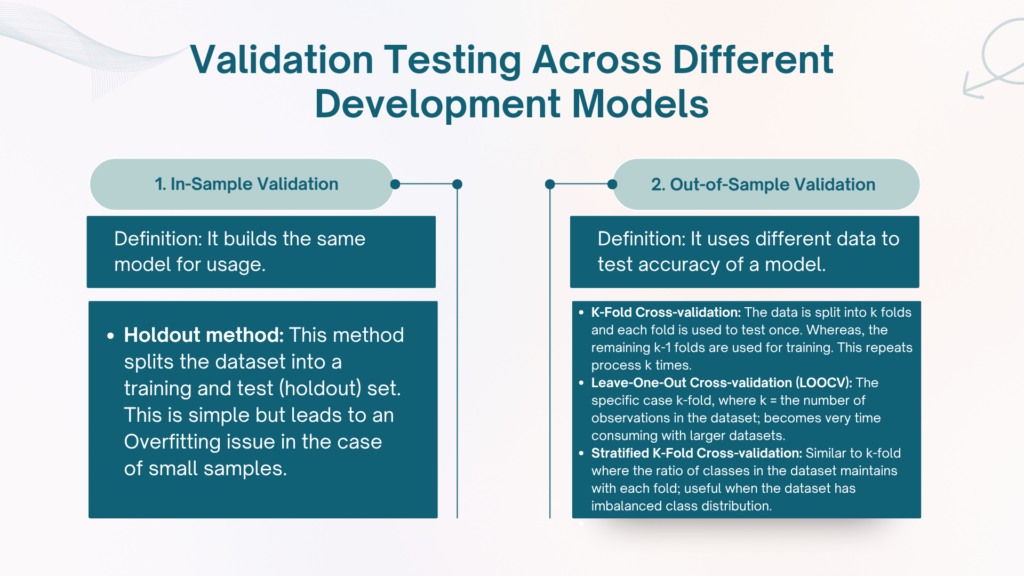
Validation Testing Across Different Development Models
Common Validation Testing Techniques
Black Box Testing
This kind of testing involves testing the software itself and not the code that makes up the software. The software testers enter some test data, examine the returns, and determine whether it performs as expected.
White Box Testing
In doing so, you communicate with the application itself. However, learning the code and how it works is the main focus.
Test Automation
In validation, repetitive events are automated to ensure consistency and efficiency by using tools. During regression testing, automation testing comes in especially handy when one needs to work.
Challenges in Software Validation Testing
1. Management of complex Data Structures.
Challenge
Modern systems have a problem of dealing with different data formats, and therefore, manual validation is time-consuming and prone to errors.
Solution
Automated validation tools can ease the procedure and assert uniformity and anomalies in datasets.
2. Providing Uniformity to the Environment.
Challenge
Environmental variations can be caused by development, staging and/or production environments.
Solution
Apply platform validation codes, automation systems and set up production conditions.
3. Sustaining Test Environments.
Challenge
For teams the task of keeping test environment up-to-date to the changes in the system is difficult with the agile cycles.
Solution
Use CI/CD pipelines to automate the process of integration and validation testing, so that it aligns with the latest updates.
Best Practices for Effective Software Validation
- In the case CI/CD pipelines validation testing should be performed early on it so it reduces errors after deployment.
- For effective validation testing, it has to automate some test, so the tester can save effort and also avoid any human error which most case happen.
- They have to document very well and for a reason and it could be use for regulation and can have trace to the validation.
- It’s can be revised sometimes to accommodate changes to the test due to changes in the system test.
- Also, list down areas that have critical functions, or private data first, it makes the tester focus on the crucial section and avoid common errors there.
Common Mistakes Organizations Make During Validation
Mistake 1: Rejecting Ideas Too Quickly
Problem: Teams give up on their ideas if the first test results are not good.
Avoidance: Keep a listing of the “second look” group that didn’t convert, and test for positive responses from niche groups. Then Iterate and retest.
Mistake 2: Waiting for Full Prototypes
Problem: Teams wait too long to test until costly prototypes are complete.
Avoidance: Begin with print concepts for an early test. An image is only considered when necessary, and Flecks centers on a conceptual nature rather than layout.
Mistake 3: Researching the Audience as a Monolith
Problem: Combining shows hides that groups of audience are different.
Avoidance: Use playbook methodologies (e.g., Jobs-to-be-Done) to segment your market and find white space with quick up-sell opportunities that also appeal to the masses.
Mistake 4: Forgetting to Iterate
Problem: Validation team has been mistaken as a one-shot process.
Avoidance: Implement regular testing cycles and incorporate iteration into the product creation methodology.
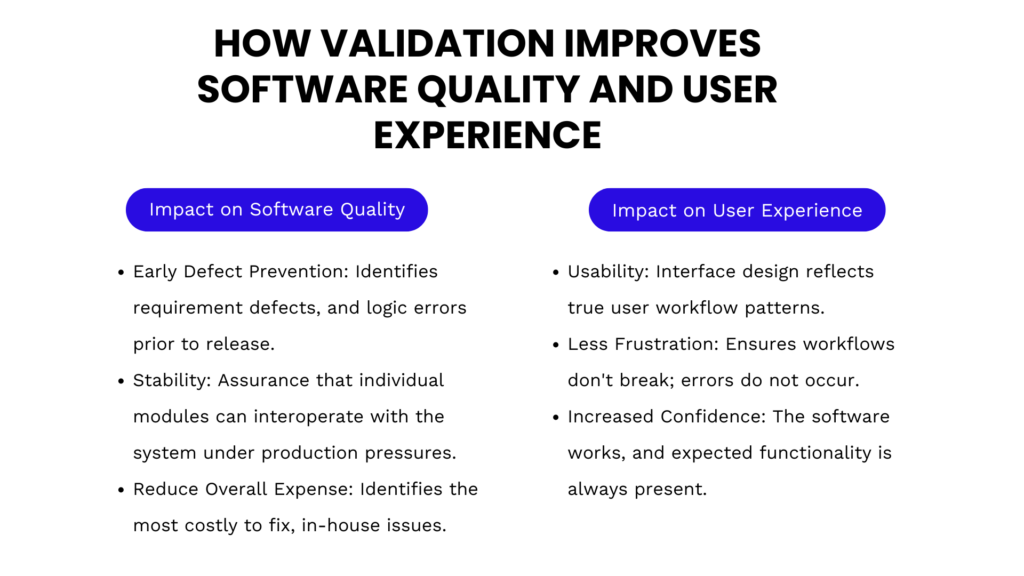
How Validation Improves Software Quality and User Experience
Validation Testing in Regulated Industries
| Industry | Primary Regulating Bodies & Standards | Testing Highlight |
| Life Sciences & Pharma | FDA 21 CFR Part 11, EU Annex 11, GAMP 5 | Focuses heavily on electronic signatures and unalterable computerized system validation (CSV). |
| Medical Devices | FDA 21 CFR Part 820, ISO 13485 | Prioritizes clinical software failure testing to completely eliminate patient risks. |
| Aerospace & Defense | DO-178C, AS9100 | Relies on deterministic mathematical and formal structural coverage (e.g., MC/DC testing). |
| Finance & Banking | SOX, PCI-DSS, SEC | Focuses heavily on transactional data security, exact rounding accuracy, and fraud prevention access control. |
Measuring the Success of Software Validation
- Defect leakage: Quantification of defects that were found in production compared with defects that were caught pre-production during UAT.
- Requirements coverage: Quantification of requirements that have mapped, executable test cases to 100%.
- Rework rate: Quantification of post-production design changes or emergency fixes made as necessary after rollout.
- User satisfaction: Quantification of the end user feedback and system usability compared to the expected validation strategy acceptance criterion.
Future Trends in Software Validation Testing
1. AI in Automation: It is revolutionizing the software testing by optimizing test case design, calculating bug effort, as well as analyzing defects. High-intelligence automation saves time and human resources, improving accuracy. Thereby, businesses can quickly release the product into the market. This trend supports continuous testing with DevOps and an agile way of working, increasing the productivity as well as software quality. It makes the organizations realize the need for QA consulting.
2. Shift-left and Shift-right testing: It allows organizations to catch errors at an early stage as well as manage the performance of the application after the release. Testing of the application during development, while shift-right supports the real-time validation of the application in production. Both the methods improve collaboration with developers, reduce costs of bugs detected late, and also ensure quality software delivered on time with excellent user experience.
3. Continuous testing with DevOps: It has become imperative for the DevOps process as it focuses on rapid defect identification. Also, it includes quality assurance through automated testing within the Continuous Integration/Continuous Delivery pipelines. This helps in supporting agile development, thereby reducing the risks of failure in the releases and promoting collaboration between the developer and QA members of the organization. It facilitates high-performance as well as secure software delivery to customers rapidly.
4. Cloud-based test environments: This provides solutions to the users that are neither expensive nor require high infrastructure investment. Cross-browser and remote testing become easy which saves time and is useful for the people working in distant locations. Also, application performance and stability increases while reducing infrastructure costs.
5. Low-code & no-code automation: These approaches are helping the non-technical users automate tests and test cases at a faster pace with no or very minimal human intervention. It reduces human errors while also increasing quality.
6. API and Microservices Testing: With the advancement of modern applications testing API’s and microservices is vital to maintain the functionality of the back-end and successful integration. This testing provides application resilience and speeds up digital transformation.
Conclusion
What is software validation testing? It is a hands-on user-oriented process aimed at ensuring the software provides the correct value to the end users and to the business. When teams do a great job with software validation testing, it lowers release risk, provides higher customer satisfaction, and meets compliance requirements. It makes use of developers’ effort when building meaningful testing and value. A software product is validated if teams incorporate the software development life cycle starting from the early stages. It involves stakeholders, utilizing real-world scenarios, measuring product success metrics, etc. It considers software validation testing to be a continuous process. With good, clear acceptance criteria and real-world validation, the team builds a better product, achieves stakeholder trust, and reduces the level of errors and bugs. It delivers it efficiently to the customer.
FAQs
Q1. What is software validation testing?
It is the dynamic process of checking whether the software is really developed in such a way as to provide its users with the intended benefits. Conforming to the business needs, and operating properly in ‘live’ environments.
Q2. Why is software validation important?
The benefits of validation are as follows: to verify that the final product meets customer/user requirements, to establish that the software is fit for intended use, or to discover errors in design or functionality.
Q3. What is the difference between verification and validation?
Verification makes sure the team creates the product correctly with regards to its defined requirements (are we building the product right?), validation makes sure the team creates the product according to the customers requirements/needs (are we building the right product?).
Q4. What are the types of validation testing?
Validation testing verifies the product meets user needs and real world requirements. The major validations are UAT, Functional Validation Testing and System Validation.
Q5. When should software validation be performed?
Teams carries software validation in all phases of the design process, starting from the requirements phase, implementation, integration, and system validation up to the operational phase. Also, they carry before each change.
Q6. How does software validation improve user satisfaction?
Software validation contributes to increased user satisfaction by ensuring the product meets real user needs, has no usability errors, and is trusted to work-as claimed.