
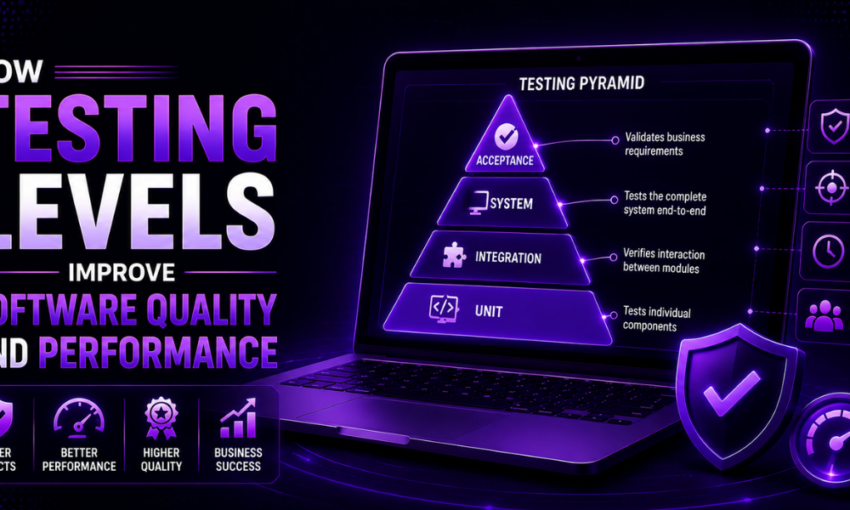
The proper testing of software engineering provides the fundamentals of creating easy-to-use and reliable software applications. The Sprint development teams conduct regular checks and scheduled reviews to prevent minor issues from becoming major ones. Successful software engineering testing is the connection between technical quality and the needs of the user. Software operation and further function are as expected and will be as expected if used under any conditions, purposes or functions. Investing in software engineering testing helps reduce incidents during production, prevents tarnishing the brand. It creates a good and stable experience for the users and increases the churn rate. This blog will focus on the advantages for software makers, software product managers and general managers, and managers of a company looking for dependable software and pleased customers.
What Is Testing in Software Engineering?
Definition and Purpose of Software Testing
During the development cycle of a software product or application, testing involves testing that software is operating as it should (secure, reliable and efficient) and meeting its particular objectives.
Why Testing Is Essential in Modern Development
Today, testing of software engineering plays a vital role, as there can be very damaging consequences associated with software defects that can ruin your company’s reputation or upset users. Software failures, such as the system crash at Delta Air Lines which prevented them from flying a quarter of their aircrafts after an incorrect software update (a third-party integration issue) further justify rigorous testing. Though the cost of software testing can be high, early detection of flaws in software architecture and security vulnerabilities has saved companies millions. Rigorous software testing yields highly reliable software applications, with users and customers supplies quality products. This exceed their requirements and have more potential for sales and market share increases, and are satisfying for the end user.
Testing as a Quality Assurance Activity
Essentially, testing of software engineering prevents disasters and finds problems early. It boosts:
• User experience
• Performance
• Security
• Reliability
Ultimately, it makes the difference between a mediocre product and an excellent product.
Common Goals of Software Testing
The software is used to locate defects and fix them during the initial development stages to produce a quality product. It also helps developers meet functional and non-functional requirements, increase quality, and reduce cost and risk. It defects early in the development process. It ensures requirements are validated to test that quality is maximized. Lastly, it also minimizes risks and cost savings can be attained.
Why Testing Matters in Software Development
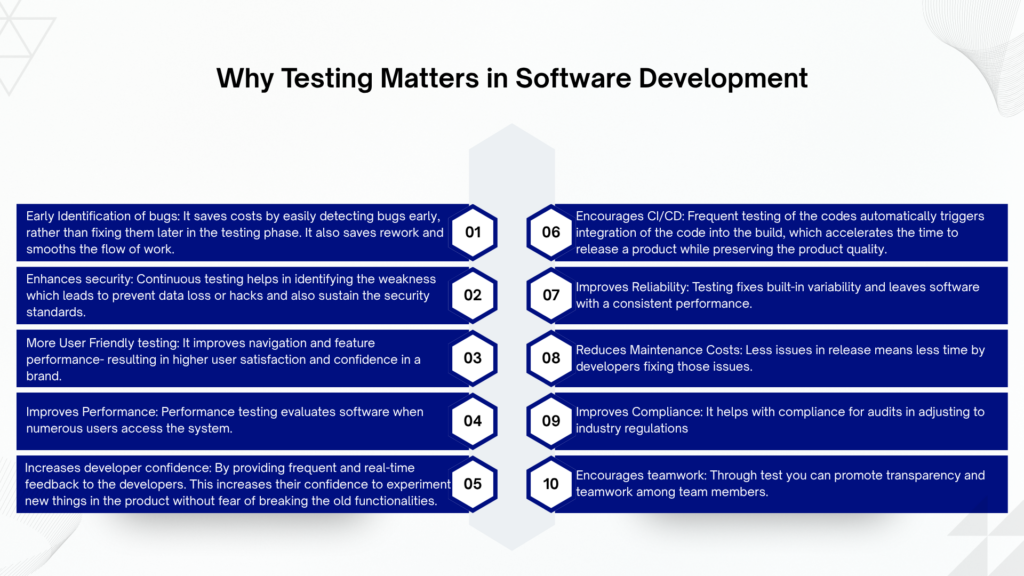
The Importance of Software Testing for Business Success
Cost Reduction – Shifting left testing in software development earlier is a must in the Software Development Lifecycle (SDLC). As developers may be building and testing at the same time. Early identification of bugs is key for reducing costs of fixing defects. Especially for developers who can discover and address errors later in development cycles.
Strong Security and Compliance – As Businesses increasingly run their core functions and hold personal information with Software, testing software security at regular intervals for security updates and patches is critical, and for developers not expose the software to malware.
Overall Quality Improved – A complete testing methodology, covering performance testing and security testing, ensures a team produces high quality software. Efficient solutions provide better value to your users, with solutions that work well in various situations.
The best possible User Experience (UX) – Complete testing with performance, security etc, can provide the best UX to the end users with the best possible quality. This can enhance brand value for companies, encourage brand loyalty, and ensure customer satisfaction.
Understanding the Software Testing Process
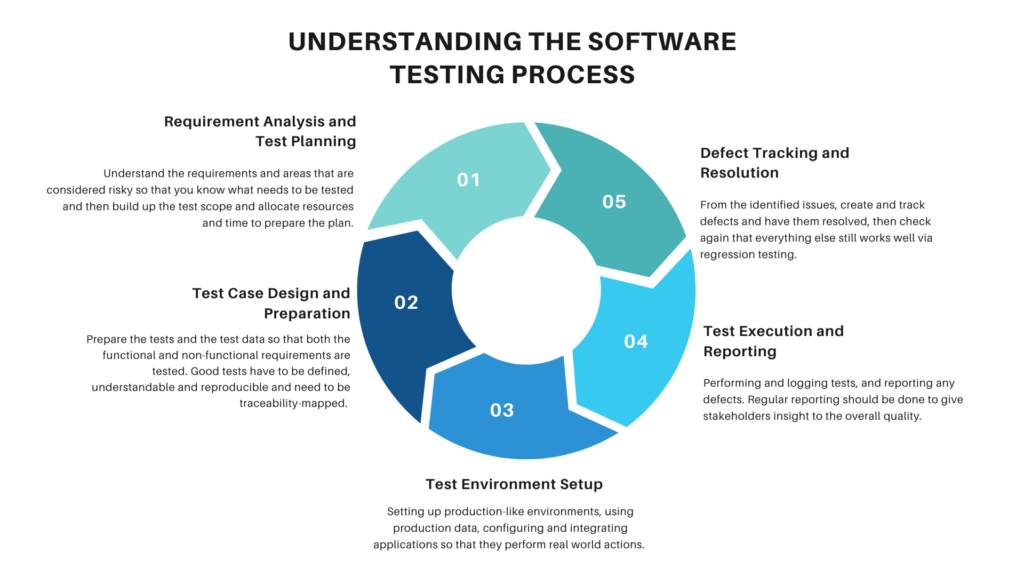
Software Quality Assurance and Testing – What’s the Difference?
| Factor | Quality Assurance | Software Testing |
| Responsibilities | It involves ensuring that the developed product meets the customer’s requirements and is of the desired quality. | It involves finding and documenting the defects in the system. |
| Techniques | It involves techniques like root cause analysis, process audits, defect management, etc. | It includes techniques like unit, functional, integration, and system testing. |
| Cost | It generally costs less than Software Testing. | It generally costs more than Quality Assurance. |
| Time | It generally takes less time than Software Testing. | It generally takes more time than Quality Assurance. |
| Effort | It requires less effort than Software Testing. | It requires more effort than Quality Assurance. |
| Testing | It is not a testing process. | It is the process of running a program to find errors. |
| Risk | It involves risks in ensuring the product meets customer requirements and desired quality. | It involves risks in identifying and documenting defects. |
| Documentation | It involves documenting processes to ensure the product meets customer requirements and desired quality. | It involves documenting the defects identified in the system. |
Types of Testing Used in Software Engineering
Functional Testing: Testing checks if the system performs the functions as stated by the requirements. Example – Checking if the sign-up button is working or if users receives an automated confirmation email or not.
Non Functional Testing: In addition to functional testing the testing of performance aspects of the system is non functional testing. Examples of this type of testing are speed, security, performance, etc. It observes how ready the system.
Manual Testing: In manual testing there is no use of any tools and scripts. Manual testing involves testers testing the system with user interactions. Testers can click on buttons, write information and check results. Testers find manual testing beneficial for areas such as usability testing and exploratory testing, and especially when the scale of the application is small.
Automated Testing: Automated testing uses tools and scripts to execute tests automatically and is especially helpful for carrying out routine tests or larger test cases. As automated testing requires less human involvement the system can test in less time and with less human errors and increased reliability.
Functional and Non Functional Testing Compared
| Category | Functional Testing | Non-Functional Testing |
| Definition | An umbrella term for various testing types that test the functionality of a software | A board term for multiple test types that check non-functional aspects of software |
| Purpose | Verify the software functions faultlessly based on the business and user requirements | To ensure and improve high levels of security, performance, usability, etc |
| Manual or Automation | Can be manual or automation testing | Automation testing |
| When to perform | Before non-functional testing | After functional testing |
| Testing types example | Smoke testing, Sanity testing, Regression testing | Load testing, Stress testing, Accessibility testing |
| Advantages | Ensure the software functions as it shouldAllow keeping the software clean from bugsHelp to meet business and user requirementsDone from a real-life end-user perspective | Improve the performance of the softwareEnsure high-security levelsMake the software more user-friendlyHelp the software meet customer needs |
Testing Levels in Software Engineering
- Functional Testing: It checks the software as per the requirements.
- Non functional Testing: It checks how it performs under different circumstances.
- White box testing: It checks as per the internal working of the code.
- Black box testing: It checks as per the functionalities without seeing the inner working.
- Ad-hoc testing: It does random testing without planning to eliminate bugs.
- API testing: It checks application programming interface functionalities.
- Exploratory testing: This testing find unpredictable conditions which can lead to bugs.
- Regression testing: This testing aims to prevent broken code.
- Sanity testing: It check a particular feature only when time is less.
- Smoke testing: This testing method is the one where, whenever code releases to the testing server, developers immediately start checking it.
- User Acceptance Testing (UAT): The end users execute this testing. It’s usually for end user approval on real life situations.
Manual Testing vs Automated Testing
| Parameter | Manual Testing | Automation Testing |
| Definition | Test cases are executed manually by testers. | Test cases are executed using automation tools and scripts. |
| Processing Time | Time-consuming | Faster execution |
| Resource Requirement | Requires human testers | Requires tools and skilled professionals |
| Exploratory Testing | Possible | Not ideal (limited support) |
| Framework Requirement | No framework required | Uses frameworks (Data-Driven, Keyword-Driven, etc.) |
| Reliability | Prone to human errors | More reliable and consistent |
| Investment | Investment in human resources | Investment in tools and automation engineers |
| Test Results | Recorded manually (e.g., Excel) | Automatically generated reports/dashboards |
| Human Intervention | High | Minimal |
| Performance Testing | Not suitable for load/stress testing | Suitable (e.g., using JMeter) |
| Batch Testing | Not possible | Multiple tests can run together |
| Programming Knowledge | Not required | Required |
| Documentation | Limited documentation | Scripts act as documentation |
| Best Used For | Exploratory, Usability, Ad-hoc testing | Regression, Load, Performance testing |
How Software Testing Improves Quality
- Utilize real world data: Utilize actual, real world data to demonstrate a typical usage of the software so you can find any and all the problems with the application.
- Share with stakeholder: Work with stakeholders like testers, developers and end users on the demonstration and testing.
- Test early and continuously: As early as possible and ongoing throughout the development life cycle, begin to test the software application.
The Role of Testing in Agile and DevOps Environments
Continuous Testing Practices
Agile and DevOps tell teams that they release the changes bit by bit so doing manual testing wouldn’t make sense. The developer runs each test automatically after each change. They fix any issues when the latest release goes in. Therefore, it doesn’t interfere with what works.
Faster Releases With Continuous Quality Checks
Automated tests can instantly notify of code quality and thus will alert the developer when there’s an error, they’ll know quickly that there’s a problem. They’ll iterate their releases and become faster with development, leading to faster market release.
Testing in Agile Sprints
As more code is written during agile sprints, defects are found in old functionalities. Automated tests maintain the quality of this old code. Without them, it becomes hard for testers to keep up and they tend to discover defects later on. This results in increased fix costs.
Automation in DevOps Pipelines
Agile and DevOps culture prioritize frictionless code deployments where automated tests play an integral role. Automated tests integrate the system under tests in your CI/CD pipelines. Thus, testing the application at every deployment stage enables daily code releases without compromising on its quality.
Software Development Standards and Testing Compliance
1. ISO (the International Organization for Standardization)
The ISO has introduced a software testing standards family, which is including one of the most significant standards, ISO/IEC 29119. It provides a straightforward structure for software testing processes, techniques and documentation. It’s a really helpful thing to have at hand to ensure teams run tests in a structured and consistent format.
2. International Software Testing Standards
In order to maintain consistency of testing methods in other parts of the world, software could be tested anywhere, many testing standards have been developed by organisations such as ISO for the global community. It should bring consistency to quality assurance testing methods and performance.
3. The IEEE (Institute of Electrical and Electronics Engineers)
IEEE has also created a few standards around testing; the most popular will be IEEE 829. This standard concentrates on the documentation of a test within a team. It includes:
- What the team should be able to put this into
- How the team should report the results
- How the team can mark the development of the test.
It’s about maintaining a well-structured and clear testing process. These standards serve as guidelines to help teams stay on track and identify problems right away, as well as help make sure software quality is met throughout the software development lifecycle.
4. Miscellaneous Software Testing Standards
The standards these are following are not the large recognizable standards such as an ISO or IEEE. For instance, for software testing, there are some rules established in the software field known as CMMI (Capability Maturity Model Integration). They are related to the enhancement of the entire development process. It strives to improve quality and performance gradually.
Common Challenges in Software Testing
- Time constraints: A key constraint, for the application is to test on time. It often leaves little room for in-depth testing. Therefore, it may overlook significant issues.
- Skilled testers or poor testing setup: Also, due to lack of skilled testers or poor testing infrastructure, the testing process can not be effective.
- Requirement changes: Last but not least, if the requirements and/or specifications of the software undergo frequent changes this can make testing efforts become difficult and subject to rework.
Best Practices for Effective Software Testing
- Artificial Intelligence (AI) and Machine Learning (ML) in testing: The integration of AI and ML technologies has revolutionized software testing. An AI-powered testing tool is capable of analyzing a ton of data, forecasting complex issues, even creating test cases entirely on their own, which translates to more efficient and effective testing processes.
- Shift-left testing approach: The focus of shift-left testing approach is to test as early and as often as possible in the software development lifecycle. Venturing into testing from the beginning of the development process allows the testing teams to catch and fix problems at an earlier stage. Therefore, minimizing the problems that may lead to expensive defects later in the project.
- Continuous testing: Continuous testing is gaining more popularity in the agile and DevOps environment. Moreover, it includes automating testing and performing continuous testing within your development pipeline. This is done in order to have teams fully test and validate changes to software in real-time, leading to faster and more reliable software updates.
Emerging Trends in Software Testing
- Considering how rapidly the pace of growth in IoT (Internet of Things) happens, there needs to be adequate tests around the reliability and security of the product. Especially in medical and automotive fields, testers use tools such as Postman and Wireshark to find out communication or security related problems.
- Speaking broadly, codeless automation eases the test creation process by providing a visual user interface for the non technical testers that they can use to build automated tests and improve the time it takes to execute tests.
- There is an ever-increasing growth of the application of blockchain technology in secure data management to offer increased transparency and authenticity for transactions.
- Big Data testing manages a colossal volume of structured and unstructured data while checking accuracy to achieve improved decision-making for business intelligence.
- With performance engineering the testers focus on user experience while constantly attempting to engineer the performance of software across the SDLC.
- While assessing potential vulnerabilities and implementing protection and compliance, cybersecurity has become an indispensable part.
- Infrastructure as Code or IaC makes it easier to handle cloud infrastructure and helps to ensure greater control and automation. Tools that facilitate the management and handling of IaC include Docker and Terraform.
- While prevalent during the pandemic, the chatbot assists customers throughout their day. It has a high need for ongoing testing to prove itself accurate and effective.
- In Agile, codeless testing helps make testing quicker while fostering teamwork. Also, ML and AI assist in speeding up the testing with algorithms that cut out time-consuming tasks.
Common Myths About Testing in Software Engineering
Myth 1: Software testers are solely responsible for quality.
Reality: Quality is the team’s responsibility. Because every developer or tester is important to the product’s success, there needs to be a collaboration, providing the correct information to each other.
Myth 2: It is possible to create software that is bug-free.
Reality: No one can write error-free code; the average for the industry is 15 – 50 errors per 1,000 lines of code. An ongoing process of improvement is essential.
Myth 3: All tests should be automated.
Reality: Automation of repetitive tests has its advantages; manual testing plays an important role with respect to exploratory tests. A “balance” operation is most effective.
Myth 4: Anyone can do anything as a test.
Reality: In order to test, you must be creative and have a special way of looking at things. Testers have a vision of user scenarios and these scenarios are crucial for quality assurance.
Myth 5: Testing is a luxury item that is too costly.
Reality: Without proper testing, the savings can be bound to come with costs later. Quality assurance is a smart investment because it will save you from costly changes or tweaks after the product is launched and will make things more reliable.
Conclusion
Testing of software engineering is a continuous process that guarantees good software quality to ensure its reliability, security, and user satisfaction. It saves costs, safeguards brand reputation, aids in compliance and helps to speed up releases with automation and continuous practice. Leveraging a shared understanding of QA processes, risk assessment planning can help teams identify defects at an early stage. Also, a balanced combination of manual and automated testing methods can identify defects at an early stage. This leads to enhanced performance and achieves sustainability over time. When you buy testing for software engineering, it is as good as investing in both software products quality as well as in business success through a boost in trust of your clients.
FAQs
Q1. What is testing in software engineering?
It ensures that the software functions, is secure and operates smoothly and efficiently according to the requirements.
Q2. Why is software testing important?
It’s very crucial because it keeps applications running smoothly and secure. As a part of software testing, your applications would be used in realistic usage and this would ensure data safety.
Q3. What are the stages of the software testing lifecycle?
The software testing life cycle includes:
1. Requirements Analysis.
2. Test Planning.
3. Test Case Development.
4. Environment Setup.
5. Test Execution.
6. Test Closing.
Q4. What is the difference between QA and software testing?
Here, the essential difference is that software testing takes a “Product Oriented Approach” and “Reactive Testing”. Whereas the QA team takes a “Process Oriented Approach” and a “Proactive approach.”
Q5. What is the role of testing in Agile development?
Testing ensures quality and also gives opportunities to provide quick feedback to the teams and accommodate the changes.