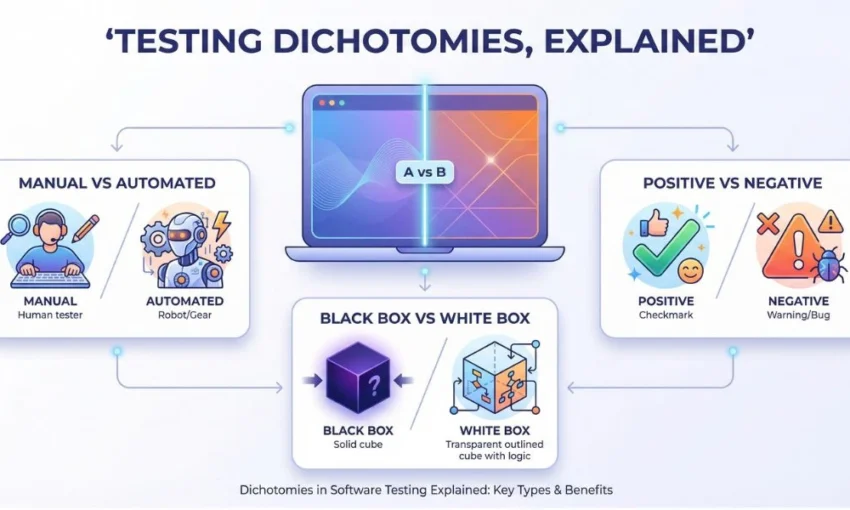
Dichotomies in software testing are the two important ideas that help the team find a good mix between a lot of testing and only a little. They cite trade-offs, e.g. speed over depth, which could be over-reliance on one style. If teams learn how to use dichotomies in software testing, they can reduce the risks and costs and deliver high-quality software in less time. This blog will explore major categories, benefits, and tips.
Software Testing Dichotomies Explained
Dichotomies in software testing are binary differences between testing methods, like manual and automated or static and dynamic. Such pairs deal with various features of quality assurance, such as functionality, performance. They encourage moderation policies and not blanket policies.
Major Types of Dichotomies in Software Testing
Dichotomies in software testing span various levels, each targeting unique risks.
Manual vs Automated Testing
Manual testing is great for experimental testing that needs careful watching because people do the test cases by hand. Automated testing, on the other hand, uses tools and scripts to be efficient and works well for repetitive jobs and regression testing.
Black Box vs. White Box
Black box testing is applied to test the functionality of software. Whereas white box testing is applied to test the internal code and logic of the software.
Functional vs. Non-Functional
Functional testing makes sure that the software meets its requirements. Non-functional testing checks things like speed, scalability, security, and how easy it is to use.
Positive and negative testing software
Positive testing checks that the software works fine most of the time, and negative testing checks that the software doesn’t break when given bad inputs to find all possible security holes.
Big Bang vs Incremental Testing
Since it is suitable for small projects, big bang testing analyzes the whole system after it is built. But incremental testing analyzes at each part on its own, which lowers the risk of integration.
Agile vs. Waterfall Testing
The iterative and flexible nature of agile testing and the sequential nature of Waterfall testing, which usually results in the discovery of problems at the late stages, make agile testing better.
Alpha Beta testing differences
| Parameters | Alpha Testing | Beta Testing |
| Technique Used | Alpha testing uses both white box and black box testing. | Beta testing commonly uses black-box testing. |
| Performed by | Alpha testing is performed by testers who are usually internal employees of the organization. | Beta testing is performed by clients who are not part of the organization. |
| Performed at | Alpha testing is performed at the developer’s site. | Beta testing is performed at the end-user of the product. |
| Reliability and Security | Reliability and security testing are not checked in alpha testing. | Reliability, security and robustness are checked during beta testing. |
| Ensures | Alpha testing ensures the quality of the product before forwarding to beta testing. | Beta testing also focuses on the quality of the product, but it also gets feedback from users and makes sure the product is ready for actual people to use. |
| Requirement | Alpha testing requires a testing environment or a lab. | Beta testing doesn’t require a testing environment or lab. |
| Execution | Alpha testing may require a long execution cycle. | Beta testing requires only a few weeks of execution. |
| Issues | Developers can immediately address the critical issues or fixes in alpha testing. | Most of the issues or feedback collected from the beta testing will be implemented in future versions of the product. |
| Test Cycles | Multiple test cycles are organized in alpha testing. | Only one or two test cycles are there in beta testing. |
Pass–Fail Testing Dichotomy & Its Impact on Release Decisions
Pass fail testing dichotomy
In software testing, the pass-fail dichotomy is a software testing approach that analyzes a test case having two possible results:
- Pass: It evaluates whether the software or feature has functioned as expected under the given circumstances.
- Fail: It shows that where the expected and actual results testing differ, it indicates that there is a problem or flaw.
This two-way evaluation will be clear and necessary to develop a clear acceptance criterion of the stakeholders and effective tracking of bugs.
Its Impact on Release Decisions
There are striking positive and negative sides to the pass-fail dichotomy of the release decision.
Positive Points:
- Brings clarity and objectivity, making go/no-go decisions easier for the stakeholders.
- Increases the efficiency in bug tracking through concentration on root cause resolution.
- Assures of minimum levels of quality and safety, which is essential in high stakes industries.
Negative Points:
- Reduces the complexity of software behaviors and might ignore minor problems.
- Combat of grey areas, causing partial judgment of unanticipated actions.
- Promotes the culture of testing to pass, which discourages in-depth investigation of edge cases.
- Risks include estimating the probabilities of failures wrong, which can bring risky products to market.
Choosing the Right Testing Dichotomy for a Project
The selection of appropriate Dichotomies in Software Testing must include:
- Dichotomies in Software Testing analyze project needs (size, complexity, stability), resources (budget, skills), and goals (speed, depth, compliance) to find the best match.
- Types like Manual/Automated, Functional/ Non-Functional, and Agile/ Structured are conducted for a complex task in a project.
- In many cases, a hybrid model may serve as the best way to balance various strengths, such as Manual vs. Automated, repetitive tasks vs. exploratory; Agile vs. Structured, to high-risk vs. high-need projects.
Benefits of Dichotomies in Testing
1) Increases Quality: Dichotomies in software testing help to uncover errors and bugs in software, hence improving product quality.
2) Customer Satisfaction: It makes sure that the software is within the expectations and requirements of the customers and results in increased customer satisfaction.
3) Cost-Effective: The early detection and correction of defects during the development process is more cost-effective than correcting the defects later.
4) Risk Mitigation: Supports in the prevention and control of risks that may arise in software, hence reducing the possibility of production failures.
5) Better Security: Testing will assist in the detection of vulnerabilities and will make sure that the software is stable against cyber threats.
6) Compliance: The software must be in line with the industry standards and regulations.
7) Higher Productivity: Software testing can aid in enhancing the productivity of the development teams by automating repetitive testing activities.
8) Improved User Experience: Testing will make sure the software works as expected to give the user a smooth sailing experience.
9) Provides Reliability: Testing is used to establish the software’s reliability for users.
10) Continuous Improvement: Dichotomies in Software Testing can be enhanced and refined using continuous testing and feedback to modify software to fit the requirements.
Challenges in Applying Testing Dichotomies
1. One Size Fits All Approach
Challenge: When using uniform tests in diverse software, you may fail to consider certain user needs, which will result in incomplete testing and a dissatisfied user experience.
Solution: Adopt customized testing procedures that can be adjusted to the requirements of the end-users by establishing realistic test conditions.
2. Lack of Skilled Workforce
Challenge: When there is a lack of skilled software testers, it may lead to defects that are missed, delays, and poor quality of products.
Solution: Invest in the training and development of existing employees, hire skilled testers, and work with educational institutions. Otherwise, access a huge number of qualified testers with the help of Global App Testing.
3. Stringent Time Constraints
Challenge: Strict deadlines can lead to the focus on developing new features instead of the proper testing of them, which can result in insufficient coverage and the quality of the product.
Solution: Use intelligent time management, incorporate continuous testing and begin testing at least three days before release to be able to assure quality levels.
4. Absence of Automation of testing.
Challenge: Manual testing is slow and can be subject to human error, and can be inefficient with complicated applications.
Solution: Automate repeated tests to increase efficiency and comprehensiveness, and employ test management tools to streamline operations. Global App Testing will be useful in scaling automation efforts.
Best Practices for Implementing Effective Testing Dichotomies
State Clear Testing Objectives: Set clear testing objectives to control the process and determine the effectiveness such as targets in defect density and measures of user satisfaction.
Develop a Software Testing/QA Plan: Definitive roles and responsibilities, as well as writing test standards, should be documented to facilitate the process and eliminate confusion.
Test Early, Test Often: Have frequent testing during the development process to find bugs early and minimize last-minute bugs.
No Programmer-Written Tests: Have independent testers to convince them about an unbiased testing process, and also to reveal the bugs you were not aware of.
Conduct Regression Testing: After an update, test the code on a regular basis to ensure that no new mistakes are introduced and that the functionality is unaffected.
Include Non-Testers: Involve stakeholders and end-users in testing to get a broad range of opinions and useful feedback.
Pay attention to the types of necessary testing: It is best to adapt the methods of testing to the needs of the particular project instead of using all types of tests possible.
Mix In-Person and Cloud Testing: This method combines the two types of testing in order to take advantage of real-time user feedback and provide efficient automated testing.
Plan Post-Launch Testing: Plan on continuing testing after Launch to ensure software reliability and user feedback.
Results of Document Tests: Make sure that the results of the tests are well documented to prevent misunderstanding amongst different members of the team.
Balance Automated and Manual Testing: Both of the testing methods should be used strategically to make the most use of them and to be able to solve more complicated situations.
Future of Software Testing: AI vs Human Testing
| Dimension | AI in Software Testing | Human Intelligence in Software Testing |
| Speed | Processes large volumes of data rapidly | Slower but capable of deep analysis |
| Repetitive Tasks | Excellent at automating mundane, repetitive tests | Prone to fatigue and error over time |
| Pattern Recognition | Identifies complex patterns across datasets | Uses experience and intuition to recognize anomalies |
| Creativity | Limited to learned patterns and algorithms | Inventive, can test beyond predefined scenarios |
| Contextual Awareness | Lacks true understanding of business nuances | Deep understanding of domain, user, and context |
| Error Handling | Self-healing and error prediction capabilities | Adaptive problem-solving and strategic thinking |
| Emotional and Ethical Intelligence | Non-existent | High, critical for user-centric and ethical testing |
| Learning & Adaptation | Learns from data, requires retraining for changes | Continuously learns from experience and changing context |
Conclusion
Dichotomies in Software Testing provide smarter QA by highlighting major differences among 10+ types. Adopting them will overcome such hurdles as budgets and talent gaps to get better outcomes. Teams that use them win in quality and speed-have your process future-proof today.
FAQs
What are the four types of software testing?
Unit Testing, Integration Testing, System Testing, and User Acceptance Testing (UAT) are the four main software testing levels, starting with small units, then on to the entire system, and finally, user acceptance testing.
What is terminology in software testing?
The terminology of software testing is the technical terminology of software quality assurance and software development. As it applied to the processes, methods, artifacts, and concepts involved in the discipline.
What are the 7 steps of software testing?
The Software Testing Life Cycle (STLC) has 7 steps, namely Requirement Analysis, Test Planning, Test Case Development, Test Environment Setup, Test Execution, Test Result Analysis, and Test Closure.