A community website can be a great idea to start, and can be a great way for people to connect together and share their ideas. But without management, this type of space can turn into a heated or legal mess, for instance. A strong content moderation policy is fundamental to promoting a healthy online environment, user protection and engagement. Some platform owners rely solely on community guidelines, while a clear content moderation policy provides moderators with detailed guidance. It includes what is acceptable and what is not. Also, which steps to take when a user breaks these rules and how to appeal them. With the rapid growth of user-generated content, it is imperative to have a policy to deter inappropriate materials, such as hate speech and misinformation. A good policy should achieve a balance between protecting people and providing the freedom to express themselves, empowering the moderators and assuring users that they are safe. This guide will provide simple steps to enhance the creation of a strong policy and develop a safe, reliable online environment for all participants.
What Is a Content Moderation Policy?
Content Moderation Policy Explained in Simple Terms
A content moderation policy broadly outlines the guidelines a company employs to determine which content is acceptable, prohibited, or restricted on its platform. This policy is a much more detailed policy than what the public can see.
The three are not the same and it shouldn’t be confused with the community guidelines and enforcement logic.
Community guidelines are a simplified version of the policy, aimed for public consumption. They inform users about what is allowed and what is not allowed on the platform.
Enforcement logic implements the content policies: Flagging, removal and appeals.
Community rules are known to users but enforcement logic executes in a non-visual way to handle the rules on a wide scale. They are characterized by the policy.
Why Every Online Platform Needs Moderation Policies
On these sites, people must follow rules to protect users’ safety, keep group trust, and follow strict laws around the world. If these rules aren’t in place, platforms could quickly lose users because they become hubs for hate speech, crimes, and false information.
Difference Between Moderation Policy and Community Guidelines
| Aspect | Community Guidelines | Moderation Policy |
| Definition | The public-facing code of conduct | The internal operational handbook |
| Target Audience | Users and community members | Trust & Safety teams, moderators, and automated systems |
| Primary Purpose | To educate members on acceptable behavior and prohibited content (e.g., “no hate speech,” “be respectful”) | Explain how regulation works, including the exact steps for dealing with violations, the penalties, the ways to go up in the chain of command, and the appeals process. |
| Content Focus | What is and isn’t allowed in the community | How to enforce rules and handle violations |
| Format Style | Simplified, easy-to-read list | Highly detailed with complex edge cases and strict decision-making matrices |
| Complexity Level | Simple and accessible | Complex and comprehensive |
| Examples of Content | General behavioral expectations and content restrictions | Warning systems, ban durations, escalation procedures, appeals handling |
Core Elements of an Effective Content Moderation Policy
1. Hate Speech and Discrimination: Platforms should ban materials that encourage racism, sexism, age or disability discrimination and intolerance of other religions.
2. Violence and Threats: There is a need for strict moderation of content that incites violence which includes sexual violence, emotional violence, psychological violence and verbal abuse.
3. Misinformation and fake news: There is a need to remove any piece of misinformation and fake news, particularly within health, politics, and public safety industries.
4. Explicit and Adult Content: There should be guidelines on what kinds of adult content can be shared to keep in line with age appropriate policies.
5. Cyberbullying/Harassment: Penalties should be used to ensure that individuals are not victims of harassment or cyberbullying on online platforms.
6. Copyright Infringement: Platforms need to make sure that there is no unauthorized use of copyrighted material to avoid legal troubles.
Reporting and Appeal Mechanisms
There should be available reporting mechanisms on bad online behavior. As an illustrative case in point, YouTube has copyright holders fill a web form in more than 80 languages, with rights holders requesting to have their stolen material removed. Most sites enable people to block users and tag their posts or silence people to control interactions. After reporting a scamming/harassment account, users can include evidence, such as screenshots, in their report, along with the entire profile.
Developers ought to make these reporting tools readily accessible and usable. These measures will make users feel more secure and trusting of the platform. It will benefit online health by fostering a more stable environment.
Transparency and Enforcement Standards
Transparency helps the audience to trust moderators; moderators need to explain their decisions. Let the users understand why their removed content. Allowing appeals, particularly in complicated instances, builds user trust within the moderation process.
How to Create a Content Moderation Policy
| Sr. No | Steps | Focus | Description |
| 1 | Understand the Platform and Its Users | Audience & Content | Know who will create the content and what that content should look like. |
| 2 | Define Non-Permissible Content in Depth | Rules | Lay out what is and isn’t allowed. |
| 3 | Address Cultural and Linguistic Sensitivities | Context | Account for differences in culture, language, religion, and more. |
| 4 | Refer to Applicable Laws and Compliance Needs | Legal | Ensure your platform complies with relevant laws and regulations. |
| 5 | Define Your Moderation Approach | Strategy | Determine the when, who, and how of moderation. |
| 6 | Define Enforcement Actions and Escalation Tiers | Consequences | Decide what actions apply to violations and how to escalate repeat offenses. |
| 7 | Define User-Driven Reporting Methods | User Input | Provide clear ways for users to report harmful content. |
| 8 | Design a Fair and Transparent Appeals Process | Accountability | Inform users how to appeal moderation decisions. |
| 9 | Enable Policy Updates, Changelogs, and Scalability | Flexibility | Update rules as needed and log those changes as your product and audience grow. |
| 10 | Define Internal Governance and Ownership | Roles | Clarify responsibilities across teams and departments. |
| 11 | Take Care of Human Moderators | Well-being | Protect the mental health and safety of moderators. |
| 12 | Draft and Publish Community Guidelines | Communication | Share user-friendly rules, enforcement actions, and expectations. |
| 13 | Use Data to Improve Your Policy | Iteration | Review moderation metrics and audits to refine your policy. |
Online Community Guidelines That Improve User Trust
Encouraging Respectful Communication
Make guidelines to be crafted in a way that fosters positivity rather than punishment. Promote positive criticism, cultural awareness and positive language.
Setting Expectations for User Behavior
Be clear about consequences. Disclaimer: “Sharing of personal addresses will result in removal of content and the bot for violation of privacy”.
Balancing Freedom of Expression and Safety
Don’t over-moderate. Publish with debate and irrevernt humor and keep users safe. Context matters.
Social Media Moderation Policy: Key Considerations
1. Direct Messages, Groups, and Channels
Direct messages and group chats are mechanisms that promote user interaction, which can, however, result in harassment and bullying. Moderation will be used effectively to achieve respectful and safe conversation.
2. Forums, Feeds and Posts
These sites help engage the local community by offering comments and questions. Spammers and other unpleasant content can overrun unmoderated forums and drive away new members and community integrity.
3. User Profiles
Profiles enable people to establish their identities and trust. Fake profiles, inappropriate content in unregulated profiles can impact trust and create community engagement issues. Authenticity needs to be actively monitored and in line with the community standards.
4. Comments
Comments are public, and can either help create thoughtful conversations or slide down the road with no moderation and become insensitive or harmful discussions. When comments are inappropriate, it can deter people from commenting and contribute to decidedly booing the site. Moderation contributes to a constructive manner of discussions, serves users and ensures positive usage.
5. Streams, Stories and Live Events are key
Live content offers unique interaction opportunities, with moderation challenges that present themselves. If live streams aren’t controlled well, they can quickly turn into nightmares. It can hurt the platform’s image and reputation and lead to a PR disaster. Everything that matters is that filtering is done quickly and correctly so that users have a good time.
Content Moderation Strategies Used by Modern Platforms
1. Pre-Moderation
Content moderation strategy where content is checked prior to posting it on platform. It allows users to approve it prior to going live. While this has its drawbacks in terms of speed and can’t be used in high-speed Internet contexts, it is applied in the security of platforms.
2. Post-Moderation
Post-moderation is a well-known form of content control that allows for the posting of content without moderating it.
It decreases the amount of time taken for checkup of content marked as deleted and is thus desired by digital businesses. It is a tactic commonly used on social media sites such as X, and Instagram.
3. Automated Moderation
AI tools and machine learning algorithms recognize and prevent content to ensure compliance to pre-tuned rules. Platforms that have a large volume of content benefit from AI for content moderation.
4. Community Moderation
User reports of inappropriate content is followed up by moderations relying on users’ feedback. It is primarily used on forum communities such as Reddit and Wikipedia that have guidelines for moderators who review content.
5. Distributed Moderation
It makes it easy to have content reviewed and removed from online communities in order to ensure adherence to a rating system. This approach, however, is far from being popular for its reputation or even legal considerations.
6. Hybrid Moderation
Hybrid moderation combines AI for content moderation with human efforts for intricate cases of content. It’s the best method of large-scale platforms.
User Generated Content Moderation Best Practices
1. Any offensive content can be quickly found by AI systems, but knowing cultural context and background requires humans, who can do the job more quickly with the help of automation tools. Combining AI with human intelligence improves the decision-making process and stops the bad things that happen when people only use AI.
2. In the process of moderation, proactiveness and reactiveness should be combined. Pre-moderation keeps damaging posts off the site, which is suited for brand-sensitive environments. It allows comments to be posted realtime in the community and then reported by community members. A combination of both methods offers optimal protection.
3. Human moderators should be supported since they work with inappropriate content and are more likely to get tired quickly. Therefore, additional training and counseling may help to prevent burnout.
4. Diverse moderation tools ensure equal treatment of all people, regardless of their language or culture, while an ethical response to the use of AI should involve clear labels.
AI Content Moderation Tools and Automation
How AI Detects Harmful Content
AI recognizes harmful content by continuously examining images, sounds, or text based on the safety rules. The AI uses the NLP using the analysis of the content semantics and intent behind to identify the presence of prohibited objects or false images.
Benefits and Limitations of Automated Moderation
The primary benefits of the automated moderation are its cost-efficiency, real time speed and scalability.
However, its limits are nuance, context and false positives. Platforms generally use a hybrid strategy, automating on a large-scale but reviewing human on the complex edge cases.
Combining AI Tools with Human Review
Digital platforms necessitate that content and moderation be done by a combination of AI and human review. The content created by users can be scanned by automated systems to identify harmful content. It is then submitted to human moderators before being made available. This hybrid approach will ensure security and protection of platforms without cross-contamination of unsanitary substances. Such companies as How AI helps human moderators explain why it is important to implement AI successfully. When the two technologies are harnessed, the companies increase their chances of coming up with the best in terms of content moderation to ensure positivity in user experience on social media and other digital platforms.
Community Management Best Practices for Safer Platforms
Building Positive Online Communities
Earn respect, be inclusive. Do not “punish” bad behavior, and reward good behavior.
Responding Quickly to User Reports
Target response times of 24–48 hours. Post status updates to increase confidence in users with the message “We have received your request.
Educating Users About Platform Rules
Post all guidelines on each enforcement notice. Elaborate on the reasons behind decisions.
Maintaining Transparency and Fairness
Publish transparency reports. Call on community responses to change of policy. Give users indications that they are being listened to.
Common Challenges in Content Moderation
1. Content: Social media produces volumes of content, and moderation is one of the challenging issues. When it comes to cyberbullying, immediate action has to take to save users.
2. Cyberbullying Strategies: To solve cyberbullying, user safety promotes platform activities, and platform responsibility, effective moderation strategies play a critical role.
3. Freedom of Speech versus Controlling: The ongoing dilemma that the moderator must grapple with is the freedom of speech as opposed to control of objectionable materials with ethical standards of ensuring safety within the environment.
4. Contextual Understanding: To correctly interpret the context and intent of user-generated content is not quite a simple task. It require a fine-tuned solution between AI and human perspectives.
5. Another area of concern is emerging threats: Social media sites will have to keep up with the changing threats on the internet and content moderators will have a crucial role to play in detecting and reducing these threats.
6. Training of Moderators: Moderate tutors must receive thorough training to enable them to acquire the skills necessary to respond well to the emerging challenges in content moderation.
Legal and Compliance Considerations in Content Moderation
- Children Online Privacy Protection Act (COPPA): Shields the information collection and utilization of children on-line in the United States.
- Digital Services Act (DSA): Committee in the EU deals with the liability of online platforms regarding the illegal processing of content.
- IT Rules 2021: Regulates the compliance of online content in India, concerned with the grievance redressal and content removals.
- General Data Protection Regulation (GDPR): Covers personal data in the EU in case access to data is involved in moderation.
- California Consumer Privacy Act (CCPA): Protects the personal data of California consumers and recognizes the right of their users to access, delete, and restrict the application of their personal data.
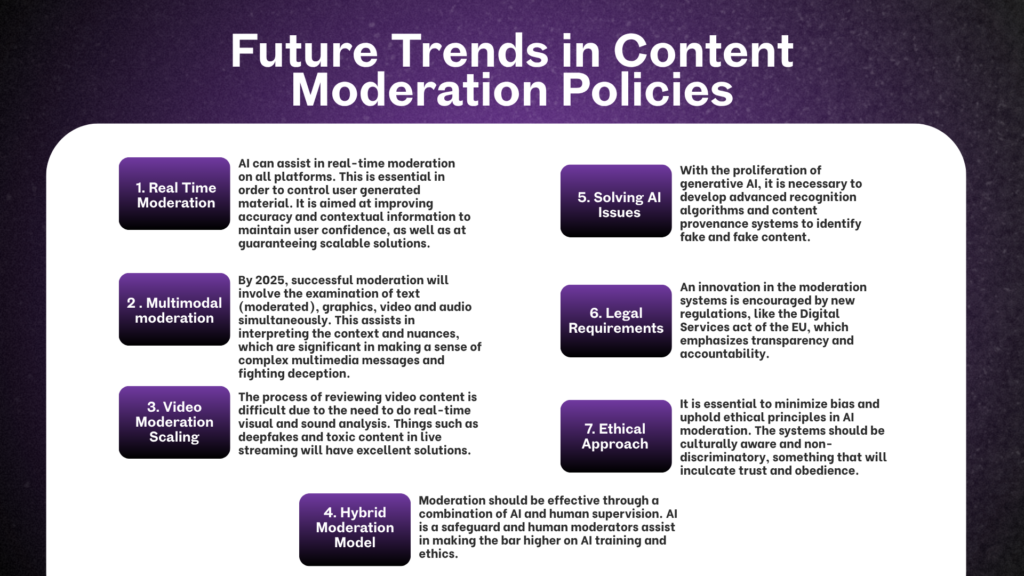
Future Trends in Content Moderation Policies
Conclusion
Creating a successful content moderation policy is not about censorship; it’s about ensuring the inclusion of a safe environment where people can grow. Every stage is significant from the prohibition of the content, to the balance and synergy of human and artificial moderation. Have a content moderation policy and update it as trends change; use data and be transparent. Your community will reward you with trust, engagement and loyalty.
FAQs
Q1. What is a content moderation policy?
The content moderation policy is a set of guidelines and rules put forward by any online platform.
Q2. How do you create moderation rules for online communities?
To develop appropriate moderation policies, start by setting the purpose of your community and creating behavioral guidelines. In addition, set out some progressive sanctions for any violations of those rules.
Q3. What are online community guidelines?
Community guidelines are a set of rules and behavioral standards established by the platform or its moderators to define appropriate content.
Q4. How do AI content moderation tools work?
The process of AI-based content moderation involves using the power of artificial intelligence to quickly screen or take action on any offensive content.
Q5. Why is content moderation important for social media platforms?
Content moderation protects users from exposing them to inappropriate content, prevents the spread of any incorrect information. It also ensures digital regulation compliance.