
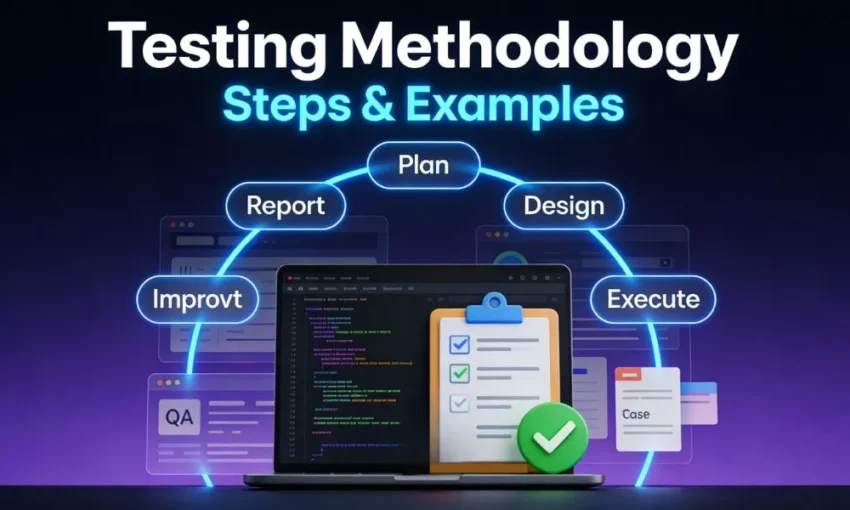
In this fast-moving world of technology bugs can be costly and reputational damage is almost guaranteed. Now, let’s discuss the testing methodology. The basis of any reliable software development is a testing methodology. It guarantees an application runs smoothly, which will save time and cost in the future.
A strong approach to testing will help identify flaws early in the project cycle, ensuring the best possible product quality and meeting business goals. Software teams using structured approaches to testing build user-and user-trusted software.
This blog explores how to test, from simple to complex techniques. You will learn the steps, types, examples, and future trends to use when creating your projects. From developer to QA professional, knowing this methodology can take your engineering game to the next level.
What Is Testing Methodology?
Testing Methodology Explained in Simple Terms
Testing methodologies are the techniques and procedures adopted in assessing a specific product to make sure it delivers the performance it promises and is readily usable. Typical testing methods include testing that the product conforms to the specification. It doesn’t have any undesirable side effects when used outside its design limits, nor will it fail safely in the worst-case scenario.
Importance of Testing Methodologies in Software Engineering
The complexity of software applications rises, particularly after the recent developments in AI, making a well-developed testing methodology essential. This guarantees that software products meet the requirements, function efficiently across different platforms and devices. Thereby, address usability and security. The lack of proper development and testing may cause projects to go way beyond budgets, run longer than planned, and underperform to meet the expectations of the stakeholders. Hence, effective testing is a key to successful software development.
Key Objectives of Software Testing Process
1. Find and identify software bugs, errors and defects before the product goes out to consumers. This helps the developers to identify vulnerabilities very early before the risk occurs in the future.
2. Enhance the overall quality of the software by ensuring all the features are functioning properly as per the project requirements and user expectations.
3. Test the program to ensure that it runs well in numerous situations such as high traffic, multiple users and continuous usage.
4.Protect the program: locate vulnerabilities, protect sensitive data and thwart cyber attacks or unauthorized intrusions.
5. Certify that the program meets the requirements of the business, needs of the customers and technical specifications also found out in the process of development.
6. Enhance reliability and stability to allow working with the program, without a crash, malfunctions or unforeseen shutdowns.
7. Improve customer experience through an intuitive and error-free, easy and fast customer experience on all devices and platforms.
8. Provide compliance with legal requirements and industry standards, encompassing data privacy and security regulations.
9. Reduce cost of development and maintenance costs through early identification of faults in the program development cycle.
10. Instill confidence in stakeholders, developers, and customers that the software product is mature enough to be implemented. It will be utilized over the long term.
Types of Testing Methodologies
1. Waterfall Model: This is a linear and sequential process in which the test is done after the development. Tests will be planned during the needs and design steps, but they won’t happen until after the code is written. It has strict guidelines and different testing stages (unit, integration, system, and acceptance). Although it gives definite milestones it is not flexible and therefore defect fixing may take time. Most appropriate when dealing with stable requirements and regulatory compliance requirements.
2. Agile Model: An iterative dynamic protocol that has testing that is in sync with development. Acceptance criteria is used to develop test cases based on each user story. Agile encourages people to work together, give and receive little to no feedback, and automate tests, usually with TDD or BDD. The agile testing pyramid lets categories be covered the most in the least amount of time. Most apt to changing needs and customer-focused applications.
3. Iterative Model: In this modeling method, the system is built and tried in small steps, which lets comments be added after each round. All cycles involve requirements analysis, design, coding and testing, with an expanding test suite. It focuses on regression test and risk-based approach. Does really well in very large projects where the requirements can change, and where there are more than one release.
4. Verification and Validation (V-Model): Has V workflow (between development and testing). The preparation of a test plan starts in coordination with the activities of development and thus it is early. It focuses on traceability and official entry/exit requirements of phases. Ideal in small-to medium projects, and clear requirements and safety-critical systems.
5. Spiral Model: Structures development into a plan, risk analysis, engineering and evaluation quadrants. It is centered around the risk assessment and testing is based on the identified risks. Documentation changes per cycle and formal reviews define project progress. Ideal to use in risky applications and sophisticated systems.
6. Extreme Programming (XP) Model: Makes testing a primary contributor to the development via TDD. An ongoing integration and pair programming improves the quality of code and reduction of defects. XP also encourages simplicity and collective ownership. Thus, it is suited to rapid development and frequently changing requirements.
Software Testing Methodologies Explained in Detail
Software testing approaches are the systematic processes and models for planning and conducting the testing phase during the SDLC. These testing methods in software engineering determine the manner in which an organization handles requirements, structures itself, and conducts testing operations.
Software Testing Lifecycle (STLC)
- Requirement Analysis: It is the initial stage of Software Testing Life Cycle (STLC). During this phase, the testing personnel conducts research on the project requirements and what must be tested. Testers interact with clients, developers, and business analysts to eliminate confusion and have clarity about the software. Risks, unmet requirements and testing priorities are also defined.
- Test Planning: This is a step where the testing team formulates a comprehensive testing plan. The testing scope, budget, time, resources, tools and testing techniques are determined. Team members are provided with roles and responsibilities. They have to record expected testing outcomes. This will facilitate the smooth running of the software.
- Test Case Development: Testers develop elaborate test cases and develop test data according to the requirements. Each test case has defined expected results. These test cases are read thoroughly with the aim of having adequate test coverage of the software functionality.
- Setting of a Test Environment: A testing environment that has the necessary hardware, software, databases and network settings is set. Such an arrangement will guarantee that testing is carried out in a realistic setting.
- Test Execution: Test cases are run, and defects are pointed out and bugs reported to the developers. Fixes are also followed by retesting and regression testing.
- Test Closure: It is the last phase for writing up test reports, recording results, studying defects, and checking the overall process of the testing to improve in the future.
Testing Methodology Steps: End-to-End Process
- Analyze requirements. Have a clear idea of how the app is supposed to work in every aspect.
- Create a test environment based on all the requirements.
- Analyze software and hardware requirements.
- Write down the responses of each system.
- Identify testing methods needed in order to test these responses. Provide an outline of standards that will be used (language, tools, etc.) in every test.
- Design test cases.
- Run tests, study, and save results.
QA Testing Methods Used by Modern Teams
1. Unit Testing
Unit testing is a low-level testing which is carried out at a ground level in order to test the individual software units or functions. It is involved in early development, thus making all sections standard. This method assists creators in understanding how the code operates and swiftly recognizing and resolving unfamiliar problems introduced by changes.
2. Integration Testing
Integration testing makes sure that all of the app’s different parts or services work with each other. Integrity testing checks whether the system or part works the way it should by checking for functional needs. This is achieved by integrating different components into a group and by testing them.
3. System Testing
System test allows QA teams to test the interaction of the components of the application in a wholesome system. System testing is based on the requirements and will test the overall functionality of the application, ensuring that all user inputs give the intended output.
4. User acceptance testing (UAT)
The final release occurs after UAT, which involves validation to determine the ability of the product in a real-life scenario. It mimics user behavior to determine whether the system is business-need-compliant and can be deployed. In the recent past, remote and crowd-sourced test approaches have also become accessible, which has enabled a range of involvement in UAT and mainly worldwide apps.
Agile Testing Methodology vs Traditional Testing
| Aspects | Agile testing | Traditional testing |
| Definition | In Agile testing, testing should be done when the development begins. | In Traditional testing, testing should be done when the development is completed. |
| Testing used | Exploratory testing should be done | Scripted testing should be done |
| Customer involvement | Encourage the customer involvement | Limited customer involvement |
| Flexibility | Flexibility is high | Flexibility is low |
| Time management | It takes less time because testing is done when the development starts. | It takes more time because it test when development ends. |
| Defects | It is used for resolving defects. | It is used for finding defects. |
| Modification | If the modification in the code is required, it can be implemented during the testing phase. | All the modifications should take place after the testing is done. |
| Test Documentation | It required minimum documentation | It required maximum documentation. |
| Test Approach | It follows iterative approach | It follows top-down approach |
| Project plan | Project plan should be complex | Project plan should be linear |
Advantages of Agile Testing
- Quickly adapts to changes in scope or the project plan.
- Regular changes will keep the customer and the product owners loyal.
- Product testing is done early and often and improves product quality.
- Engages all team members.
- Accelerates delivery with treadmill cycles.
- Failure risks are reduced by detecting problems at earlier agile lifecycle stages.
When to Use Each Methodology
| Aspect | When to Use Agile Model | When to Use Traditional Model |
| Requirements | Unknown or unstable requirements where the scope may change and flexibility is needed. | Clear and stable requirements with very limited scope changes. |
| Customer Involvement | Projects requiring frequent customer feedback and continuous user participation. | Projects where customer involvement is limited after initial planning. |
| Development Speed | Rapid development cycles with frequent updates and quick deliveries. | Long-term projects with structured phases and planned delivery schedules. |
| Experimentation | Suitable for experimental projects, innovative ideas, or testing new features. | Suitable for projects with predefined processes and minimal experimentation. |
| Project Size | Best for small to medium projects that require adaptability. | Best for large and complex projects needing extensive coordination and planning. |
| Compliance & Documentation | Works well when less documentation and flexibility are acceptable. | Ideal for projects requiring strict regulatory compliance, detailed testing, and heavy documentation. |
| Budget & Timeline | Suitable when budget and timelines can be adjusted during development. | Suitable when budget and timelines must remain fixed from the start. |
Real-World Examples of Testing Methodologies
1. SaaS Development
Agile is of great importance to SaaS development firms to constantly update their features and to scale.
2. E-Learning Platforms
As one of the e-learning software development services, agile will make it easy to quickly change material and add new features.
3. Startups
Startups follow an Agile approach of quickly testing ideas and re-orienting as needed.
4. Enterprise Software
Large organizations use the Agile methodology in their digital transformation and innovation efforts.
Common Challenges in Software Testing Methodologies
Challenge 1. Inadequate Communication
The absence of communication when it comes to software requirements is a barrier to the development of proper test cases. This problem is worsened by the time zone differences and different work shifts.
Solution
Development and testing teams should work together regularly, with product managers on board to keep them in check. It is possible to promote transparency and productivity with the help of tools like BrowserStack Test Management.
Challenge 2. Missing Documentation
After discussing project scope and specific requirements with a client verbally, teams fail to document it, with subsequent assumptions resulting in delayed testing and/or unnecessary tests.
Solution
Develop detailed documentation on the project needs. This provides benchmark for QA teams to have a clear view of the desired outcomes and helps to inform any appropriate tests developed.
Challenge 3. Diversity of Testing Environments
Testing on many devices, browsers and OS combinations is difficult. Emulators are not at the same level of realism as reality, and on premise labs are expensive.
Solution
Test on a variety of platforms with access to more than 3,500 real devices and browsers and test without having to use physical labs.
Challenge 4. Poor Testing
Pressures from tight timelines can cause testing to have poor coverage and cases to be missed.
Solution
A KISS approach to test case ordering; use automated tests for repetitive test cases; manual test using high volume of test cases to cover critical parts to ensure comprehensive coverage and timely delivery.
Best Practices for Effective Testing Methodology
- Shift Left – Early and Continuous Testing: Testers should be involved from the requirement stage in order to avoid the bugs.
- Automate the tests manually: Automate the repeated tests like regression and smoke test. Perform manual testing on the exploratory and UI experience test.
- Test using a Risk based approach: Apply the 80/20 rules for the test scope. Test cases: analyze 20% of the functionality, and 80% are responsible for the errors. Also, test the high risk/features.
- Short, clear, modular and reusable test cases: Make the test cases easy to understand, avoid too complex situation in test case so it could be re-usable in test scenarios and test only one feature.
- Realistic test data: Perform test using realistic data that would be used in production.
- A managed and well-configured environment: Make sure your testing environment mimics production and you are always in control and no error because of the environment is generated.
- Report in detail and objective way: Provide detailed bug report using metric; explain why it is important for the users and business value.
Future Trends in Testing Methodologies
1. Higher Automation and AI Assimilation: Automation is necessary in the process of improving the effectiveness of tests and reducing human mistakes. Programs such as Playwright, Cypress and Selenium, help in automating Functional and Regression testing resulting in faster releases and accurate results. Tools like Functionize and Testim, with AI and ML capabilities, can be used to predict defects and optimize test cases. They achieve better test coverage through the analysis of large datasets to see patterns and problems.
2. Shift-Left and Shift-Right Testing: Shift-Left Testing finds application to combine testing as part of an early software development cycle, giving the opportunity to detect bugs early and save costs. While Accepting Testing in the Real World is important, Shift-Right Testing focuses on making software more reliable and faster by doing continuous testing and real-world software features.
3.DevTestOps Integration: DevTestOps is a testing methodology that can be applied to the DevOps pipeline. Also, every change must be validated separately prior to deployment. This enhances the quality of software and the rate of delivery. Development Infrastructure as Code (IaC) principles help to maintain infrastructure settings through tools such as Terraform and Ansible to minimize deployment problems.
Key Takeaways: Testing Methodology Simplified
Testing methodology can be said to be the bridge between the developer and the user requirements, ensuring the computer software is reliable, secure, and works as expected. It involves methodologies like “Agile”, “Waterfall” and “V-Model” as well as functional requirements and non-functional requirements such as performance and security.
Conclusion
Understanding the methodology of testing empowers software engineering from guesswork to precision. The team can choose the approach that works best for them, like Agile for flexibility or Waterfall for predictability, and still make sure that the software they release is high quality and ready to use.
Make your process more future-proof with AI, shift-left, and continuous integration. One investment you can make in software that will stand out is an investment in the testing methodology.
FAQs
Q1. What is testing methodology in software engineering?
Software Testing Methodology refers to the practices, rules, and techniques used the test software. It ensures that it contains no flaws and satisfies all the requirements.
Q2. What are the types of testing methodologies?
Methods of Testing are techniques, processes, and frameworks to ensure software quality. It can be broadly classified as functional testing, non-functional testing, and structural testing.
Q3. What is the software testing lifecycle?
Software Testing Life Cycle (STLC) is a process that is followed to achieve the quality of the software. It is done to satisfy the business requirements during the process of software testing.
Q4. What is agile testing methodology?
Agile methodology in testing is an iterative testing process that is carried out throughout the development process, instead of at the end.
Q5. Which testing method is best for software projects?
There is no one perfect testing method, and a hybrid strategy, a mix of Agile, automated, and exploratory testing, is most effective.