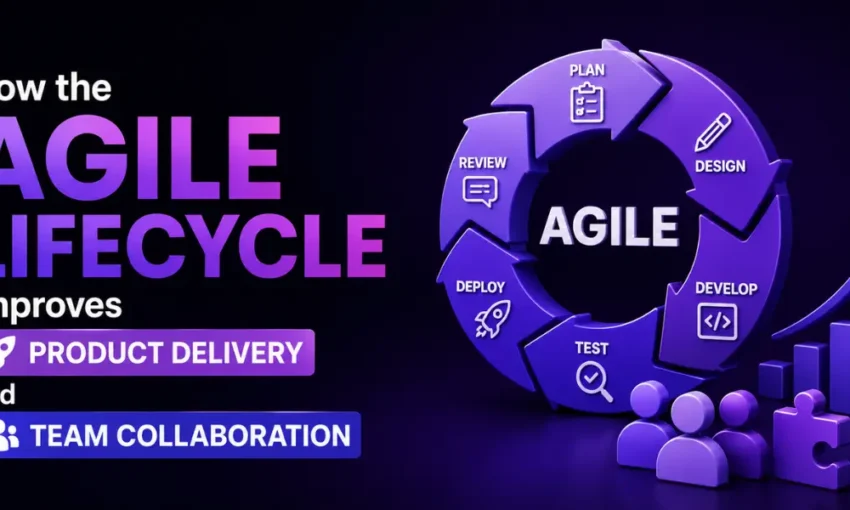
Today’s business environment is fast evolving and a staff team needs strategies that will deliver value and yield the ROI quickly, as customer needs change. The agile lifecycle has revolutionized software development and product management. It has moved away from a linear process to a set of iterations called a “sprint”. From which software and products can be incrementally released or shipped every 2-4 weeks. This allows for more certainty, transparency and stakeholder engagement and reduces risk in delivering products. Agile teams are three times faster to market, and every customer is satisfied. It comes with a strong focus on ongoing partnership, fostering smooth cooperation and collaboration among team members. Organizations that wish to perform well in the digital marketplace must embrace this form of integration.
What Is Agile Lifecycle?
Agile Lifecycle Explained in Simple Terms
The Agile software development life cycle is a sequence of small, repeatable cycles of work known as iterations or sprints, that can be used to build software. Every sprint ends with working software which teams can test, review and improve. The use of which is the basis of life cycle in agile software development.
Why Agile Became Popular in Software Development
Agile gained popularity since it removed some of the significant pitfalls of conventional, inflexible approaches such as Waterfall. Agile empowers teams to make quick and rapid changes to their development (also known as sprints), deliver functional software at a faster pace, and gather feedback from actual users throughout the development process.
Difference Between Agile and Traditional SDLC
| Aspect | Agile Software Development Lifecycle | Traditional Software Development Lifecycle |
| Approach | Agile is flexible and works in smaller development cycles called iterations or sprints. | Traditional follows a fixed and sequential process such as Requirements, Design, Implementation, Testing, and Deployment. |
| Flexibility & Change | Easily adapts to changing requirements, even in later stages of development. | Changes become difficult and costly once a phase is completed. |
| Customer Involvement | Customers provide continuous feedback and collaborate throughout the project. | Customer involvement is usually limited to requirement gathering and final testing stages. |
| Documentation | Focuses more on working software than extensive documentation. | Places strong emphasis on detailed documentation at every stage. |
| Risk Management | Reduces risk through continuous feedback, quick testing, and early delivery. | Higher risk if requirements change because testing happens later in the process. |
Phases of Agile Lifecycle
Requirement Gathering and Product Vision
The development team works hand in hand with the customer, so that they know what they actually want the software to do for them. The crew make sure that they fully understand the requirements of the customer and then categorizes and prioritizes them to build the most critical ones first.
Sprint Planning and Backlog Prioritization
The team has a well-defined strategy for developing software. It’s up to them to decide what they want to select for each development cycle (also known as an iteration).
Development and Continuous Collaboration
This is where the team starts to make the plan a reality. They operate in small, short cycles producing small quality chunks of the product. Because each cycle builds on the previous one, it helps the team to remain on schedule so they can also give the team rapid feedback for continuous improvement.
Testing and Quality Assurance
They then test the software to verify that it is working as intended and will meet the customer’s needs as the team develops the software. Testing ensures the product meets a high standard and eliminates any mistakes. It allows the team to spot any issues early on in the process that would end up causing trouble.
Deployment and Feedback Collection
When the team has tested all of them and verified working as expected they deploy the software and make it available for customers/end-users to make use of. This is the time when everything development has come to fruition.
Maintenance and Continuous Improvement
The software team job isn’t finished once they’ve released the software. They continue to maintain the software. It keeps it running smoothly and up to date when the client has new requirements or changes.
Agile Development Lifecycle and Its Key Principles
1. Customer Satisfaction
Agile approach focuses on describing a product in its lifecycle, flexibility and responsiveness to customer requirements. It focuses on customer cooperation and feedback enabling teams to make corrections at any phase of development, in contrast to conventional methodology.
2. Phased and Gradual Development
This technique structures the development into mini cycles or sprints and each one has a potentially shippable product increment. It allows teams to constantly release useful functionality, which has created a state of feedback to bring in user feedback, and make sure the completed product meets the views of the customer and will not become obsolete.
3. Product Backlog
The team has a living Product Backlog that contains all the features, user stories and tasks. They also give attention to the backlog whereby they give priority to the most valuable items first so as to effectively cover scope and expectations in the development cycle.
4. Cross-functional teams
Cross-functional teams, which consist of members of different departments, can facilitate collaboration and problem-solving. Their variety of skills foster products innovations and quality assurance. They match customer needs and organizational objectives leading to success of the Agile development process.
Agile Methodology Stages Explained
1. Concept stage: In this phase, the stakeholders and project managers develop project priorities and scope, discuss the budget, delivery dates and the features required to determine feasibility and requirements.
2. Inception stage: The stage involves planning, during which managers establish roles, describe procedures and avail tools. There are two important parts to it:
- Product Architecture: The crew picks tools, programming languages and technical specifications.
- User Experience Design: The designers come up with the mockup of the interface and lead the team to develop the product backlog according to the customer feedback.
3. Iteration stage: It is the most cooperative stage according to which team members create the basic functionality of the product with the help of the backlog. Quality assurance teams are the ones that will see the product up to the first draft which is to be of the expected standard.
4. Testing stage: It is a check that the software is now ready to release and involves a variety of testing:
- Unit Testing: The team tests single parts.
- Integration Testing: The group checks the compatibility of product components.
- Acceptance Testing: The staff evaluates the needs of the user.
- System Testing: The team assesses the system performance.
5. Release stage: Once the QA test is successfully completed, the team transports the product to the Release stage, i.e., releases it to the general public.
6. Review stage: It is for the long-term success where the team focuses on frequent customer feedback, bug-fixing, and a smooth user experience.
Software Development Agile Process in Modern Teams
Daily Stand-Ups and Sprint Reviews
Agile lifecycle teams that work in the present day comprise daily stand-ups and Review of sprints. Open and free discussions during these meetings will promote open communication, faster resolution of issues and innovation.
Continuous Integration and Delivery (CI/CD)
The agile lifecycle combines with the CI/CD practices, which allow for constant improvements, instantaneous feedback, and quick adaptations. This strategy does not only remove the time-consuming plan strategies but also instills a culture of continuous improvement.
Collaboration Between Developers, QA, and Stakeholders
The agile lifecycle promotes teamwork among developers, QA and stakeholders. Open communication also makes the teams successful as it can solve the problem faster and eliminates silos that hinder the traditional way of development.
Scrum Lifecycle Process Within Agile
Role of Scrum Master and Product Owner
The Scrum Master and Product owner have different but complimentary roles in Agile Scrum teams. The Scrum Master is also a facilitator and can act as a leader whose aim and objectives are to remove any obstacles that hamper the productivity of the development team. They are not in control of the team/team members but provide a healthy team dynamic and assist in keeping focus, which they may rather be a gate-keeper to keep team members focused and not overworked. Their work is to create conditions in which the group can self-organize and operate well even at the expense of some of the current organization norms.
On the other hand, the Product Owner has the role of a vision of the product, as well as, setting of priorities priorities and maximization of value. They communicate with the stakeholders and development team and make sure the product backlog is based on the user stories that are most important. The Product Owner is not involved with the team and instead is in charge of the product development, unlike the Scrum Master.
These two roles allow the team to be successful: the Scrum Master prepares the way to work effectively, and the Product Owner ensures development of the appropriate features. The two roles play a vital role towards developing quality products in an Agile environment.
Agile Workflow Management for Better Productivity
Task Prioritization and Workflow Tracking
The agile lifecycle produces transparent communication that enhances collaboration. Teams follow these tasks, and the priority of work is based on the stakeholder response and demands of the market.
Kanban Boards and Agile Tools
Kanban is more continuous-flow, and not time-boxed, with a visual board to monitor work items by operating through stages (To Do and Done). It uses work-in-progress (WIP) limits to avoid overload and increase the concentration.
A flow metric (cycle time and throughput) evaluates efficiency. Capacity enables team members to pull new tasks. It suits well with teams whose work is continuous.
Kanban is flexible, visually managed and has minimized context switching. Thereby, making it a good fit in teams that are adapting to a modern working process.
Managing Dependencies and Bottlenecks
The agile lifecycle helps to detect possible problems at the very beginning, and takes corrective measures instantly. This minimizes the total project risk and avoids mass failures of large scale projects due to bottlenecks.
Measuring Sprint Performance
Agile lifecycle quantifies the performance of a sprint by means of iterative delivery. Teams achieve a shorter time to market, lower overhead, and higher-quality deliverables.
Benefits of Agile Lifecycle for Businesses and Teams
Better collaboration and interaction
The principle of Agile development is that tight cooperation between the team members, stakeholders, and the customers enhances interaction and communication.
Flexibility and adaptability
It also offers flexibility and adaptability and can easily adjust to changes in requirements, priorities or market conditions.
Improved quality and reliability
Constant testing and improvement would assist in achieving high quality software hence quality and reliability.
Higher customer satisfaction
A focus on value delivery is important in ensuring that the product satisfies customers and thus, increases customer satisfaction.
Increased team morale
The open and proactive culture enhances motivation and productivity, making the team more motivated.
Agile Project Management Process Explained
1. Backlog Definition: Agile teams have a running list of features, improvements and fixes which are at the heart of agile planning.
2. Modern Backlog Engineering: In many businesses, the backlog items are equal to business hypotheses but unvalidated. It should be rapidly done, which involves business interest, technical feasibility, and user information.
3. Sprint Planning: The team finds out what they need to develop in the next iteration and puts priorities on the basis of value, team capacity and risk so that they build on what is paramount first.
4. Incremental Implementation: The team concentrates on clean architecture, automated testing as well as maintainability where the long-term code evolution is better than short-term delivery.
5. Nonstop Testing: It focuses on automated pipelines that test code changes at all phases of an agile life cycle to ensure stability in the products and release them promptly.
6. Review and Retrospective: The team will conclude every sprint by reviewing the performance of the software and the process continuously. It ensures that there is always improvement within the agile life cycle phases.
7. Agile Metrics and Performance Tracking:
| Agile Metric | Definition | What It Measures | Benefits |
| Velocity | Measures the amount of work completed by a team during a sprint, usually in story points or completed backlog items. | Team productivity and sprint progress. | Helps improve sprint planning, forecasting, and ensures a stable delivery pace. |
| Cycle Time | Measures the time taken for a work item to move from “In Progress” to “Done.” | Speed of completing individual work items. | Identifies delays, improves workflow efficiency, and enables faster value delivery. |
| Throughput | Tracks the number of work items (stories, tasks, bugs) completed within a specific period. | Delivery output and team capacity. | Helps identify bottlenecks, evaluate performance, and optimize workflow. |
| Cumulative Flow Diagram (CFD) | A visual flowchart that displays work items across different workflow stages over time. | Work-in-progress (WIP), cycle time, and throughput. | Helps detect bottlenecks, monitor workflow health, and improve delivery timelines. |
Common Challenges in Agile Lifecycle Implementation
Lack of predictability
It is challenging to predict timelines, costs, and outcomes due to continuous changes, and it leads to a lack of predictability.
Limited scope control
Screening the requirement keeps changing which can result to scope creep and restrict the use of scope control.
Reduced emphasis on testing
Quick delivery can also lead to a focus on reducing testing and quality assurance, with less concentration on testing.
Threat of team burnout
Sprinting and deadlines can also have pressure on the team members thus raising the chances of team burnout.
Lack of structure
The non-formal processes may lead to more loose governance and supervision leading to lack of structure.
Agile Lifecycle vs Waterfall Lifecycle
| Aspect | Agile | Waterfall |
| Life Cycle | It is a continuous iteration life cycle model to develop and test a software product. | It is a linear sequential model to develop and test a software product. |
| Process | In this The entire process of development is divided into sprints | The software development process is broken down into different phases. |
| Flexibility | Agile development model is flexible to make changes at any point of time (or at any stage of development process) . | In Waterfall model to make changes after one phase is difficult and costly. |
| client involvement | Continuous client Interaction and feedback | There is very little client involvement and very little feedback is taken. |
| Delivery Time | Its delivery time is very short and functional software is available very quickly. | Its delivery time is very long, the entire project must be completed before delivery. |
Which Approach Is Better for Modern Projects?
Neither method seems to be universally better. The correct option depends solely on how predictable and or flexible your project is in its requirements. Agile is the standard of choice in modern active projects, whereas Waterfall is the best approach in highly regulated business settings with written requirements.
Future Trends in Agile Development
- Agile at Scale: The trend toward implementing Agile is large-scale now, and models like SAFe and LeSS have enabled agility on the enterprise level.
- AI and Automation: Incorporation of AI technology can improve Agile processes by optimizing project management and automating manual work, increasing efficiency.
- DevOps Collaboration: DevOps along with Agile teams will provide constant integrations and deliveries and improve the quality of the software along with time-to-market.
- Cross-Functional Teams: Scrum focuses on cross-functional, and diversified teams which improve innovation and problem-solving, and as a result result in improved project outcomes.
- Agile Remote Teams: Understandings of Agile practices to remote teams are in a state of evolution with respect to the products and strategies that make remote teams work.
Conclusion
The agile lifecycle has transformed how product delivery and teams work together through 2-4-week iterations called sprints, resulting in a 35% faster time to market and increased customer satisfaction. While Waterfall is managing the problems late as a consequence of not understanding the issues until they are present, agile empowers communication transparency, early risk identification and constant collaboration which results in 50% faster issue resolution and better retention rate. This approach supported a cross-functional teamwork approach for real time decision making and prompt resolution of the decision problem. In the ever-changing digital landscape, to keep its pace, an organization must embrace and become part of the agile development lifecycle, alongside remote work and AI developments.
FAQs
Q1. What is Agile lifecycle in software development?
Agile Software Development Life Cycle (SDLC) is an approach that takes an iterative and adaptive style for software development.
Q2. What are the phases of Agile lifecycle?
With the Agile Software Development Lifecycle (SDLC), the way to work through a project is by breaking it down into smaller manageable phases that produce incremental working systems and are adaptable to the input received.
Q3. How does Agile improve team collaboration?
Overcoming the silos of each department and cultivating a mental attitude of shared responsibility is a good example of Agile’s ability to strengthen cooperation among team members.
Q4. What is the Scrum lifecycle process?
In the Scrum life cycle, teams are cross-functional, developing products in Sprints–incremental and iterative time-box cycles typically two to four weeks long.