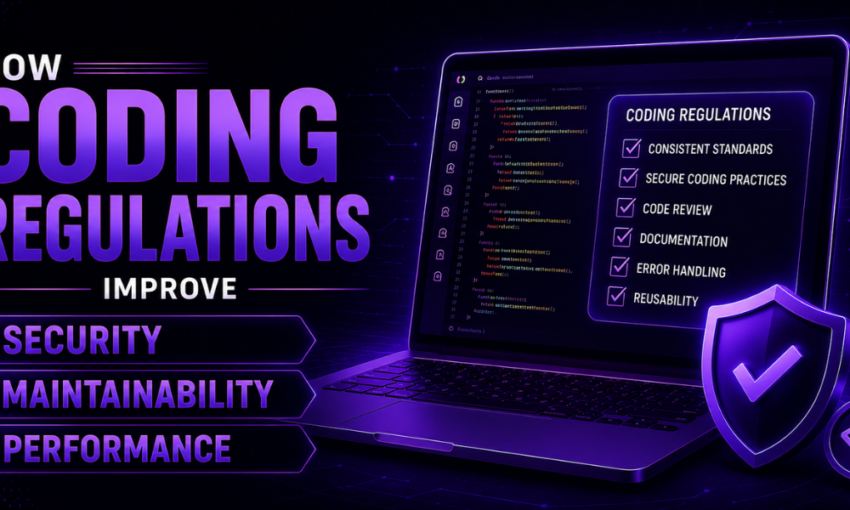
Coding regulations can assist groups create more secure, more straightforward to sustain, and more efficient software. Today, they are used like a shared rulebook to ensure that everybody is on the same page when it comes to coding, reviewing, testing and approving code. Businesses do not only need to have their codes formatted cleanly because of coding rules. They minimise errors, facilitate team working and minimise risk to future changes. They also contribute to more robust security through driving developers to adopt secure practices early on in the development process. Developing software that adheres to coding standards ensures teams develop software that performs better and lasts longer. Coding regulations are especially important these days as the applications evolve rapidly. At the same even users look for faster results, leading to ever-increasing security threats. A codified framework to regulate codes provides teams a sensible method to manage complexity without delaying delivery.
What Are Coding Regulations?
Defining Coding Regulations in Software Development
These coding regulations also go by the names of coding standards and also codes of practice. These include naming, formatting and error handling.
How Coding Regulations Differ From Coding Standards
Coding standards or coding guidelines are procedures that programmers use to create clean and consistent code, such as proper naming, code formatting, problem solving, etc. Secure coding principles, however, go far beyond these lines as they focus on reducing security flaws over adhering to norms that impact the quality and maintainability of code.
The Purpose of Establishing Development Rules
Security coding is important because many of the successful attacks on systems are due to coding errors that could have been prevented at the time the system was built. Outgoing secure practices from the beginning decreases the odds of accidentally inserting vulnerabilities from which hackers can exploit the data or system. A software development life cycle (SDLC) integrates with building security guarantees that considers in each feature, software update, and integration.
Why Organizations Enforce Coding Regulations
Company enforce coding guidelines help to secure applications. It guarantee a good delivery quality, and to reduce life cycle costs. They facilitate the expansion of a development team without compromising quality.
Why Coding Regulations Matter in Modern Software Engineering
1. Standards for secure code: Discover and fix security gaps during SDLC, which significantly prevents security issues downstream.
2. Eliminates late bugs: DevSecOps team is consistent and technically thin enough to develop products fast, thereby gaining a competitive advantage.
3. The standards of secure code: It helps avoid risks by addressing vulnerabilities in a manner to avoid service interruption.
4. Customer data is vital for confidence: 95% of the organizations report that customers are unwilling to purchase if they do not have trust on data security. Therefore it is needed to have strong security code.
5. Meet compliance of different regulations: The standards of secure code support organizations to meet compliance with HIPAA, GDPR, PCI DSS, and other regulations. It fixes security vulnerabilities that are meant to be avoided by those regulations.
Understanding Coding Standards and Guidelines
What Are Coding Standards?
The purpose of code standards is to provide templates for safe, secure, reliable, maintainable and efficient code. They can be on a wide-range of subjects such as:
- Programming conventions
- Code organization
- Indentation
- Commenting
- Error handling
Common Coding Guidelines Used by Development Teams
1. MISRA C/C++
MISRA C/C++ standard is made by The MISRA Consortium. It provide safe and secure applications to its initial aviation clients; it applies to the whole industry, particularly those with safety-critical applications.
2. SEI/SANS CERT
The CERT guide produces better quality and safer software that comes with detailed recommendations for developers. They come as “Rules and Recommendations”, and they claim completeness.
The framework provides for detailed risk data.
3. OWASP Top 10
OWASP stands for Open Web Application Security Project, and it improves the security of Web applications in a given application domain. The OWASP Top 10 list identifies the Top 10 critical web security risks, mapping the identified weakness to relevant CWE IDs with risk metadata.
4. Joint Strike Fighter Air Vehicle C++ Coding Standard (JSF AV)
This specification provides a subset of the MISRA C guidelines specifically for use in the JSF AV.
5. Common Weakness Enumeration (CWE) Top 25
CWE identifies common software weaknesses, based on reporting of real-world security incidents. It classifies these weaknesses and uses this to produce a CWE Top 25, which highlights security problems that pose significant technical risks.
Why Coding Standards Are Important for Business Success
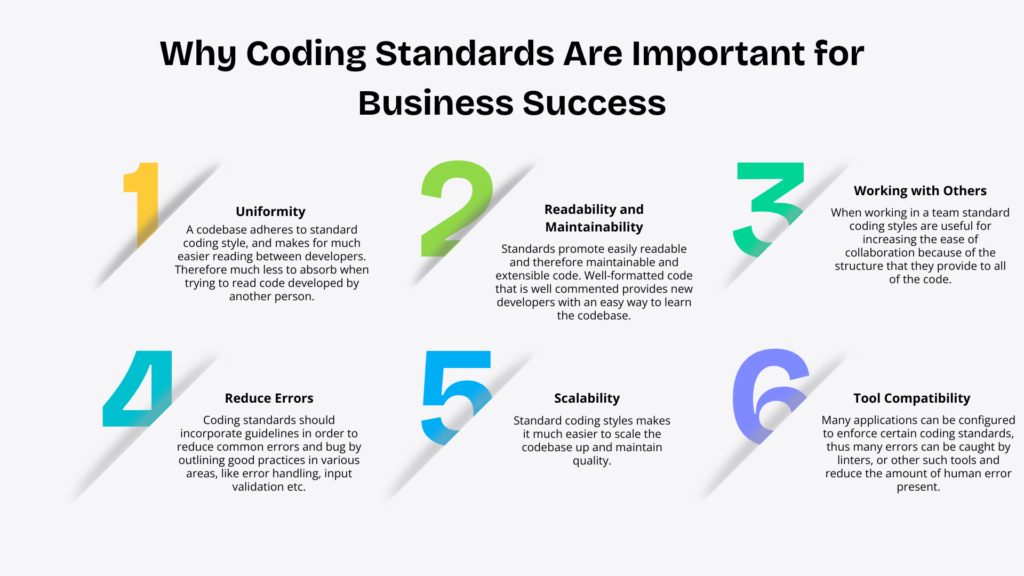
The Relationship Between Coding Regulations and Software Development Standards
- Proof of Compliance: When teams write code to a set standard, it’s possible to prove that they are complying with regulations external to company limits (for example, the ISO 27001, HIPAA regulations or Payment Card industry compliance rules).
- Risk mitigation: Some regulatory codes can’t guarantee the safety of the operating systems as other more rigorous codes could. In turn, dangerous elements in coding can be scrubbed.
- Automation: The tools that automatically parse coding to adhere to a coding standard usually also produce reports, which the compliance team will submit for the organization.
Secure Coding Practices Every Developer Should Follow
1. Validate and sanitize input
Developers are responsible for validating and sanitizing user input to ensure it conforms to expected format and that it doesn’t allow injection attacks. Developers should also avoid direct injection (SQL injection and cross-site scripting (XSS)). Input validation is one of the most basic secure coding guidelines you need to adopt when creating your application.
2. Strengthen authorization and authentication
Utilize strong authentication for verifying the identity. Use authorization to confine access control for specific sets of people by implementing the access control. Access for a certain part of an app restricted by role is a very common pattern among websites. Lastly, it also helps you protect sensitive data from being exposed due to authorization gaps or insecure implementation of authentication.
3. Protect sensitive data
Developers need to securely protect sensitive data such as API keys and authentication. Encrypt and store it safely. Data protection should be embedded into app architecture since beginning.
Coding Compliance Requirements Across Industries
In embedded Systems Coding Standards generally used in the embedded system’s domain. It uses during there is the intention to meet the requirements of the following functional safety standards:
| Standard | Title / Scope |
| IEC 61508 | Functional Safety of Electrical/Electronic/Programmable Electronic (E/E/PE) Safety-Related Systems – It is the foundational international standard for the functional safety of electrical, electronic, and programmable electronic safety-related systems across various industries. |
| ISO 26262 | Road Vehicles/Functional Safety – It is an international standard that specifies functional safety requirements for electrical and electronic systems used in road vehicles throughout their lifecycle. |
| EN 50716 | Railway Applications – Requirements for Software Development – It is a European standard that defines software development requirements for railway applications to ensure safety, reliability, and quality. |
| IEC 62061 | Safety of Machinery – Functional Safety of Electrical, Electronic, and Programmable Electronic Control Systems – It specifies requirements for designing and implementing safety-related control systems for machinery using electrical, electronic, and programmable electronic technologies. |
Coding Conventions in Software Engineering
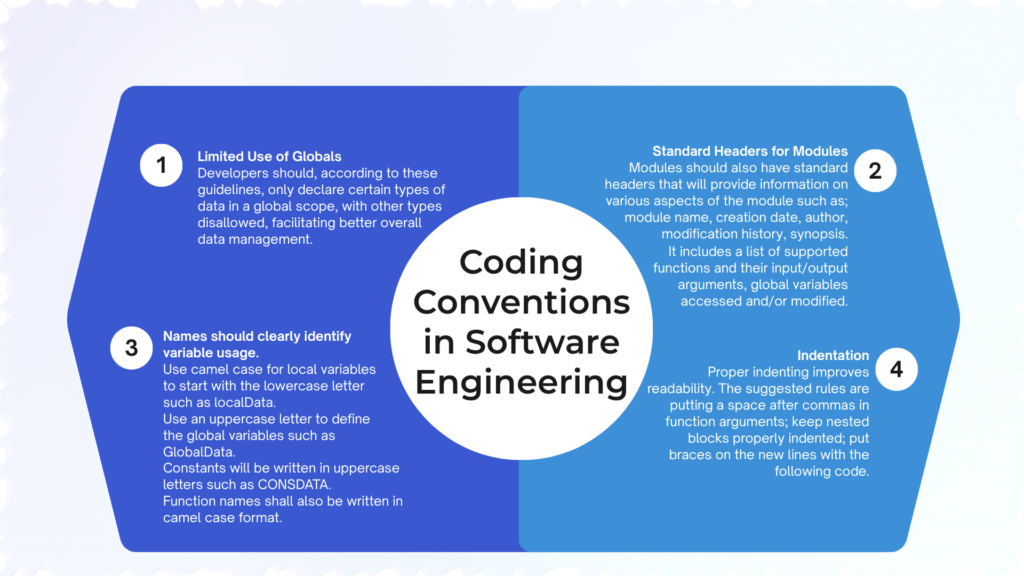
How Coding Regulations Improve Software Security
- Input Validation: Strict validation of all data received by the user is used to stop harmful injections.
- Least Privilege: It limits the user and components in its interaction with their environment as needed to accomplish a function.
- Safe Error Handling: It never leak system information such as system configuration information, file structures and stack traces through error messages that it generates.
Code Quality Best Practices for Maintainable Applications
1. Have a Coding Standard
When developers follow the same coding standard, the code will appear consistent regardless of who wrote it. Some of the more famous coding standards include The Airbnb JavaScript Style Guide and the Google JavaScript Style Guide.
2. Use Version Control
There is a thing call version control and that will make my life as a programmer easier by giving me control of every code change. and allow me to revert back to a certain position.
3. Write Modular and Clean Code
Break the functionality into modules. This is a form of code organization that can make the code more maintainable, readable, and testable.
4. Automate Testing
Test frameworks like Jest, Mocha and Jasmine exist that allow developers to test their code automatically. By using all unit tests, Integration tests and End-to-end tests a developer can see that the code doing as expected.
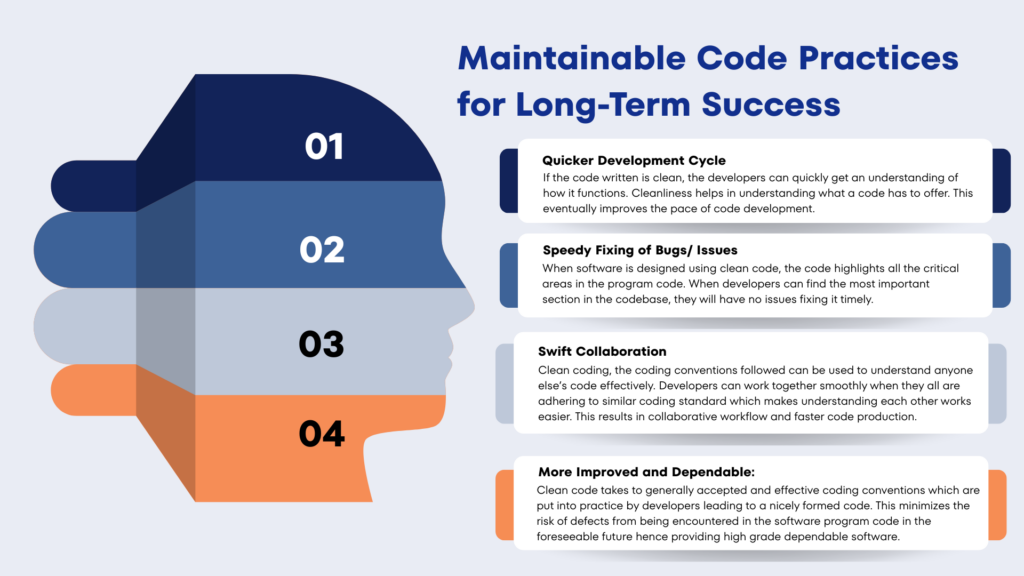
Maintainable Code Practices for Long-Term Success
Code Reviews and Regulatory Compliance
1. Catch bugs earlier
Through unit tests, we can catch and fix bugs before we send features out. This is because reviews use earlier gained knowledge; it saves less time to re-evaluate. They minimize the difficulty of remembering information needed later.
2. Ensure Compliance
Code reviews help us to enforce common coding styles, particularly in large or diverse open-source teams. Maintainers are involved in the review process.
3. Improve security
Involving a security expert can help us to find and remedy the vulnerabilities during the review. This should supplement automated scans as well.
4. Improves quality of code
Another method to improve the code quality can be the usage of code reviews. An experienced reviewer may detect issues a computer would never be able to. This reduces technical debt.
How Coding Regulations Improve Application Performance
- Prevent Attacks: Combats Injection vulnerabilities uses strict input validation and output encoding that will prevent malicious code injection.
- Eliminates the Human Error element within teams: By giving them a standardized “to-do” checklist to work from. After this, you won’t be left vulnerable again due to forgotten weak passwords, imperfect handling of sessions, or logic errors.
- Raise Code Standards: It makes peer reviews and static-code analysis easier with consistent policy definition.
- Protection of Data: Define the appropriate encryption methods and algorithms for transmitting and storing data.
Common Mistakes Teams Make With Coding Standards
| No. | Common Mistake | Description | Solution |
| 1 | Incorrect Requirement Analysis | Launching projects with undefined requirements can cause frequent requirement changes and lead the project away from business goals. | Work closely with stakeholders to gather requirements, create user stories, use requirement-gathering techniques, and ensure all requirements are clearly documented. |
| 2 | Non-implementation of Security Measures | Failure to apply security practices early in the development process can result in vulnerabilities such as weak authentication and SQL injection risks. | Follow a secure-by-design approach, perform regular security assessments, and train developers to secure coding practices. |
| 3 | Creating Unmaintainable Code | Poorly structured code increases technical debt and creates difficulties in future development, debugging, and maintenance. | Follow coding standards, maintain consistent code formatting, conduct code reviews, and add proper documentation to improve maintainability. |
| 4 | Poor Testing Techniques | Inadequate testing allows bugs to remain undetected, affecting software reliability and performance. | Implement Test-Driven Development (TDD), automate testing processes, and regularly test application functionality to identify and fix issues early. |
| 5 | Lack of Documentation | Missing or outdated documentation makes it difficult for users to understand the software and for developers to maintain or improve the system. | Maintain detailed and updated documentation, including API documentation, using centralized documentation tools for easy access. |
| 6 | Ignoring Performance Optimization | Poor application performance can result in slow response times and negatively impact the user experience. | Optimize database queries, implement caching strategies, and conduct regular performance testing to improve application speed and reliability. |
Future Trends in Coding Regulations
1. AI and ML Integration
Using AI and ML solutions such as GitHub Copilot allows for perfecting development from implementing code reviews and bug detection systems to developing applications at a faster rate.
2. Low-Code and No-Code Development
Apps can be built by users using drag and drop features such as what you find on Microsoft Power Apps. This encourages collaborative ways of working and lower costs as it is designed for non-software developers to be able to build their own custom apps.
3. Cross-Platform development
They allow you to make one app and run it equally well on Android and iOS. Cross-platform development frameworks, including Flutter and React Native.
4. Cloud-Native Development
Technologies such as Kubernetes and Docker enable scalable, resilient applications, and can focus on the cloud first approach that allows remote development, CI etc.
5. Cybersecurity-Driven Development
With increasing cybersecurity threats, consider using secure code. Developers must resort to frameworks such as OWASP to achieve better security for the applications.
6. Blockchain Development
Aside from cryptocurrencies, blockchain can also be used for decentralized applications and secured data management through the use of languages such as Solidity (which is based on JavaScript).
7. Progressive Web Apps (PWA’s)
These apps borrow features of best of web applications & mobile applications, the capability of an offline experience or very quick loading time like X (Twitter).
8. Quantum Computing development
As quantum computing become closer from real, the demand for developer specialized in this field using a language like Q will increased to solve many complicated task.
Conclusion
Coding rules are key to the development of secure, maintainable and fast software. They contribute to consistency, fewer bugs, better team collaboration, and ongoing team development. By having the right coding regulations in place, organizations can boost all aspects of the development lifecycle. They manage the risks first, thus enhancing security. They organize and keep codes simple and readable, which in turn enhances maintainability. The better the structure and discipline, the more efficient the software; this leads to improved performance. This for businesses reduces their costs, speeds up their delivery, and results in higher product reliability. To developers it means less confusion and enhanced teamwork. Coding rules are not only a technical choice in a competitive digital environment, but they also offer a savvy operational advantage as well.
FAQs
Q1. What are coding regulations in software development?
Coding regulations (also known as coding standards) are guidelines and rules of code that developers adhere to. They make sure code is both consistent and readable as well as secure.
Q2. Why are coding standards important?
Coding standards are used to keep consistency, make coding easier to read and to make it easier to collaborate with others on the team.
Q3. What are secure coding practices?
Secure coding practices are crucial for designing software that is secure. Best practices such as validating all entries, encoding outputs, and implementing least privilege.
Q4. What is the difference between coding standards and coding regulations?
Organizations create coding standards that they use internally to improve the readability of software. Whereas governing bodies create coding regulations that are legally binding. They are basically distinguished by their source, enforceability and principal.
Q5. What industries require coding compliance?
Coding compliance is needed in several industries including healthcare, aerospace and defense, automotive, finance and medical device.