
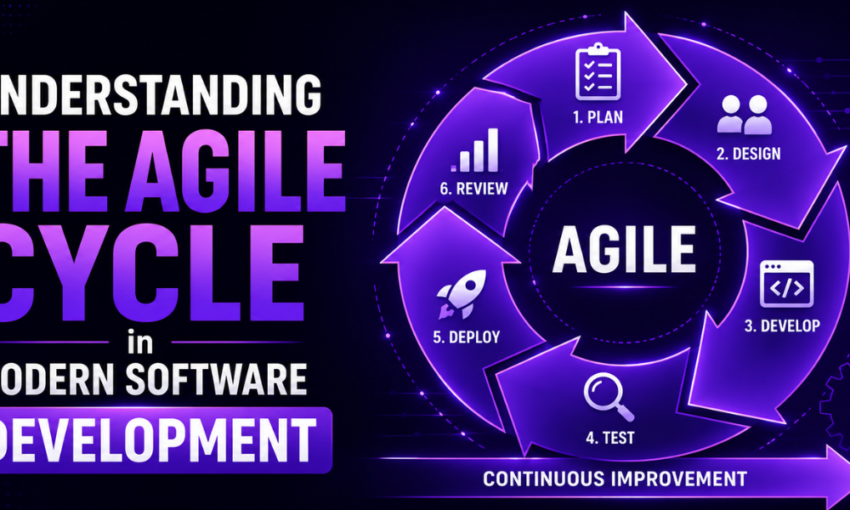
To create value sooner and adapt to shifting requirements, many teams have adopted software development agile cycle as the foundation of their project. Today’s markets are very dynamic and need an organization to react fully to the changes in a flexible and agile way based on customer needs and constantly adapting. The cycle agile meets the required demands because the work is divided into small incremental cycles. These characteristics are repeatable, brief (frequently), and can be short. This blog clarifies what the agile cycle really is, by going over each of the stages, each of the roles, and the benefits that are apparent in the process. If you are a stakeholder, product manager or developer, make sure to understand the cycle agile to collaborate more effectively, minimize risks, and deliver value to users earlier.
What Is the Agile Cycle?
Defining the Agile Cycle in Software Development
Agile life cycle would look a bit different depending upon the project management methodology adopted by a team. For instance, Scrum teams adopt the short cycles of time, It is same as sprints which are similar to iterations, and the short time cycles. But regardless of the software development methods that your team implements, they have the common objective of offering good working software to users on schedule.
Why Agile Became the Preferred Development Approach
Agile was chosen as the development methodology to overcome the serious defects of traditional linear models such as the Waterfall. Agile works by establishing tasks into short cycles (sprints), so that teams can respond rapidly to shifts in market conditions and incorporate user feedback, always providing increased quality, functional software in lesser amounts of time.
Core Principles Behind Agile Methodology
- Early and continuous delivery will ensure software will be immediately valuable and the customer will get value aligned to expectation with updates and feedback cycles.
- Initiate changes on a variety of levels during the development lifecycle to build and ensure quality and relevance of the product with changes planned as and when needed without halting the flow.
- Iterate software releases incrementally on short steps, delivering valuable functionality and fast feedback.
- Help create synergies among all stakeholders and developers to minimize lack of understanding and fasten the decision-making process.
- Enable workers’ empowerment and trust and create a conducive work environment which fosters productivity and quality.
- To put communication as a priority, prevent misunderstandings, and solve issues quickly. Thereby, improving team communication.
- Get the actual job done with functional products, no spelling up of unnecessary documentation.
- To avoid burn-out and maintaining consistent production, ensure a constant workload.
- Focus on good design and coding that will lead to increased long term agility and less technical debt.
- Avoid extraneous features to avoid complexity; beware of fat and emphasise on real business value.
- Institute flexibility for teams with task management to increase productivity and innovation.
- Perform retrospectives, use processes flexibly/more efficiently to pick out strengths and areas for improvement.
How the Agile Cycle Supports Continuous Improvement
The Agile cycle encourages continuous improvement, with chunks of work broken down into time-boxed iterations (sprints). The framework enables teams to quickly test out their ideas, track actual customer behavior and make improvements to their approach as they continue to receive feedback from the customer on a regular basis, and they continue to reflect as a team.
Understanding the Agile Methodology Process
Agile Values and Principles
This goes perfectly with Agile founders’ philosophy in the first Agile principle, wherein problems in software are best solved through interactions between teams of people, not through processes and tools. Agile ideology makes software engineers program and interact among one another with regularity. The concept involves team programming, daily meet-ups and pair programming.
Iterative Development Explained
Clients only wish for the end product. It wouldn’t affect the internal process of software creation. Conventional methodology usually prolongs the delivery period. In some instances, team even take a few months or even years to fully develop a product.
Customer-Centric Product Delivery
The traditional process, or what we also term the “Waterfall delivery method,” necessitates project rigid specifications and minimal to no customer involvement throughout the SDLC. This obligates the software engineer to ensure that the initial plan is carried out effectively. After which, the Agile methodology ensures that it accommodates the latest client feedback. They do it by letting the teams modify development to adapt to evolving consumer demands.
Continuous Feedback and Adaptation
Perhaps, in a case where you do not accept variability, Agile is probably not be what you are looking for. We are firm that a number of the groups are tempted to battle with changing specifications but it should be noted that as requirements adjust and evolve client needs fluctuate, so does technology thus it ought to include flexibility.
Agile Development Cycle vs Traditional Development Models
| Parameters | Traditional Software Development | Agile Software Development |
| Model Preference | Relies on predictability and planning beforehand | Emphasizes adaptability through higher flexibility |
| Project Priorities | Strict plans to meet project requirements | Achieving maximum customer satisfaction with working software. |
| Team Communication | Written documentation and formal communication | Face-to-face communication for better collaboration |
| Project Planning | Longer phases for delivery with a rigid, near-unchangeable plan | Short sprints for planning and delivery with high adjustability throughout the project |
| Team Functionality | Functionally divided | Cross-functional |
| Team Organization | Hierarchically organized team | Teams are always self-organized |
| Recommended Project Scale | Small-Medium | Large-Scale |
| Development Model | Evolutionary delivery model | Life cycle model |
| User Requirements | Interactive inputs | Always defined before coding or implementation |
| Client Engagement | High | Low |
| Customer Involvement | Only before the project has started | Involved throughout nearly every process and also allowed to offer feedback |
| Escalation Management | Escalates to managers | Entire team resolves escalation issues together |
| Product or Process | Emphasizes the process | Emphasizes the product |
| Test Documentation | Comprehensive test planning | Tests planned one sprint at a time |
| Effort Estimation | Project managers offer estimates to get approval from the PO | Scrum masters facilitate |
| Approvals and Reviews | Reviews and approvals come from the PO after the project is over | Reviews done after each iteration for improvement |
Key Agile Methodology Phases Explained
There are a number of phases to the agile software development life cycle, each with associated steps.
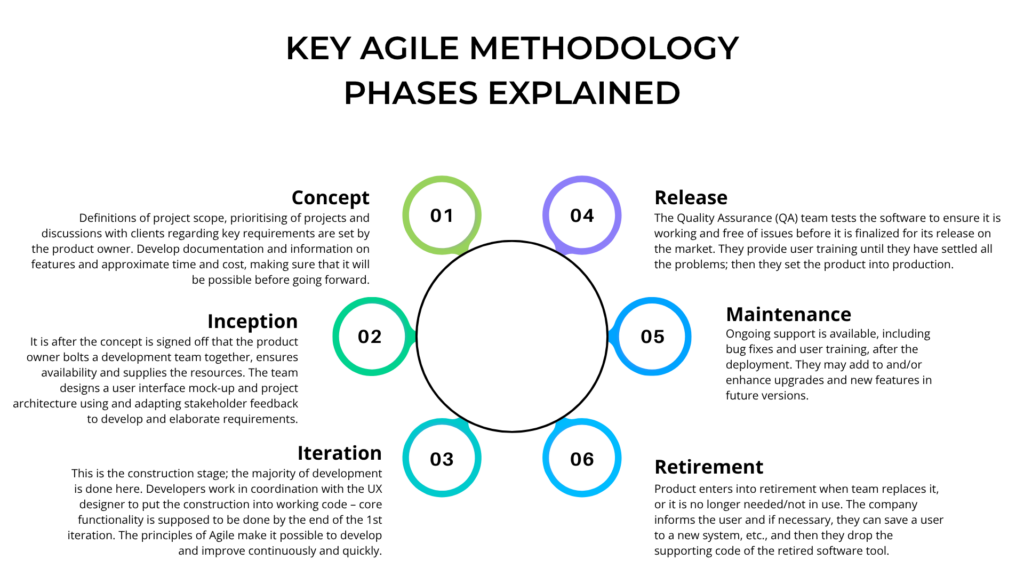
Every phase focuses on incremental improvement to create quality deliverables and deliver the best solution.
Phases of Agile Development in Detail
1. Requirement Gathering: the team meets the customer and understands their business requirement, and get the requirement match with business value. It involves effort and schedule estimates of the development time, both technologically and economically they are feasible.
2. Design the Requirements: the team diagram user-flow diagrams and wireframes showing system structure and user interfaces, draft high-level UML diagrams and prototypes for business consideration by their clients.
3. Construction / Iteration: The team develop software in small iterations from one to four weeks, and deliver a functional piece of work at the end of each iteration, integrating new features and modifying current functionality.
4. Testing / Quality Assurance: Unit, integration, and system testing ensure fixing of all identified issues so that the developed software can pass quality assurance.
5. Deployment: the team deploys the developed software to users and ensure its proper launch, resolving any immediate problems if occurred.
6. Feedback: The developed software is now used by clients and any feedback is collect and analyze. It is used to make changes to further development and adjust the development plan.
Scrum Development Lifecycle Within the Agile Cycle
What Is Scrum?
Users use Scrum as a management framework. Teams can self-organize their tasks and work collaboratively to achieve a common goal. People can face complex adaptive problems in this environment, which would let them fully exploit the potentiality and the creativity of a group to deliver a product. Scrum is used as a management framework to allow team self-organization.
Roles in Scrum Teams
The key roles os Scrum Teams are:
- The Product Owner is responsible for prioritizing the Product Backlog.
- The Scrum Master is responsible for facilitating the Scrum process and identifying and resolving impediments.
- The Development Team is a cross-functional team that builds the product.
In general the Scrum Team works together to identify and organize its tasks in an effective way that would help to provide a value through its product. The Product Owner represents the stakeholders.
Sprint Planning and Execution
The sprint planning meeting. This is the first meeting of each Sprint. The Product Owner, the Scrum Master and the Development Team decide which items of the Product Backlog to pull into the sprint and the team commits to a specific Sprint Goal and creates a Sprint Backlog. The Sprint Goal and the Sprint Backlog describe what is intended for the Sprint. These tasks are performed to accomplish the items selected into the Sprint Backlog.
Daily Stand-Up Meetings
The Sprint Meeting: The daily stand up, also known as Daily Scrum. It is a short, daily meeting that involves the development team members. Each member explains what they did yesterday, what they are going to do today and what obstacles they have.
Sprint Reviews and Retrospectives
This is the end of the sprint meeting when the Product Owner, the stakeholders and the Scrum Team get together to review the work that has been accomplished and provide feedback. Then the sprint retrospective is a meeting at the end of sprint where the Scrum Team reflect upon the sprint and discusses the items performed or not during the Sprint, identifying points to be improved.
Agile Workflow Management for High-Performing Teams
- Sprint Planning: At a scheduled sprint planning time-box event, the team will create their list of high-priority items and will communicate goals for a potential release of the product. In this time-box, it’s critical the team be honest about the capacity in their teams to complete items. Avoid promising too many features too quickly and rely on previous sprint velocities.
- Daily Standups: These meetings promote communication and help people work through obstacles. They are problem-centered rather than status-centered and are a great way of moving along a project, as they are relatively short.
- Review and Retrospective: Following a sprint, a review and retrospective are held to illustrate how much has been achieved as well as assess the process. Improvement should be persistent from lessons learned and therefore should be driven by the right metrics such as cycle time for more effective delivery.
Benefits of Following an Agile Cycle
- Better co-operation between team members: Agile encourages good co-operation among team members and creates a team environment.
- Self-Organizing Teams: Teams become empowered to solve a problem(s) on their own, focusing on increasing the team’s problem-solving power.
- Cross Functional Skills: Teams typically include members who have different skills, thereby providing a full range of those skills required.
- Managerial Support: Managers support the learning of skills and provide a supportive environment with team autonomy.
- Emphasis on Agility: Agile has a strong emphasis on techniques that allow teams to be agile as project requirements and conditions change.
- Improved Task Organization: Agile practices generate more efficient workflows through improved task organization.
- Technical Practices: Implementing technical practices are helpful to people when designing their software and it can help teams to encounter uncertainties in their way to success.
Common Agile Frameworks Used by Organizations
| Frameworks | Structure | Iterations | Roles | Best For | Key Strength |
| Scrum | Time-boxed sprints | 1-4 weeks | Product Owner, Scrum Master, Dev Team | Complex projects, new Agile teams | Structure & predictability |
| Kanban | Continuous flow | None (continuous) | Flexible | Support work, continuous delivery | Flexibility & flow |
| XP | Short iterations | 1-2 weeks | Customer, Coach, Developers | Software development | Technical excellence |
| Scrumban | Hybrid | Sprint-based planning, continuous flow | Flexible | Maintenance & evolving projects | Balance of structure & flexibility |
Challenges Teams Face During Agile Adoption
Mistake 1: The retrospective has become the ‘ceremonial’ task that everyone has to do to complete the sprint, nothing comes of it.
Fix: Have actionable items, take actions from retrospectives, and inspect the success in the following sprint.
Mistake 2: Poor User Stories. The team doesn’t know what work to perform and there’s a lack of clarity and direction as the user stories are too general or unclear.
Fix: Use regular backlog grooming sessions and the inclusion of clearly defined acceptance criteria for every user story.
Mistake 3. Neglecting infrastructure. The tools and the environments, the entire workflow remain problematic as teams do not invest time inspecting and cleaning the environment.
Fix: Spend time on investigating and cleaning your environments regularly, invest time on automating tedious tasks.
Mistake 4: Lack of robust CI/CD Pipelines. It will not be able to provide rapid feedbacks.
Fix: Set up CI/CD automated build and test processes.
Mistake 5: Inexperienced/ ineffective Scrum Master. A command-and-control Scrum Master and attitude can be demotivating for your teams.
Fix: Scrummaster training. Focus on servant leadership, decision making at team level.
Mistake 6: Problematic Product Owners. There is no dedicated Product Owner or their engagement levels is very low.
Fix: Assign one committed, engaged and empowered Product Owner.
Mistake 7: Lack of learning culture. Agile has failed miserably in an environment which is not conducive to learn.
Fix: Create a learning environment where innovation is encouraged and failures are viewed as learning opportunities.
Mistake 8: Getting caught up into technical debt. The organization is not spending time to improve the legacy code.
Fix: Allocate time for refactoring and stick to your coding standards.
Mistake 9: Mistaken assumption: Agile is not the answer for all of the problems.
Fix: Concentrate on mind-sets, behaviors, values & tech excellence.
Mistake 10: Neglect managing backlog well. The team is in the habit of thinking in terms of tasks, stories or components and not in terms of the business value that they contribute towards.
Fix: Take on a light-weight process for selecting your next piece, for example, using value/effort estimate, or using job stories that frame them around an outcome.
Best Practices for Managing the Agile Cycle
- Sprint backlog: The project manager develops the sprint backlog from the product backlog in planning meetings. In these meetings, the project manager integrates the project with the product owner to determine features that have high priority.
- Progress Monitoring Charts: A team employs a burn-down chart to visualize work remaining against time to project completion.
- Sprint Reviews: Demonstrates what has been done during the sprint. Teams show the product backlog items (in visual form or presentation), we can see what the team has done.
- Encouraging Self-Organizing Teams: Self-organizing teams promotes decision-making and adaptability leading to better team ownership and commitment to work.
- Sprint Retrospectives: Before the end of each sprint, the team discusses what went well and what didn’t during the past sprint so they can learn from it.
Agile Cycle in Modern DevOps Environments
Agile and DevOps both aim to deliver software more quickly and reliably. If Agile addresses the planning and delivery of features, then DevOps addresses consistency and automation of delivery, testing and operation.
Here’s the synergy between Agile and DevOps:
- Agiile promotes regular development cycle using sprints whereas DevOps offers automation for build, testing and release.
- Agile addresses small chunks of value being delivered, DevOps tries to get those chunks to production rapidly.
- While Agile promotes collaboration in the team whereas DevOps extends the collaboration to development, operations and QA teams.
With both Agile and DevOps in use the bottlenecks are minimized, product becomes more stable and it is delivered faster.
Measuring Success in Agile Projects
- Customer Impact Metrics: Use direct metrics via tools like Google Analytics and indirect metrics via surveys/support tickets to understand customer’s engagement. Re-measure each time period (e.g. After a month, after six months) with the use of automated tools to monitor usage.
- Team Commitment Metrics: Use completion rates to track teamwork and delivery capacity. If a high percentage of tasks are complete then a team is likely to be working well together. Constant non-completion of tasks is a sign that a team may not be working in unison, and likely an over-optimistic estimation process is being used. Try planning Poker as a way to improve estimations.
- Team Health Metrics: It’s difficult to quantify team health, but collect qualitative information through retrospectives and mood tracking. With digital tools it is possible to get feedback in real-time. As team health increases, the quality and quantity of work tends to follow.
Common Misconceptions About Agile Development
Misconception 1: They think that it is unstructured and unplanned
Reality: It includes multiple multi-sprint planning as well as intra-sprint planning, but gives space for continuous changes.
Misconception 2: For large projects, not feasible
Reality: In large scale projects, Agile also works by breaking the project into smaller pieces and it will be the iteration based approach of the development.
Misconception 3: It cannot be followed in distributed set up
Reality: It works very well for the distributed setup. With usage of multiple tools the members can communicate and work together remotely.
Misconception 4: With Agile we will become faster
Reality: It does not mean you will become faster in shorter time. After some time, we tend to come into a sustained velocity which reduces the time taken in market or for development.
Future Trends Shaping the Agile Cycle
1. Agile at Scale
An area of the latest debate around Agile is how to scale Agile practices to address the needs of large and complex projects. There is an increasing popularity in organizations regarding Agile development frameworks, such as Scaled Agile Framework (SAFe) and Large-Scale Scrum (LeSS). These agile scaling frameworks allow organizations to become agile and to handle a complicated project in an effective manner.
2. Incorporation of Automation and Artificial Intelligence
Combining AI and Automation into Agile methodologies is one of the best ways you can streamline and optimize your whole project delivery. IntegratingAIinto the project with automated tools will make your task and project work faster and more efficiently.
3. Cooperation between 3D Design and Agile Development
Through their collaboration, DevOps and Agile teams will be reshaping the future development of agile project management. These methodologies work synergically and enable continuous integration, delivery and deployment. Thereby resulting in speedy time-to-market and better software quality.
4. Cross-Functional Teams
Among the best practices for agile development is the use of cross-functional teams and all their skill sets, which emphasises in Scrum development. The implementation of multidisciplinary teams can increase productivity, project outcomes, innovation, problem-solving and creativity.
5. Agile for Remote and Distributed Teams
As remote work trends take over, the organisations are adapting the agile practices to effectively manage remotely working teams. Tools and strategies that promote remote working can be used to promote seamless collaboration, communication, and project delivery, even in geographically dispersed environments.
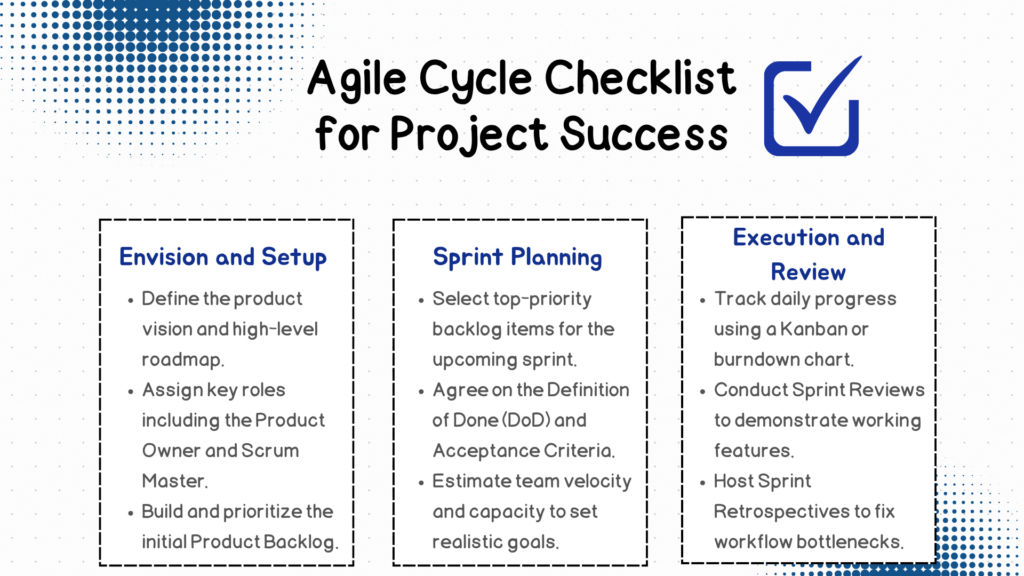
Agile Cycle Checklist for Project Success
Conclusion
The cycle agile redefines the process for getting ideas into the water of working software, focusing on small iterations, frequent feedback, and on-going collaboration and delivery. It minimizes risk, enhances product quality and helps to unify teams with customer requirements. Teams can gain the full benefits of the cycle agile when they follow best practices: define clear goals, test often, include strong stakeholders, and embrace continuous improvement. Given that for modern product teams, understanding the agile cycle is crucial. Lastly, for teams, “speed” and “adaptability” are key attributes to remain competitive and deliver value.
FAQs
Q1. What is the Agile cycle in software development?
The cycle agile works in a cycle: developers divide the product into smaller chunks (normally in a 1 to 4 week cycle known as a Sprint).
Q2. What are the stages of the Agile lifecycle?
The agile lifecycle stages are: Concept, Inception, Iteration (Construction), Release, Maintenance, and Retirement.
Q3. How is Agile different from Waterfall?
Waterfall involves teams completing each phase sequentially before the next phase can begin. Whereas, Agile employs an iterative and adaptable approach that breaks the software project down into manageable cycles of work, or sprints.
Q4. Why is Agile popular among software teams?
Agile is popular because the teams trade one style of planning, long term rigid for iterative, Incremental Development.
Q5. How does Agile improve product quality?
The benefits Agile brings to software include producing higher-quality software, as testers integrate their checks into the development cycle, not only at the end.
Q6. What challenges do teams face when adopting Agile?
Common adoption challenges include: Organizational culture opposition, role ambiguity and confusion, and unavailability of the Product Owner. The paradox of working in short sprints while retaining existing management or quality control processes is considered a common adoption challenge.