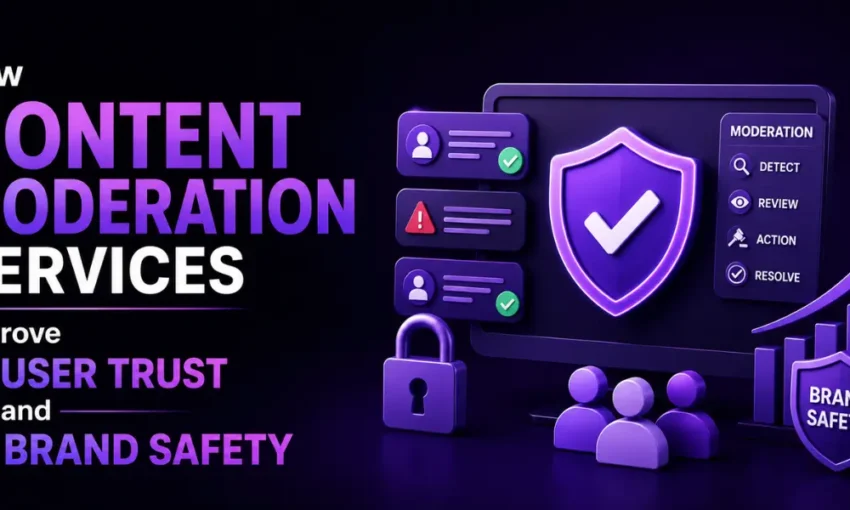
Online spaces struggle with both user safety and keeping users involved in the internet era. Toxic content such as hate speech or fake news disseminates as fast as useful content on online spaces and creates harm towards user credibility and brand value.
Online businesses have become an indispensable instrument in content moderation services. They offer a mechanism to police and regulate user-generated content. It helps in the upholding of community guidelines and brand safety standards. Content moderation services have become indispensable for every brand that seeks to earn and build user trust and security. With the establishment of the standards of conduct with content moderation, brands will have built secure online spaces for users to share their thoughts and feelings.
What Are Content Moderation Services?
Content Moderation Explained in Simple Terms
Content moderation is the process of observing, assessing, and managing all the user-generated content (UGC). It adheres to your platform’s community guidelines, laws, and brand guidelines. It is the foundation of digital trust and safety as it helps protect users from offensive materials, hate speech, pornography, sexual harassment, scams and fake information.
Why Businesses Need Content Moderation
Businesses require content moderation so that their brand name stays intact, provides customers with safe and friendly platform to engage, and satisfies digital safety rules. It increases companies’ user engagement by eliminating spam, hate speech, and offensive content.
Types of Platforms That Require Moderation
1. Pre-Moderation
Platforms pre-moderate content before it appears for creators, with a proactive review mechanism that can approve/disapprove content. These kinds of moderation work normally when websites are targeting kids or are tightly controlled platforms, like in the specific case of some forums.
2. Post-Moderation
Post-moderation is the process used to check the content after publishing it. This type of approach provides more expression freedom; however, in the short term, it can also display harmful information. Post-moderation compromise between freedom of speech and safety (or potential safety) on social networks.
3. Reactive Moderation
There is the possibility to engage in a reactive moderation by responding to user reports/complaints through the ‘moderate’ thread. If users think all the content is inappropriate, moderators will review it and take measures as they see fit. This involves a great deal of user engagement in content moderation.
4. Proactive Moderation
Proactive moderation moderates instances of content that are not reported by users. It was proactively discovered by the moderator. The moderators assist by automated tools but also by human intelligence to search for infringements as quickly as possible.
5. Automated Moderation
Automated moderation uses algorithms and machine learning to detect and remove forbidden material. It is effective in dealing with significant amounts of data, but is unable to pick up on context and highlight correctly which results in false positives or negatives.
How Content Moderation Services Work
There are effectively 3 kinds of AI models for classifying and detecting sensitive content, each used for specific purposes. This class of model identifies classes of text not explicitly defined by the developer.
- Generative models: These models produce a list of topics within a specified piece of text. This type of model detects classes of text that are not explicitly programmed by developers.
- Classifier models: These models assign probabilities to specific categories such as hate speech, violence, and profanity. The strength of the classifier model lies in when there is an exact expectation of which category of expected text. These are visible in the severity scoring of content moderation.
- Text analysis models: These models compare words to pre-assigned “blacklist” dictionaries of categories. While not as complex as an AI model they are reliable and fast.
Social Media Moderation Services and Brand Protection
- Ensuring a Safe Environment: The brand moderates interactions between its users in order to provide a friendly environment which is free of abuse and harmful content.
- Minimizing harmful content: They filter abusive and inappropriate content to avoid psychological stress for the user.
- Reducing hate speech and abuse: Management of abusive behavior helps the community grow into an honorable place for users.
- Offering resources for sensitive topics: The brand provides the user with help and guidance during critical topics in order to strengthen the community and value.
- Building a trustworthy community: Users are loyal to platforms that they trust, brands can easily strengthen their communities by always applying the rules and communicating sincerely with the user.
- Protecting the brand’s image: With proper moderation, brands prevent the community from posting negative PR to their page and from spreading content which does not resonate with their values.
- Slowing down the spread of false information: Moderators work on debunking any misinformation spreading on the page. Therefore the brand can offer valuable knowledge and protect its integrity.
- Curbing cyberbullying: The brand stops the user from bullying by banning their account and removing harmful posts as well as ensuring safe communication within the community.
User Generated Content Moderation Best Practices
- Set up clear guidelines: Ensure that there are clear content moderation guidelines for users and employees, and include the moderation team in creating these for realism.
- Moderate All Content: Moderating all content including employee posts for guidance and ensuring it is in line with the guidelines. It prevents loss of brand and reputation through the use of approved checks.
- Content Moderation for Online Communities: From the moment you enter the Internet, content moderation should be part of any plan to ensure that your brand is safe from harm.
- Continuous Training: Update human reviewers regularly in terms of the nuances in policy enforcement and culture, update AI regularly in terms of enhanced filtering.
- Seek assistance and take immediate action: After breaking rule, be transparent about your actions to demonstrate the rules were disregarded and that you mean business.
AI Content Moderation Tools and Automation
| Tool | Short Description | Key Features | Pros | Cons |
| Hive Moderation | AI-powered content moderation platform that analyzes text, images, and videos for harmful or policy-violating content. Best suited for real-time automated content screening. | Multi-modal moderation that comprises text, image, and video); AI-based toxicity detection; Spam and abuse filtering; Real-time API processing; Custom moderation categories; Scalable cloud infrastructure; Automated flagging system | Strong AI accuracy across media types; Easy API integration for developers; High scalability for large platforms | Limited governance dashboards; Requires tuning for niche content types; Less human moderation support |
| ActiveFence | Enterprise Trust & Safety intelligence platform focused on detecting online threats, harmful behavior, and coordinated abuse. Best suited for enterprise-grade safety monitoring. | Threat intelligence detection; AI-driven risk analysis; Fraud and abuse prevention; Deepfake detection; Real-time monitoring dashboards; Policy enforcement automation; Global safety intelligence feeds | Strong enterprise security focus; Advanced threat detection capabilities; Scales for global platforms | Complex deployment process; Not ideal for small platforms; Limited pricing transparency |
| Checkstep | AI-powered content moderation platform designed for scalable policy enforcement and trust & safety workflows. Best suited for scalable SaaS communities. | AI moderation engine; Policy management tools; Automated enforcement workflows; Real-time content monitoring; Multi-language support; Risk scoring systems; Moderation dashboards | Easy policy configuration; Strong automation capabilities; Suitable for scaling platforms | Enterprise depth varies; Requires tuning for accuracy; Limited transparency on pricing |
| Spectrum Labs | Behavioral AI moderation platform that detects toxicity, harassment, and harmful user behavior patterns. Best suited for behavioral risk detection systems. | Behavioral AI models; Toxicity detection engine; Real-time moderation; Risk scoring system; Community health analytics; Multi-language detection; Policy enforcement tools | Strong behavioral intelligence; Reduces false positives; Effective for social ecosystems | Complex model tuning required; Less general-purpose moderation tools; Enterprise focus only |
| Azure AI Content Safety | Cloud-based moderation service that detects harmful text and image content using machine learning models. Best suited for cloud-native enterprise platforms. | Text and image moderation APIs; AI-based harmful content detection; Real-time moderation capabilities; Policy configuration tools; Cloud integration support; Scalable inference engine; Developer APIs | Highly scalable cloud infrastructure; Strong enterprise reliability; Seamless cloud ecosystem integration | Requires technical implementation; Limited out-of-box workflows; Cloud dependency |
How AI Detects Unsafe Content
AI content moderation services use machine learning to recognize problematic content trends. They instantly scan content for obvious keywords, offensive imagery, and signs of spam. AI content moderation services can scan millions of articles in a short period of time.
Machine Learning and Real-Time Moderation
Machine learning offers content moderation services the benefit of adaptability to changing threats. An AI system uses human feedback to learn to recognize newer patterns in malicious content. A content moderation service can use that information to moderate in real-time.
Benefits and Limitations of Automated Moderation
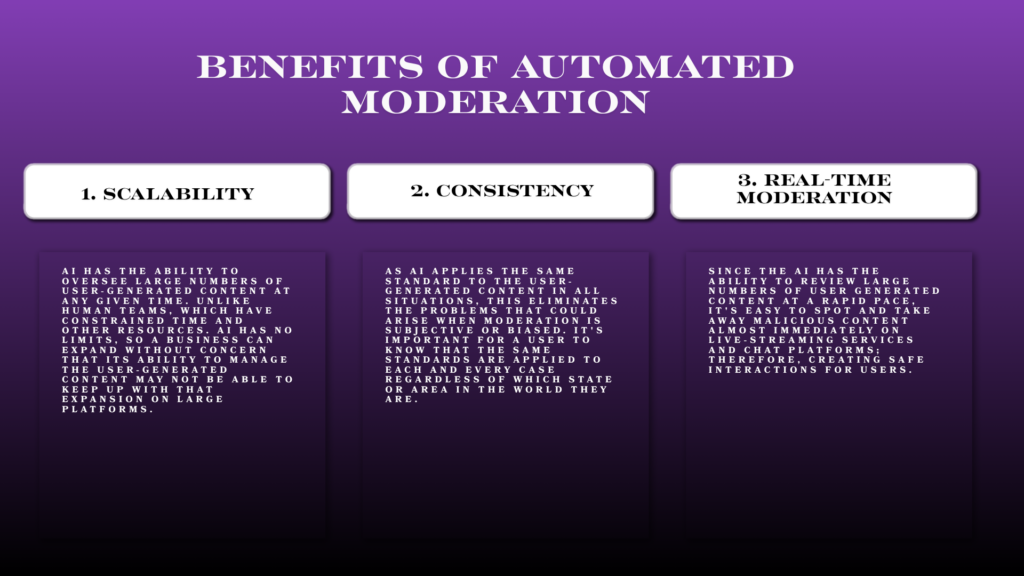
Benefits of Automated Moderation
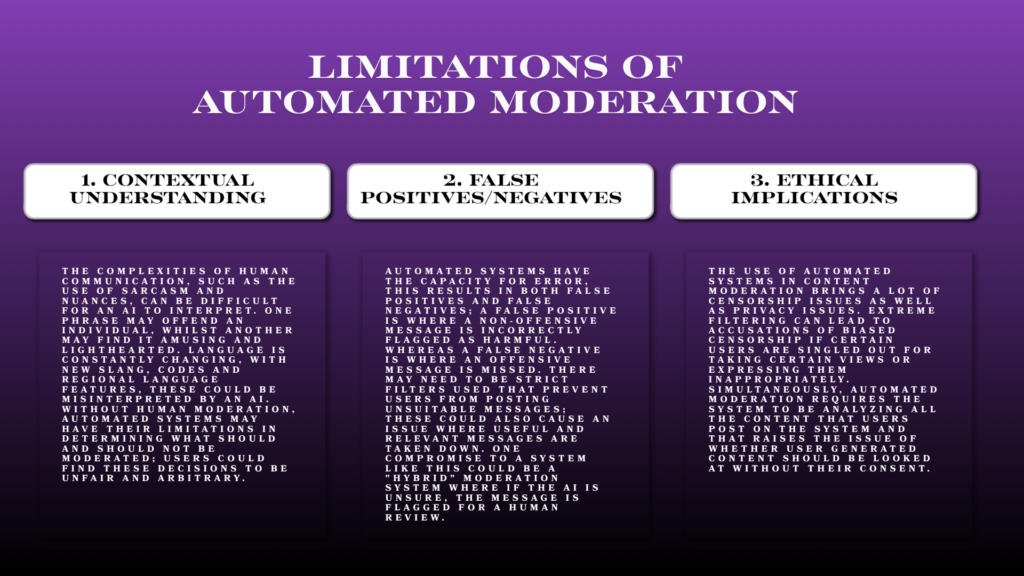
Limitations of Automated Moderation
Community Moderation Services for Safer Online Experiences
Building Positive Digital Communities
Community moderation services construct a healthy digital environment with users feeling valued. Users avoid toxic content and content moderation services eliminate toxic content. These services foster lasting engagement, fostering healthy communities.
Managing Toxic Behavior and Harassment
Content moderation services are able to easily detect and eliminate harmful conduct and harassment. They raise the flag for the users that are abusive and ensure that the party does not suffer repeated bad behaviors. Content moderation defends the vulnerable users against harassment.
Encouraging Healthy User Engagement
Content moderation services foster the healthy engagement by the eradication of negative content. They emphasize good behaviour and provide positive spaces. Content moderation platforms result in a greater retention rate.
Outsourced Content Moderation vs In-House Teams
| Criteria | Manual Moderation | Automated Moderation |
| Speed | Human moderators may take hours or days to review large volumes of content. | AI-powered systems can scan, flag, and remove inappropriate content in real time. |
| Scalability | Requires hiring and training additional moderators as content volume grows, making scaling costly and time-consuming. | Can easily handle thousands of posts, comments, and videos across platforms with millions of users. |
| Consistency and Bias | Decisions may vary due to personal bias, mood, fatigue, or interpretation of policies. | Applies the same rules consistently across all content, reducing human bias. |
| Cost-Effectiveness | Involves ongoing expenses for salaries, training, and management of moderation teams. | After implementation, operational costs are relatively low, making it cost-effective for large-scale platforms. |
| Accuracy and Contextual Understanding | Excels at understanding context, sarcasm, cultural nuances, and user intent. | May struggle with context-sensitive content, leading to false positives or missed violations. |
| Language Coverage | Requires multilingual and culturally aware moderators, increasing complexity and cost. | Can be trained to moderate content across multiple languages and cultural contexts. |
| Best Use Case | Ideal for complex, sensitive, or context-heavy content requiring human judgment. | Best for high-volume, time-sensitive, and large-scale content moderation environments. |
| Key Advantage | Better contextual understanding and decision-making. | Faster, more scalable, consistent, and cost-efficient moderation. |
| Key Limitation | Slower processing and higher operational costs. | Limited understanding of nuanced language, sarcasm, and cultural context. |
Which Option Is Better for Growing Platforms?
Generally speaking outsourcing content moderation is the better choice for fast growing platforms. Access to 24/7 worldwide coverage, scaling capacity, specialized tool sets comes at a low cost than that of a in-house team. Internal teams provide a much better control of the brand, decision making on localized and sophisticated content.
Brand Safety Solutions Through Content Moderation
- Brand Reputation protection: Moderation provides the defense that will protect a brand’s credibility and trust on social media. This has the capability to preserve a brand’s image with customers so as not to lose the existing customers, and at the same time, gain new customers.
- Improved User Experience: A better experience contributes positively towards the overall engagement on social media. Moderators remove malicious content and help make the platform a friendly place for customers to ensure satisfaction and maintain loyalty to the brand.
- Legal risk minimization: More rules and regulations are implemented. Filtering ensures that brands comply with the laws and rules imposed by social media sites. This benefits the brand with prevention of legal problems.
- Build Trust: Trust is a very important element to the overall relationship between customers and brands. Having content moderators can build trust among customers as this displays that brands consider the safety of their customers and will only aim for stronger connections.
- Prevent security risks: Social media moderation plays a significant role in identifying and minimizing the security threats present on social media. These threats are identity theft and phishing attacks on both the brand and their customers.
Content Review Services Across Different Industries
Social Media and Entertainment Platforms
Content moderation services use social media websites to guarantee the security of online consumers. Content moderation service bans damaging posts, comments, and videos. Entertainment platforms use these services to ensure their websites are offering a family-friendly environment.
E-Commerce and Marketplace Businesses
Content moderation companies vouch for reviews and listings on the e-commerce sites. Content moderation services filter fake news and spam. These services draw in more buyers for trustworthy marketplaces.
Gaming and Streaming Communities
Content moderation services significantly help website administrators reduce harrassment and the spread of toxic postings on their gaming platforms. Content moderation services apply to chat, streams and comments. These services create safe gaming environments, thereby improving user satisfaction.
Education and Online Learning Platforms
Learning websites offer content moderation solutions to help ensure a safe learning environment. Content moderation services resist the spread of inappropriate material in discussions.
Future Trends in Content Moderation Services
Hybrid AI and Human Workflow
Use AI for processing and analysis at scale, including human interventions for unusual scenarios. Benefits include efficiency and minimization of false positives, fairness and a trauma-informed approach.
Localized AI
Localized AI provides localized expertise with subject matter experts and fluent speaking. Ensures data accuracy and prevents misunderstandings with users as well as uniform moderation practices.
Cross-channel consistency
Consistency of moderation policies across a company’s different platforms is very important for the credibility of a company. When platforms and policies are unified, they are easier for users to understand and trust. They also provide officials with more information when auditing a company.
Trust and safety trends aligned with a brand.
The safety and moderation of the product should communicate the brand image and security parameters, which integrate into business parameters. This will ensure that the company has brand-alignment with its products and provides users with trust and better security practices.
Data Annotation & Labeling
Continuous data annotation ensures accuracy in AI models, helping them keep up with rapidly changing content that poses a risk on a platform. The use of annotated data can efficiently identify and alert the system to new forms of harmful content, enabling real-time responses.
Privacy and compliance by design
Integrate privacy with AI moderation along with privacy policy adherence, encryption of data, and GDPR adherence in order to be a successful business practice. Good knowledge management will support efficiency in many aspects.
How to Choose the Right Content Moderation Service Provider
1. Scalability – Choose a moderation services company that can grow along with your company. They support your increased content or burst in your user’s activities with effective user-generated content management and security.
2. Cost and Pricing – Be clear about the cost structure provided for moderation services and what could be a fee or a potential hidden cost to upscale services so you can plan your budget and stay on the ground.
3. The availability and turn around time of your moderation team – It is very important that if your company and moderators are in different time zones, they are always ready to deal with any moderation issues that come up to keep your online community safe.
4. Legal compliance and security – Ensure that the partner you have chosen to moderate is aware of relevant laws and regulations. Ensure that they have proper data security measures in place that keep your data and your user’s’ data confidential and safe.
Conclusion
Overall, the content moderation services help by creating a mechanism that builds user trust and ensures online brand safety. They search for and block inappropriate content, respond to online abuse and promote healthy online communities by enforcing community guidelines. These services are crucial in preventing potential legal issues and protecting brand reputations. As online content gets bigger, it requires more and more efficient and effective moderation solutions. As a result, both high accuracy and scale will require control by both humans and AI. A good monitoring service will help businesses build a platform based on trust, safety, and openness.
FAQs
Q1. What are content moderation services?
Specialized platforms, tools and people edit and moderate UGC to make sure it complements a website or app community guideline, regulation and branding.
Q2. Why is online content moderation important?
User-Generated Content (UGC) is reviewed by platforms, tools, and staff to make sure it follows community guidelines, the law, and the brand’s identity or mission.
Q3. What are AI content moderation tools?
The purpose of online moderation tools is to prevent web users from being exposed to unwanted and/or abusive content. They prevent damage to a brand’s reputation and ensure adherence to law and regulation around the globe.
Q4. Should businesses outsource content moderation?
Companies generally need to consider outsourcing content moderation when the sheer volume of UGC grows too large, global and round the clock coverage is a necessity. Also, consider unique language and skill sets.
Q5. How do moderation services improve brand safety?
Brands will benefit from this from an advertising perspective due to the increased brand safety provided by these moderation services.