

A successful software product even though presented by a vision must possess some savory quality assurance (QA) behaviors to ensure user satisfaction. QA methodologies offer a systematic approach that enables teams to develop confident, productive, and secure applications. In this fast-shifting digital world, we are highly dependent on speed and quality, and the development of new QA models. These models identify problems at an early stage, reducing costs, and improving product efficiency. This blog will delve into the different types of methodologies and the various ways they’re tested. It will also include the massive importance of Vendor QA in the quality and performance of software to help QA teams select the best methodology for their projects.
What Are QA Methodologies?
QA Methodologies Explained in Simple Terms
These forms of QA have a systematic style of work. It aims to carry out the software development process to guarantee the optimal quality of the results.
Why QA Is Important in Modern Software Development
There are several reasons why QA is of critical importance to modern software development. It can save time and money by quickly finding and fixing problems as early in the production process as possible, rather than having to engage in expensive repairs later. QA plays a key role in ensuring product quality, reliability, and stability, as well as security. The responsiveness and stability of the system are certified by performance testing. Also, QA is used to ensure accessibility and usability, helping cater to the various demands of users.
Difference Between QA and Software Testing
| Factor | Quality Assurance | Software Testing |
| Responsibilities | It involves ensuring that the developed product meets the customer’s requirements and is of the desired quality. | It involves finding and documenting the defects in the system. |
| Techniques | It involves techniques like root cause analysis, process audits, defect management, etc. | It includes techniques like unit, functional, integration, and system testing. |
| Cost | It generally costs less than Software Testing. | It generally costs more than Quality Assurance. |
| Time | It generally takes less time than Software Testing. | It generally takes more time than Quality Assurance. |
| Effort | It requires less effort than Software Testing. | It requires more effort than Quality Assurance. |
| Testing | It is not a testing process. | It is the process of running a program to find errors. |
| Risk | It involves risks in ensuring the product meets customer requirements and desired quality. | It involves risks in identifying and documenting defects. |
| Documentation | It involves documenting processes to ensure the product meets customer requirements at desired quality. | It involves documenting the defects identified in the system. |
Types of QA Methodologies Used in Software Testing
Agile QA Methodology
Agile testing is a dynamic and collaborative practice that incorporates continuous testing in brief sprints. It focuses on the interaction between developers, testers, and stakeholders, and it can be changed to meet the evolving needs. This process may be enhanced to establish feedback loops, allowing software to be built to satisfy user expectations while maintaining productivity.
Waterfall QA Methodology
This conventional model of developing software consists of sequential processes, which include the requirement gathering process, design, implementation, testing, deployment, and maintenance. It is best applied to projects with well-defined requirements and fixed duration that cannot accommodate changes, where late testing may delay the detection of issues.
DevOps and Continuous Testing
It is a combination of quality assurance and CI/CD pipelines. They automate tasks to ensure consistency and detect errors more quickly. It enhances cooperation between development and operations teams and focuses on continuous testing and deployment. DevOps testing is more productive, shorter time-to-launch, and high-quality standards, which is ideal in a project with flexibility needs.
Shift-Left Testing Approach
Shift-Left Testing focuses on testing the software at the earliest stages of the development process, which will make it possible to detect and fix the mistakes at the earliest stages. Its combination of testing, designing, and development is cost-efficient and time-saving. Also, it is agile and enhances the quality and productivity of the software produced.
Software QA Methodologies Explained in Detail
Manual Testing
Manual testing can be performed by testers who manually set up the testing environment and run the tests. Human operation endangers mistakes that can add up to increased expenses. Manual testing, however, is quite versatile and applicable to ad hoc testing, usability testing, and exploratory testing.
Automated Testing
Automated testing is quickly and reliably carried out using the script, test scripts that allow the process to run automatically. It automates monotonous processes, allowing human testers to focus on vital and innovative activities. Automated testing helps in a variety of ways, including verifying correctness and speeding up the development process.
Hybrid QA Models for Modern Teams
Automated and manual testing together makes a powerful QA strategy, but only if they don’t work at cross-purposes. Automation and manual testing of standardized work components in complex manual situations. Discover and learn about the top QA testing tools to choose the suitable one for your business organization.
Quality Assurance Testing Methods Every Team Should Know
- Unit Testing: This kind of testing looks at each part of a program separately to make sure they all work right. This is what programmers use to make apps, and it mostly deals with smaller parts like functions or classes.
- Integration Testing: This is used to check the interactions of several components. This testing determines problems during the inter-module connection, and establishes dependencies during which all modules have to operate together before release of the products.
- System Testing: Checks functionality of the application end-to end as per specifications. It measures how different components, including databases, interfaces with users, and APIs interact with one another to find out possible issues before the launch.
- User Acceptance Testing (UAT): It checks that the application is usable and meets the customer’s performance. It characterizes requirements prior to being put into service. UAT assists the companies in evaluating how their product conforms to the customer’s expectations. It prepares for use in a production environment.
Agile QA Methodology and Continuous Testing
QA Role in Agile Sprints
QA experts during Agile sprints are a part of the development group to ensure the creation of quality from the beginning. No longer are they gatekeepers but co-workers through and through, looking for defects, creating automated tests, and maintaining implementation of all user stories in DoD.
Test-Driven Development (TDD)
The process of making software called Test-Driven Development (TDD) starts with writing automated unit tests and then moves on to writing the real output code. It will force writers to put requirements in the right order, ensuring that tests are covered, reducing bugs, and naturally creating a simple, modular source code design.
Continuous Integration and Continuous Testing
Two fundamental concepts of DevOps, both referred to as Continuous, are Continuous Integration (CI) and Continuous Testing (CT), both of which are necessary to develop quality software at a rapid pace. CT can be understood as an extension of CI with added automated quality gates to every step of the code merging and compilation process to ensure the new bits don’t break any of the existing functionality. They work hand in hand to eliminate “integration hell” and deliver quick, reliable feedback.
Benefits of Agile QA for Fast Releases
Agile Quality Assurance (QA) is introduced throughout the sprints to guarantee quick, safe and continuous software releases. Agile QA helps to shorten release cycles, detect bugs early in the development process, automate testing, and allow collaboration in real time, all of which lead to greater developer productivity and decrease the likelihood of critical bugs making it into production.
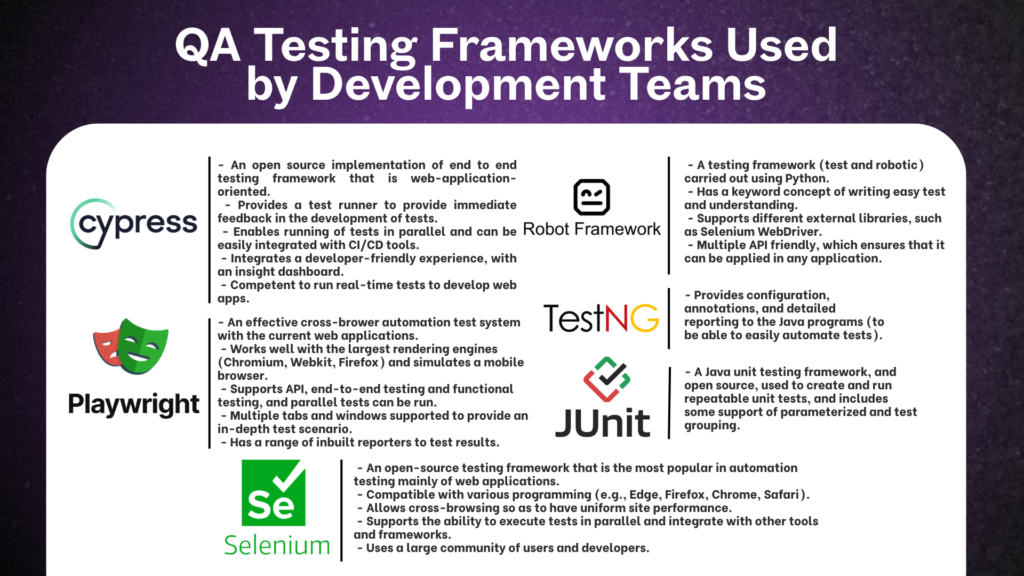
QA Testing Frameworks Used by Development Teams
Choosing the Right QA Framework
1. Determine project goals, budget and schedule to frame QA testing selection.
2. Find out the type of application that needs to be tested (a web, mobile, API, etc.).
3. Choose on attributes to be checked e.g., functionality, security and performance.
4. Select the suitable testing techniques. These techniques are manual, automated, and continuous. The types are functional, non-functional, and integration.
5. Stage different testing exercises to have complete coverage of all the software points.
Software Testing Process in QA Methodologies
Step 1: Requirement Analysis: Examine requirements to ensure they are absolutely complete, clear, consistent, verifiable, and testable, which makes planning and design easier.
Step 2: Test Planning: Pre-establish a strategy and plan the deliverables, determining the scope of the testing, the kind of testing, testing level and tools.
Step 3: Test Design: Design test cases, prepare automation scenarios and pre-set environment.
Step 4: UI/UX Testing: Perform UI testing to make sure the component functions and UX testing to determine the usability at the highest level to provide a favorable user experience.
Step 5: Exploratory Testing: In exploratory testing, there are no specific cases and test cases are not predetermined, which allows testers to think and immediately apply their ideas.
Step 6. Regression Testing: Re-test a few cases that were run in the past after reaching a defect solution to highlight that no new bugs or defects are included and the old is not destroyed.
Step 7: Test running and Bug Reporting: Run tests on various levels (unit, integration, system) and defects with the assistance of a bug-tracking system, and (sometimes) with the assistance of test-automation tools.
Step 8: Release Testing: Run Smoke Tests of the Release Version to find that it is stable. Thereafter run the test scripts and ensure that the new functionality is working. Lastly report on the findings of the experiment.
Step 9: Reviewing: Ensure the software is required, tested and passed. Run several tests on the software to ensure its correct functioning.
Step 10: Post-run testing activities: Compare outcomes with project objectives, apply analytics to acquire the insights of improvement and sustain the test range with a smaller team in the future to enhance it.
How QA Improves Software Quality and Performance
- Risk Management: Risk management is an integral part of software quality assurance. It enhances software testing procedure throughout the Software Development Life Cycle (SDLC) to give the maximum product quality.
- Constant Supervision: monitoring will be done continuously to make sure that it meets industry standard. Being sure that, despite bringing about team independency and removing biases, software QA testing will also be expected to deliver on the image of the company, protection. It is good to engage different automation testing tools to organizations.
- Maintenance Cost Savings: QA teams should determine testing areas they have to improve to remove vulnerabilities and prevent bugs at earlier phases. It is a preventive step that is required to ensure that all applications are bug-free, reduce the cost of maintaining and supporting revenue growth even after deployment.
QA Best Practices in Software Testing
A Software Requirement Specification (SRS) document is essential for best software testing processes; an SRS document is used to define the software requirements and goals that need to be fulfilled before the software can be tested.
A detailed test plan will need to be agreed and developed, covering holistic testing scope, test type, and testing methods, with a highlight of the areas of risk.
Developing structured test cases guarantees that a wide variety of possible situations are covered.
Through early testing, the existing procedures like Agile and DevOps will help to detect defects early in the process and address them at less cost. The waterfall testing model incorporates various types of testing including functional testing, non-functional testing and security testing to enhance the quality of the software.
Reporting bugs is more effective with the help of non-testers, and using automation wisely helps to make the job easier.
With a specific test management platform, the QA activities will be facilitated and continuous measurement of the test measures will result in improvement. In the end, working together and planning well results in better software that is a success for users.
Common Challenges in QA Methodologies
Challenge 1. One-size-fits-all Approach.
The generic testing approaches usually do not state certain software needs and therefore make a wrong evaluation. An example is that a teacher scheduling application can fail to support the individual requirements of teachers and learners, leading to a lack of functionality.
Solution
Use a personalized approach to testing, according to Ideal Customer Profile (ICP). Carry out an in-depth study of the end-user requirements and develop test conditions of the software that mimic the actual usage of the software.
Challenge 2. The shortage of Skilled Labor or Experience.
There is a shortage of qualified software testers and, as a result, none can find qualified teams, which puts them at risk of overlooking key defects. This may result in project delays, losses and product low-quality.
Solution
Invest in the employment and training of competent testers. Create a vibrant working environment to bring in talents and liaise with educational organizations to build the appropriate skills to students.
Challenge 3. Severe Time Constraints.
Crowded timetables tend to cause hasty test work, thus leaving gaps in coverage and less-than-perfect product quality.
Solution
Effective time management and resource allocation should be applied. Use continuous integration and automation testing, and start testing at least three days before release to test complete checks and debugging.
QA Methodologies vs Traditional Testing Approaches
Agile QA vs Waterfall QA
| Features | Agile QA | Waterfall QA |
| Timing | Continuous; happens concurrently with development. | Post-development; a dedicated end-phase. |
| Flexibility | High; accommodates changing requirements and fast feedback. | Low; mid-project changes are costly and difficult. |
| Testing Type | Highly automated to support fast, iterative sprints. | Mostly manual; heavy upfront documentation. |
| Collaboration | Close collaboration between developers, QA, and product owners. | Siloed; QA and development teams work separately. |
| Risk | Low; bugs are identified and resolved early in small chunks. | High; major architectural or requirement bugs are discovered late. |
| Effort | It requires more effort than Quality Assurance. | It requires less effort than Software Testing. |
| Testing | It is the process of running a program to find errors. | It is not a testing process. |
| Risk | It involves risks in identifying and documenting defects. | It involves risks in ensuring the product meets customer requirements and desired quality. |
| Documentation | It involves documenting the defects identified in the system. | It involves documenting processes to ensure the product meets customer requirements and desired quality. |
Manual Testing vs Automated Testing
| Parameter | Manual Testing | Automation Testing |
| Definition | Test cases are executed manually by testers. | Test cases are executed using automation tools and scripts. |
| Processing Time | Time-consuming | Faster execution |
| Resource Requirement | Requires human testers | Requires tools and skilled professionals |
| Exploratory Testing | Possible | Not ideal (limited support) |
| Framework Requirement | No framework required | Uses frameworks (Data-Driven, Keyword-Driven, etc.) |
| Reliability | Prone to human errors | More reliable and consistent |
| Investment | Investment in human resources | Investment in tools and automation engineers |
| Test Results | Recorded manually (e.g., Excel) | Automatically generated reports/dashboards |
| Human Intervention | High | Minimal |
| Performance Testing | Not suitable for load/stress testing | Suitable (e.g., using JMeter) |
| Batch Testing | Not possible | Multiple tests can run together |
| Programming Knowledge | Not required | Required |
| Documentation | Limited documentation | Scripts act as documentation |
| Best Used For | Exploratory, Usability, Ad-hoc testing | Regression, Load, Performance testing |
Traditional QA vs DevOps QA Practices
| Feature | Traditional QA Practices | DevOps QA Practices |
| Testing Timing | End-of-cycle (post-development) | “Shift-Left” (starts on day one, alongside coding) |
| Automation | Highly manual; relies on human testers to execute test cases | Heavily automated; tests are triggered automatically with every code commit |
| Environment | Staged/Staging environments that often differ from production | Ephemeral environments matching production, often spun up via Docker/Kubernetes |
| Feedback Loop | Slow and delayed; finding bugs days or weeks after code was written | Immediate; automated gates alert developers to bugs as soon as they commit |
| Team Structure | Siloed teams (Developers vs. QA) | Integrated squads (Development, QA, and Ops working as one unit) |
| Primary Goal | Finding and fixing defects before customer release | Preventing defects from ever reaching the pipeline and maintaining delivery speed |
Future Trends in QA Methodologies
1. AI-Assisted Revolutionizing of QA Process: AI is capable of making the QA process more effective and accurate since it can conduct automated testing and predict the defects based on the analysis of the data. Using AI allows the QA team members to focus on high-risk areas without engaging in manual work.
2. Explainable AI (XAI): XAI will guarantee that AI systems are capable of providing transparent decision-making processes and will help to build trust and accountability, especially in regulated sectors.
3. Self-Healing Automation Tools: Such tools automatically fix test scripts, which saves them maintenance time. It allows test takers to focus on other good activities.
4. No-Code and Codeless Test Automation: The trend allows the non-technical individuals to come up with tests within a short time using test automation. It is expected that no-code automation will form 45% of the industry in test automation by 2025.
5. Testing, Shift-Left Maturity: Left testing in the development life cycle reduces faults and enhances quality. By 2025, 70 percent of enterprises are estimated to shift-left testing.
6. Advanced Test Data Management (TDM): Advanced TDM provides superior synthetic data to test and thereby enhance outcomes and credibility to conclusions.
7. Quantum computing: Quantum computing will transform QA, as it will be possible to process complex data quickly and develop the complex test processes.
8. Blockchain Technology: With the onward development of blockchain technology, the testing of decentralized applications (dApps) is performed through dedicated testing to provide feasibility in terms of compliance and safety.
Conclusion
The success of application development depends on the presence of strong QA methodologies to deliver reliable, secure and fast software. The practices have assisted teams in detecting and addressing problems at an early stage, minimizing expenses, and promoting user experiences. Whichever development methodologies are adopted, such as Agile, Waterfall, or DevOps, the type of QA solutions adopted greatly affects the quality of the product. Software advances, and QA methods should likewise, with automation and AI and continuous testing becoming an integral part of the process to keep up with the competition and user satisfaction. With the advent of new technology, it is necessary to become more QA-friendly to future-proof the software development process and produce high-quality products.
FAQs
Q1. What are QA methodologies in software testing?
Any business and technical requirements-driven core strategy, framework or process that attempts to guarantee a software product quality is referred to as Quality Assurance (QA) methodologies.
Q2. What is the difference between QA and testing?
The difference between QA and Testing is that QA is to prevent defects from arising, and testing is to find them.
Q3. Which QA methodology is best for Agile projects?
While there is no one definite “best” methodology, there are two that are commonly cited as the best for an Agile project; namely, Behavior-Driven Development (BDD) and Test-Driven Development (TDD).
Q4. What are the most common QA testing frameworks?
The most popular QA testing tools used to test the web user interface are Playwright, Selenium, and Cypress. JUnit and TestNG to conduct unit/backend testing, Appium for mobile applications testing and Cucumber for behavior-driven development (BDD) approach.
Q5. How does QA improve software quality and performance?
Quality assurance ensures the quality and performance of software and prevents software bugs early in its life cycle.