
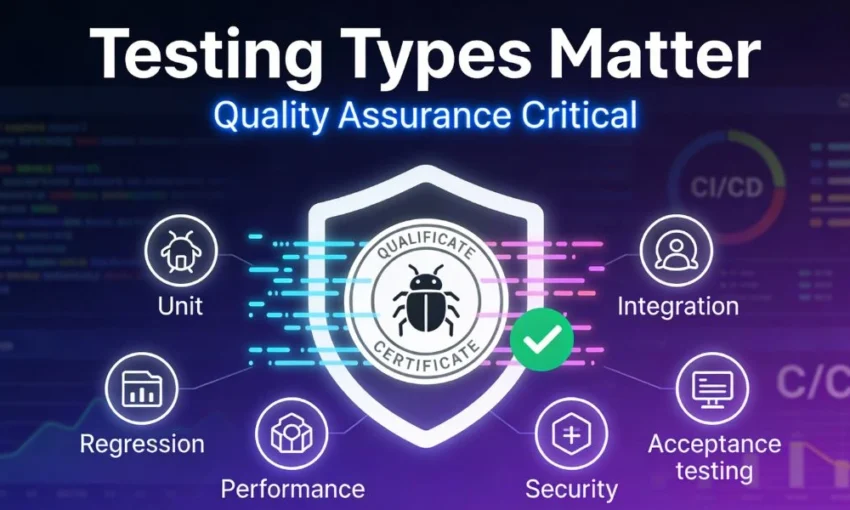
Testing plays a vital role in the creation of dependable software that meets the needs of its consumers without causing any frustration. Knowing about the types of testing in software engineering will help us understand why neglecting testing causes problems such as defective programs and security threats. This article explains the different testing techniques used in software engineering in easy-to-understand language.
The digital age is characterized by numerous applications that perform all kinds of activities, including banking and medical services. An error within any of these applications will significantly affect consumers’ trust. There are many types of testing in software engineering that help address these issues. It ensures that your program works properly at each stage of the process.
What Is Software Testing in Software Engineering?
Software Testing Explained in Simple Terms
Software testing is the process of testing and assessing a software application or a system. It is on the basis of ensuring that the system or the application performs as expected and according to its specifications. It entails testing to correct bugs or faults and guarantee quality.
Importance of Software Testing for Quality Assurance
Quality Assurance (QA) involves software testing as one of its main aspects. It is aimed at detecting defects so that a software product can comply with the requirements and expectations of the users. Whereas QA is a proactive process focused on eliminating defects, software testing is the investigation aspect of assuring product functionality, security, and performance.
Key Objectives of Testing in the Development Lifecycle
The prime objective of Software Testing is to find issues early in the development phase of SDLC (Software Development Life Cycle) to minimize the risks at the later stage. Testing of the program can be done either by hand or automatically. Manual testing requires a tester to test software by hand. Automation testing, on the other hand, includes writing test scripts in a favorite computer language and running those scripts to see if the software meets the standards.
Types of Testing in Software Engineering: Complete Overview
Functional Testing
This kind of testing ensures that the application operates as expected. Functional testing falls under black box testing. Since it is concerned with the functionality of a software application, but not the performance. Unit testing and integration testing differ significantly from functional testing because the latter assesses software from a consumer standpoint.
Non-Functional Testing
This refers to examining the external qualities of the software program, such as its speed, reliability, scalability, performance, etc. Non-functional testing helps determine whether the software meets quality standards besides functionality. Such testing comes after functional testing to assess system efficiency.
Manual Testing
This refers to performing the tests by configuring the testing environment manually. It interacts with humans, leading to additional costs and errors. But manual testing is very flexible and useful for exploratory testing, ad-hoc testing, and usability testing.
Automation Testing
The automated testing processes involve scripts to execute the test cases, hence increasing the speed, accuracy, and reducing the human effort required in doing repetitive actions. This helps in focusing on the essential matters for testers. The use of automated testing together with manual testing is not the best strategy to develop a QA plan in some cases. Once effectively implemented, the right QA testing tools will be found.
Software Testing Types List Based on Testing Levels
Unit Testing
This testing revolves around testing the behavior of the individual parts or functions within the software code. When it is determined that a particular input produces the right output, the unit test becomes a vital basis for software integration.
Integration Testing
It complements unit testing as it aims at ensuring the correct behavior of individual modules after their integration into one software package. Integration testing is especially important when developing software based on microservices because they need effective communication with each other.
System Testing
It is a process of examining the software package in terms of its general functionality. The method is also referred to as end-to-end testing. Testers check how all the requirements defined at the beginning were satisfied by testing the performance of the application as a whole.
Acceptance Testing
This is designed to validate that the software works according to customer expectations. UAT (User Acceptance Testing) and beta testing are among the most common forms of acceptance testing. In this testing, a product is released to users to gather their opinions on aspects of its performance.
Functional vs Non-Functional Testing Explained
| Category | Functional Testing | Non-Functional Testing |
| Definition | An umbrella term for various testing types that test the functionality of a software | A board term for multiple test types that check non-functional aspects of software |
| Purpose | Verify the software functions faultlessly based on the business and user requirements | To ensure and improve high levels of security, performance, usability, etc |
| Manual or Automation | Can be manual or automation testing | Automation testing |
| When to perform | Before non-functional testing | After functional testing |
| Testing types example | Smoke testing, Sanity testing, Regression testing | Load testing, Stress testing, Accessibility testing |
| Advantages | Ensure the software functions as it shouldAllow keeping the software clean from bugsHelp to meet business and user requirementsDone from a real-life end-user perspective | Improve the performance of the softwareEnsure high-security levelsMake the software more user-friendlyHelp the software meet customer needs |
Different Types of Software Testing in Detail
Performance Testing
This entails conducting an analysis of the performance of software in order to determine and resolve problems associated with loading speed, stability, scalability, and reliability. It is vital to define expectations in advance to determine whether the testing process will succeed.
Security Testing
This testing is meant to check an application’s level of protection against security hazards and any attempt at intrusion by hackers. This testing will help determine weak spots in the application and provide guidance when securing it from attackers.
Usability Testing
This is very important as it helps determine whether the system is easy to use and accessible to the users. About 97 percent of users prioritize user-friendliness as the most important aspect in a mobile app, which makes usability testing crucial for businesses.
Compatibility testing
It tests an application’s performance on different platforms, browsers, and devices. It ensures that it performs consistently in different consumer settings. This is to ensure the product works in the desired environment across the different browsers, devices, and platforms.
For instance, testing can involve using different browsers such as Chrome, Safari, and Firefox. It is also done in different devices such as smartphones and desktops. Even testing the application on Windows and Mac OS ensures quality in different user segments.
Software Testing Techniques Used by QA Teams
White Box Testing
It tests the code, logical operations, and architecture of the software being tested. This test type involves developers who must have programming skills. Tests errors in the code, including loops, conditions, and data flow, among other things.
Black Box Testing
It tests the functions of the software without testing its internal code. The focus of testing is on inputs and outputs. Black box testing is unskilled in terms of programming. It validates requirements for the user.
Gray Box Testing
It is a blend of both white box testing and black box testing. It tests the system partially while having some knowledge of the code, while testing in a user’s capacity.
QA Testing Methods in Modern Development
Manual QA Testing Methods
Manual testing involves direct hands-on involvement of human testers, where the testing is not done using any software. Applicable to exploratory tests and usability tests, and where human knowledge is demanded.
Automated QA Testing Methods
Automated testing is the term for testing performed with the help of computer software several times and with little human involvement. Continuous integration and regression testing critically depend on it.
Hybrid Testing Approaches
Effective quality assurance would typically involve the use of both types of tests. Manual tests are capable of performing tasks that will need human intuition and creativity. While automated tests are more speedy and efficient. There is even a possibility to utilize automated testing without coding a thing, with Original Software.
Why Understanding Types of Testing in Software Engineering Matters
Cost-Efficiency & Time Efficiency (Early Bugs Detection)
- Avoid Costly Fixes: Bugs in software are found early on through different testing methods, such as unit testing, which is less expensive than finding bugs later on.
- Save on Development Process Time: By avoiding complexity in bugs, they become easy to debug, hence reducing the process time of the development lifecycle.
Quality Assurance in Regards to the Software Product
- Functionality Assurance: The software is subjected to testing to prove that it is functional and will provide a seamless experience to the user.
- Performance and System Reliability: With the help of the software testing process. It demonstrates its ability to take on enormous traffic without causing a breakdown of the system.
- User Data Protection: This is achieved by testing the software’s security features so as to avoid data breaches.
Improve User Experience (UX)
- Ease-of-use Assurance: The test is used to check the software’s ease-of-use for the consumer.
- Output Quality: In this context, testing helps improve the output efficiency of the software.
Stability & Maintainability
- Regression Test: It involves testing the updated code to make sure that there are no bugs.
- Module-based Development of Software: Unit testing aids programmers in writing quality code.
Common Mistakes in Software Testing
1. Disregarding Edge Cases
Error: When the boundary conditions are not taken into account, there can crash of an application or even precious data may be lost.
To prevent the Error: Find test cases to think about the abnormal cases, boundary conditions and odd behavior of the users.
2. Over Relying on Manual Testing
Error: Excessive manual testing may result in inaccurate testing.
To prevent the error: It should be combined with automated testing and testing without using coding techniques and manual testing.
3. Poor Design of the Test Cases
Error: When poorly designed test cases are employed, it will be difficult to detect any defects.
To prevent this Error: Design test cases correctly, taking into account, the steps, expected results, acceptance criteria.
4. Failure To Conduct Regression Testing
Error: If the aspects of regression testing are ignored, bugs may come back into the application.
To Prevent this Error: In order for any functionality to be tested, you need to perform regression testing each time an application is modified.
Best Practices for Effective Software Testing
- Implement Left Hand Shift: Get quality early and conduct rapid tests for every change.
- Put more emphasis on risk tests: Test what matters the most to the users and the business.
- Representative settings and data: Do not falsify data, maintain privacy.
- Keep a live regression matrix: Keeping a live regression matrix: Selectively drop brittle tests periodically.
- Use metrics for decision-making: Track defect escape rate, mean time to recovery, and performance budgets for metrics in order to make decisions.
- Pairing and collaboration: Get everyone from dev, testing, and the product owner on the same page about what’s accepted and create behavior-driven examples.
Future Trends in Software Testing
Agentic AI
It leverages autonomous software agents for the end-to-end testing workflow. Thus, enhancing its speed, accuracy, scalability, and continuous quality assurance capabilities in complex systems.
AI governance
AI governance platforms help with ethical, secure, and compliant AI testing by providing automated bias detection, compliance monitoring, and dynamic validation of AI models and algorithms.
Shift-left testing and Shift-right testing
Using shift left and shift right testing to combine early stage and production stage testing while moving testing to the “left” and then to the “right” can improve software quality and cut down on bugs, downtime, and time to market.
Low-code testing
Low-code testing platforms are designed to make test automation easier to create and manage via a drag-and-drop interface. It allows non-technical teams to build test cases and move rapidly through agile development processes.
Integration of AI and machine learning
Machine Learning and AI integration in testing optimizes testing by leveraging predictive analytics, intelligent test generation, and expediting Root Cause Analysis. Thereby providing greater accuracy, less effort, and faster problem solving.
Key Takeaways: Types of Testing in Software Engineering Simplified
Software testing is a process through which applications can be tested for correctness, security, and efficiency prior to delivery to consumers. Functional testing, non-functional testing, human testing, and automatic testing are the main types of tests that are done on an app. In the testing life cycle, some of the most important testing stages are unit testing, integration testing, system testing, and approval testing. White box testing, black box testing, and gray box testing are some of the techniques that ensure high-quality software. Performance testing, security testing, usability testing, and compatibility testing further ensure a good experience for users.
Conclusion
If you understand the types of testing in software engineering, it helps you to create perfect software products that will make users happy and businesses successful. Every type of practice, from unit testing to AIT-driven trend, evolves with technology and thus preserves quality despite the quick releases. Prioritize investing in a broad strategy that avoids pitfalls. Leverage solutions such as automation to save valuable time, benefiting your users and your bottom line.
FAQs
Q1. What are the types of testing in software engineering?
There are basically two types of software test engineering: functional testing (expresses what the software does), and non-functional testing (expresses how the software works).
Q2. What is the difference between functional and non-functional testing?
The major difference between functional and non-functional testing is the difference in scope. Whereas the focus of functional testing is more on the performance of the system, the focus of non-functional testing is on the performance of the system.
Q3. What are testing levels in software engineering?
Testing stages in software development involve a form of validation which is planned into a set of four distinct steps, namely Unit Testing, Integration Testing, System Testing and Acceptance Testing.
Q4. What are the most important software testing techniques?
The key software testing types lists are mentioned below:
Exploratory Testing (discovers unexpected defects)
Functional Testing (verifies requirements)
Regression Testing (tests that changes do not affect previous features)
Automated Testing (speed/efficiency)
Boundary Value Analysis (tests edge cases)
Q5. Why is software testing important?
Why software testing is so important is because it makes sure that a product is reliable, secure, assumed reasonable, and works as its developer intended; before even getting it in front of users.