
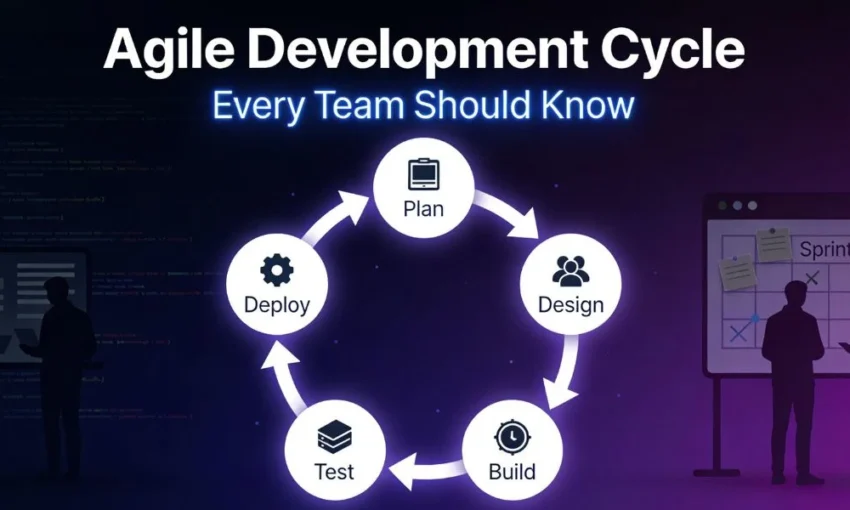
Teams nowadays have to work quickly to deliver software and keep up with the changing requirements. This is enabled by the agile development cycle, where flexibility and collaboration are used to make quick changes. It depends on the feedback based on small development cycles, such as sprints. This practice is contrasted to conventional inflexible means. To improve customer satisfaction and efficiency, it is important to understand processes or phases in the agile cycle. Focus on people rather than processes, and on software rather than documentation. It is based on the values of the Agile Manifesto, enhancing iterative development and continuous improvement.
What Is the Agile Development Cycle?
Agile Development Cycle Explained in Simple Terms
Agile SDLC describes a framework for the software development life cycle that includes a flexible and iterative approach, with a focus on teamwork, continuous delivery, and customer support.
The agile approach to the software development life cycle, unlike traditional methods, does not follow a tight single sequence pattern. Rather, it divides big projects into smaller parts known as iterations or sprints.
Agile Software Development Lifecycle vs Traditional Software Development Lifecycle
| Aspect | Agile Software Development Lifecycle | Traditional Software Development Lifecycle |
| Approach | Agile is flexible and works in smaller development cycles called iterations or sprints. | Traditional follows a fixed and sequential process such as Requirements, Design, Implementation, Testing, and Deployment. |
| Flexibility & Change | Easily adapts to changing requirements, even in later stages of development. | Changes become difficult and costly once a phase is completed. |
| Customer Involvement | Customers provide continuous feedback and collaborate throughout the project. | Customer involvement is usually limited to requirement gathering and final testing stages. |
| Documentation | Focuses more on working software than extensive documentation. | Places strong emphasis on detailed documentation at every stage. |
| Risk Management | Reduces risk through continuous feedback, quick testing, and early delivery. | Higher risk if requirements change because testing happens later in the process. |
Key Principles of Agile Methodology
- The most important thing is Customer Satisfaction. It is achieved by delivering valuable software early and continuously.
- Even late in development, welcome changing requirements. Agile processes embrace change to give the customer an edge in the marketplace.
- Deliver functioning software on a regular basis, every few weeks or months. However, shorter timelines may be preferable.
- Throughout the project, the business people and developers have to collaborate on a daily basis.
- Give out constructions that are associated with motivated people. Also, provide them with their space, needs, and trust them to do what they need to.
- Face-to-face conversation is the most effective and efficient way of communicating information to and among a development team.
- The main parameter of progress is working software.
- Agile processes are environmentally friendly. The users, developers, and the sponsors must have an endless rhythm.
- Agility is improved by being continuously focused on technical excellence and good design.
- Simple–the art of not doing more work, but more–is required.
- Self-organizing teams are the best at creating the best architectures, requirements, and designs.
- The crew then takes time at periodic intervals to introspect on how to be more effective, after which it then tunes and realigns its behaviors.
Agile Development Process: How It Works
The Agile Development Process comprises three primary agile methodology steps, which include Preparation, Sprint Planning, and Sprint.
1. Preparation: The product owner defines the product backlog, including wanted capabilities, and the development team estimates how much time each capability will take.
2. Sprint Planning: The team at this level is assigning what the team will do in this sprint. It normally takes two weeks for the product backlog. They determine the work that they can complete. This is divided into coding, testing, and documentation. These comprise the sprint backlog.
3. Sprint: The sprint is when the team works on achieving the tasks in the sprint backlog. The new problems may be written, and they are added to the list of problems in the product backlog to be prioritized. The review meeting ought to be held after the end of the sprint to present what remained in the sprint and what enhancements and strengths were achieved.
Once the sprint is over, there is a session to look back on it and plan how to make the next sprints better, which encourages constant growth.
Phases of Agile Development Cycle
1. Concept Phase: It is the first phase of the process that provides the foundation of the whole process. It sets the project vision and goals, and identifies the stakeholders. It also performs the feasibility analysis and budget/duration estimation.
2. Inception Phase: Teams are made ready prior to the execution by forming the development team. It defines the first requirements, a product backlog, and plans the first iteration to ensure that these requirements are clear.
3. (Iteration) Development Phase: It is the core of the work process; the work is divided into 1-4 week sprints. Development work is continuous, with innovators continually adding features, conducting ongoing testing, and collecting feedback. It releases incremental versions of the product at regular intervals.
4. Testing Phase: Testing is performed continuously during the development (functional, performance, and user acceptance tests). It allows bugs to be fixed in real-time, and quality is maintained.
5. Release Phase: The features are rolled out to production, documentation is carried out, and feedback from the users is received, and the features can be delivered quickly.
6. Maintenance Phase: Once released, the agile method can be resumed with performance monitoring, bug fixes, and additional improvement features to add more user experience.
Scrum Development Cycle Within Agile
What Is Scrum in Agile Development?
Scrum, a type of agile development, has short sprints that are time-boxed. These sprints are often time-limited to no more than a month, with the next one beginning after each completion. Scrum also includes a variety of ceremonies, such as daily stand-ups, sprint demos, and retrospectives. These rites may happen at the end of the time-boxed sprint planning or even more often.
Key Roles in Scrum (Product Owner, Scrum Master, Team)
| Role | Primary Focus | Key Responsibility |
| Product Owner | Value & Scope | Backlog management, Stakeholder alignment |
| Scrum Master | Process & Coaching | Removing impediments, Facilitation |
| Developers | Quality & Delivery | Building increments, Technical implementation |
Scrum Workflow and Sprint Cycle
The Scrum workflow is agile and iterative, with teams releasing working software after every brief and regular process (Sprint) (typically 2 to 4 weeks in a cycle). It is based on three roles: Product Owner, Scrum Master, and Developers. It is also based on three artifacts: the Product Backlog, the Sprint Backlog, and the Increment. Five key events will be used to deal with complexities, transparency, and frequent product delivery.
Agile Workflow Steps: From Idea to Deployment
Step 1: Making a decision about what the project is supposed to achieve and what the scope of work is related to the business objectives. Include other principles of Agile methodology, such as customer collaboration and flexible nature.
Step 2: Create an agile product backlog with user stories, features, and tasks. Engage in its proactive control and prioritize it based on the input/output of the stakeholders.
Step 3: Choose an Agile system to best fit your team (one option is Scrum or Kanban, and you may customize your process).
Step 4: Trace the flow of tasks between planning and delivery, identify common stages of the workflow, and probable obstacles to overcome.
Step 5: Set up Work In Progress (WIP) boundaries, and determine sprint cadence, ready to be focused and avoid being overloaded.
Step 6: Identify and distribute roles and responsibilities in the group in such a way that they are structured and, at the same time, allow self-organization.
Step 7: Employ a project management tool to better benefit from backlogs, progress, and enhance collaboration.
Step 8: Always monitor and modify the workflow with retrospectives and feedback as a way of creating a continuous improvement response.
Benefits of Agile Development Cycle
- More flexible: Agile development is more flexible than any other project management methodology. Changes can be easily made on the fly by development teams.
- Better communication: Delivery of a better sense of communication between the Development Team and the Product Owner. This results in greater attention being given to cooperation and feedback.
- Lower level of risk: In Agile development, you can lower the risk of the complex projects. Project managers are able to cut complex projects into smaller sprints. Thereby dissecting them and realizing shareholder demands.
- Enhanced customer satisfaction: Customers are happier when you use Agile to grow your business. One reason is that the customer participates in the development process and provides feedback on the project at various points.
Challenges in Agile Development
- Lack of control: Due to agile being more dynamic, it might be hard for a project owner to exert control over the project. It is an issue with projects with tough deadlines to be met or projects with a specific budget.
- Absence of documentation: Agile development software development tends to generate less documentation compared to other project management systems. Projects that involve a lot of documentation have a problem with this.
- Remote teams communication issues: In the agile development process, teams that haven’t been trained on how to work together as a unit may find it hard to work together at a high level. This may result in conflict and frustration.
- Complex projects are not always short: Agile development takes longer than the other types of project management models. This is because it would require advancement in the frequency of meetings and the development of more documentation.
Agile vs Waterfall: Which Development Model Is Better?
Key Differences Between Agile and Waterfall
| Agile Project Management | Waterfall Project Management |
| Client involvement is continuous throughout the development process | Client involvement is limited, mainly during requirement gathering and final delivery |
| Changes can be easily incorporated at any stage of development | Changes are difficult and costly once a phase is completed |
| Follows an iterative and incremental approach | Follows a sequential and linear approach |
| Suitable for complex and evolving projects | Suitable for simple and well-defined projects |
| Testing is performed continuously along with development | Testing starts after the development phase is completed |
| Delivers software in small, usable increments | Delivers the complete product at the end |
| Planning is flexible and adaptive | Planning is fixed and predefined |
| High collaboration among cross-functional teams | Collaboration exists but is mostly phase-based |
| Risks are identified and resolved early | Risks are often identified at later stages |
| Faster delivery of working features | Slower delivery due to sequential execution |
When to Use Agile vs Traditional Models
| Aspect | When to Use Agile Model | When to Use Traditional Model |
| Requirements | Unknown or unstable requirements where the scope may change and flexibility is needed. | Clear and stable requirements with very limited scope changes. |
| Customer Involvement | Projects requiring frequent customer feedback and continuous user participation. | Projects where customer involvement is limited after initial planning. |
| Development Speed | Rapid development cycles with frequent updates and quick deliveries. | Long-term projects with structured phases and planned delivery schedules. |
| Experimentation | Suitable for experimental projects, innovative ideas, or testing new features. | Suitable for projects with predefined processes and minimal experimentation. |
| Project Size | Best for small to medium projects that require adaptability. | Best for large and complex projects needing extensive coordination and planning. |
| Compliance & Documentation | Works well when less documentation and flexibility are acceptable. | Ideal for projects requiring strict regulatory compliance, detailed testing, and heavy documentation. |
| Budget & Timeline | Suitable when budget and timelines can be adjusted during development. | Suitable when budget and timelines must remain fixed from the start. |
Pros and Cons Comparison
Pros of Agile
- Quickly adapts to changes in scope or the project plan.
- Regular changes will keep the customer and the product owners loyal.
- Product testing is done early and often and improves product quality.
- Engages all team members.
- Accelerates delivery with treadmill cycles.
- Failure risks are reduced by detecting problems at earlier agile lifecycle stages.
Cons of Agile
- Constant changes may occur because of flexibility; this aspect affects the budget and schedule.
- Without a rigid project plan, results are less predictable.
- Very time-consuming and involves development teams.
- Agile leaders must be experienced to manage them.
- Weak in the case of inflexible, known projects.
Pros of Waterfall
- It can be a straightforward, convenient process as well.
- With fixed plans, it is easy to determine how a project will turn out.
- When the projects have clearly defined stages, it becomes easier to track the progress.
- They have all the requirements out of scope, hence reducing scope creep.
- Keeps detailed records, which help in maintenance in the future.
- For other types of projects, particularly those that require integration with non-Agile systems, the Waterfall model can be more control-oriented.
Cons of Waterfall
- Difficult to make changes once a phase is completed.
- The end products might not satisfy the needs of the users.
- Needs significant resources during start-up.
- Not suitable for rapidly changing environments.
- Late-process testing may cause expensive repairs.
Best Practices for Implementing Agile Development Cycle
1. It is important to set clear objectives and a scope of work to begin an Agile project. This helps to prioritize features based on the corporate value and requirements of the customers to ensure the development team is constantly updated.
2. Multidisciplinary teams that entail the inclusion of various competencies, such as a developer, tester, and designers, are effective in enhancing teamwork and problem-solving. Therefore, it leads to new solutions.
3. Scrum, Kanban, or Extreme Programming are agile approaches where their teams can implement the principles of Agile in a manner that fits the project requirements.
4. Agile emphasizes integration and delivery that offers more rapid feedback and changes through automated systems and periodic review of the written code.
5. The Test-Driven Development (TDD) offers maintainable and solid code by writing tests before the code, allowing the development process to be faster.
6. Transparent culture and open communication and cooperation, use such coordination tools as Slack and Jira.
7. Customer feedback is very crucial. Do not wait until a product is developed to involve stakeholders; You must ensure you end up with what is expected.
8. It should be consistent in learning and adapting with encouragement of a growth mentality and gradual, regular development via retrospectives.
Real-World Examples of Agile Development
1. SaaS Development
Agile is of great importance to SaaS development firms to constantly update their features and to scale.
2. E-Learning Platforms
Agile will support swift content modification and the upgrades of features, which is one of the e-learning software development services.
3. Startups
Startups follow an Agile approach of quickly testing ideas and re-orienting as needed.
4. Enterprise Software
Large organizations use the Agile methodology in their digital transformation and innovation efforts.
Future of Agile Development Cycle
1. Agile is no longer an IT mono-system.
The applications of agile have shifted their perception from being more of an IT-aligned approach to other industry applications, such as being used in banking, healthcare, and retail. Agile practices are being embraced by non-IT organizations in an effort to be efficient, streamline processes, and deliver more efficient services. As an example, hospitals are employing Agile to minimize the wait time of patients, whereas law enforcers employ Scrum and Kanban to streamline their activities. Agile is increasingly being adopted by product teams, R&D teams, engineering teams, and business operations and marketing teams are also integrating.
2. Agile Remote and Distributed Teams.
Since Agile is being transformed into a company-wide culture, company leadership plays a significant role in the transformation. Many of the employees believe that they would like the top management to be involved in Agile practices. To make Agile work, leaders need to lead by example and establish a culture of commitment, making it user-focused and collaborative.
3. Implementation of AI and ML in Agile.
AI and ML are becoming popular in the Agile project management field, improving the process of planning, forecasting, and optimizing resources. As soon as ethical issues are resolved, AI tools can be used to optimize the processes and provide data-driven decision-making, and enable the promise of AI-powered Agile.
Key Takeaways: Agile Development Cycle Simplified
- Iterative Sprints (2-4 Weeks): Agile divides work into small iterations called sprints or iterations to release functional, tested software on a frequent basis as opposed to doing it once.
- Constant Feedback Loop: Ongoing user and stakeholder interactions are used to avoid the development of features that are undesired as the product is rolled out to suit the needs within the business, which change over time.
- Flexibility over Rigid Planning: In the Waterfall model, changes in requirements are discouraged even late in the process; in agile, they are considered acceptable, which allows for adapting to market changes.
- 6-phase structure: The usual phases are concept, inception, iteration, release, maintenance, and retirement.
- High Quality & Reduced Risk: Due to continuous testing of each iteration, the bugs are caught early, thus reducing rework costs, which are costly.
Conclusion
The adoption of the agile development cycle will help to change teams that are hard planners into responsive innovators. It reduces risk, pleases the consumer, and is compatible with the current speedy time. Begin simple: Select Scrum, educate your team, and repeat. In the near future, this will lead to faster launches and make stakeholders satisfied.
FAQs
Q1. What is the agile development cycle?
The agile development cycle is an iterative and incremental process with the aim of being flexible and collaborative. It’s capable of providing working software quickly also.
Q2. What are the stages of agile development?
There are usually six major stages included in it: concept, inception, iteration (development), release, maintenance, and retirement.
Q3. How does agile development work?
Agile development is an iterative, incremental philosophy of software development that emphasizes flexibility, continuous delivery, and feedback.
Q4. What is Scrum in agile development?
Scrum is a popular agile manifesto that is lightweight and is used to develop, deliver and maintain complex products through collaboration, accountability and an iterative process.
Q5. Agile vs waterfall: which is better?
Agile is better when the requirements and the speed of evolution are higher, and the collaboration among stakeholders is higher. Waterfall is more suitable in projects where the scope is clear, requirements are familiar and the number of anticipated change is minimal.