
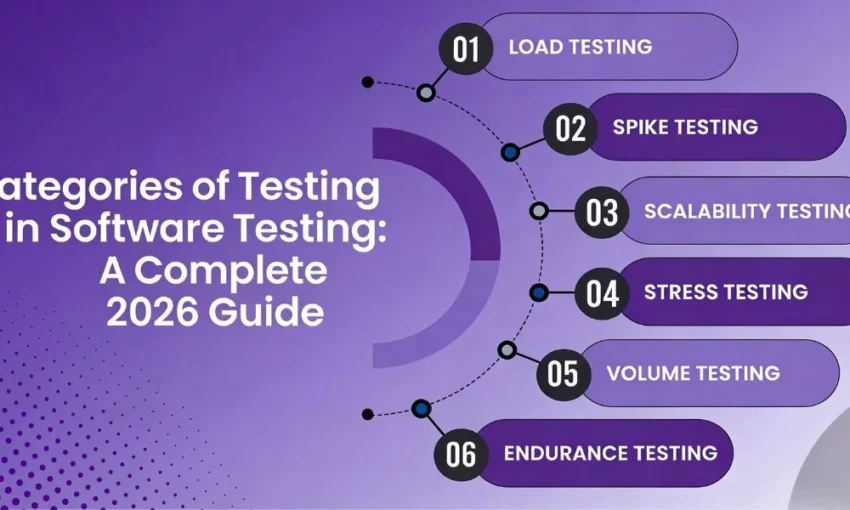
What Is Software Testing and Why Does It Still Matter?
Software testing is not just a final checkbox before launch. It is a continuous process running throughout the entire development lifecycle. When done properly, testing catches bugs before real users do. It protects brand reputation. It reduces the cost of fixing issues later. And in regulated industries like fintech or healthcare, it keeps businesses legally compliant. The global software testing market is projected to cross $50 billion by 2026. That number reflects just how critical quality assurance has become across every sector that ships digital products. But here is what many teams get wrong. They treat testing as a single activity rather than a structured system with different categories serving different purposes. This guide walks through the main categories of testing in software testing, the levels they operate at, and the seven principles that guide effective QA practice.
The Two Broad Categories of Software Testing
At the highest level, all software testing falls into two major categories: functional testing and non-functional testing. Everything else sits within or alongside these two.
Functional Testing
Functional testing checks whether the software does what it is supposed to do. It is all about behaviour. Given an input, does the system produce the expected output?mThink of it as testing the “what.” Can users log in? Does the checkout process complete correctly? Does data save and retrieve accurately? It does not matter how fast the system is or how beautiful the interface looks. Functional testing cares only about correctness of behaviour.
The main types of functional testing include:
- Unit testing — testing individual components or functions in isolation
- Integration testing — testing how different modules interact with each other
- System testing — testing the complete application as a whole
- Acceptance testing — verifying the software meets stakeholder requirements, usually done before go-live
- Regression testing — ensuring that new changes have not broken existing functionality
- Smoke testing — a quick check to confirm the build is stable enough for deeper testing
Non-Functional Testing
Non-functional testing checks how the software performs, not just whether it works. It evaluates quality attributes rather than specific features. This is the “how well” category. How fast does it load under 10,000 concurrent users? How secure is it against SQL injection? Is it accessible for users with visual impairments?
Key types of non-functional testing include:
- Performance testing — measuring speed, responsiveness, and stability under load
- Load testing — checking system behaviour at expected peak usage
- Stress testing — pushing the system beyond its limits to find the breaking point
- Security testing — identifying vulnerabilities before attackers do
- Usability testing — evaluating how easy and intuitive the software is to use
- Compatibility testing — verifying the software works across different devices, browsers, and operating systems
Both categories are essential. Functional software that is slow, insecure, or unusable still fails users. Non-functional quality without correct behaviour is equally worthless.
The Levels of Testing in Software Engineering
Beyond categories, software testing is also structured into levels. These correspond to stages in the development lifecycle, from the smallest unit of code all the way up to the live production environment. Understanding the four main levels helps teams allocate testing effort correctly and catch issues at the right stage rather than the most expensive one.
| Level | What It Tests | Who Typically Runs It |
| Unit Testing | Individual functions or methods in isolation | Developers |
| Integration Testing | Interaction between modules and services | Developers + QA engineers |
| System Testing | End-to-end behaviour of the complete application | QA team |
| Acceptance Testing | Business and user requirements in a production-like environment | QA + Business stakeholders |
Why the Level You Test at Matters
Bugs found at the unit level cost almost nothing to fix. A developer catches it within their own code, adjusts, and moves on. The same bug discovered at the system testing stage costs significantly more. It requires coordination across teams, test cycles to rerun, and in some cases, re-architecture of components. Research consistently shows that the cost of fixing a defect multiplies at each level it passes through uncaught. That is why “shift left” testing — testing earlier in the development process — has become one of the most discussed trends in QA for 2026.
The 7 Principles of Software Testing You Need to Know
Software testing is guided by seven foundational principles that have stood the test of time in the industry. These come from the ISTQB (International Software Testing Qualifications Board) framework and are widely accepted across teams globally. Understanding these principles helps QA teams make better decisions about how to test, what to test, and when to stop.
1. Testing Shows the Presence of Defects, Not Their Absence
No matter how thorough your testing is, you cannot prove software is completely bug-free. Testing can only show that defects exist. It cannot confirm that none remain.
This is an important mindset shift. The goal of testing is not to certify perfection. It is to find and surface as many issues as possible before users do.
2. Exhaustive Testing Is Impossible
Testing every possible input, combination, and scenario is not realistic. Even a simple login form has thousands of potential input combinations.
Instead, good QA teams prioritise based on risk. They focus testing effort on the areas where failures would have the most business impact.
3. Early Testing Saves Time and Money
The earlier you test, the cheaper it is to fix what you find. Defects discovered during requirements review cost a fraction of what the same defects cost when found in production.
This principle directly supports the shift-left approach that modern development teams are adopting.
4. Defects Cluster Together
In most software projects, a small number of modules or components contain the majority of the bugs. Testing effort should be concentrated where defects are most likely to exist.
Experience, historical data, and code complexity metrics can all help identify these high-risk areas.
5. The Pesticide Paradox
If you keep running the same tests, they stop finding new bugs. Over time, the software adapts to the tests, and the tests become less effective.
Test cases need to be regularly reviewed, updated, and supplemented with new scenarios to maintain their ability to catch defects.
6. Testing Is Context-Dependent
There is no single testing approach that works for every project. Safety-critical software in healthcare or aviation requires very different testing rigour than a marketing landing page.
Good QA practice starts with understanding the context: what is the software for, who uses it, what are the risks, and what regulations apply?
7. Absence of Errors Is a Fallacy
Software can pass every test and still fail commercially if it does not meet user needs or business goals.
Testing validates technical correctness. But correct software that solves the wrong problem is still a failure. QA needs to align with real business and user requirements, not just written specifications.
These 7 principles form the backbone of any mature QA programme. They are taught in ISTQB certifications and referenced by software testing teams across industries globally.
Manual Testing vs Automated Testing
One more important distinction cuts across all categories and levels: manual versus automated testing. Manual testing involves a human tester executing test cases by hand, observing results, and using their judgement to evaluate outcomes. It is slower but essential for areas requiring human intuition like usability testing or exploratory sessions. Automated testing uses scripts and tools to execute predefined test cases repeatedly and rapidly. It is indispensable for regression testing, performance testing, and any scenario that needs to be run hundreds of times as code changes. Most mature QA programmes use both. Automation handles the repetitive, high-volume work. Human testers focus on the creative, exploratory, and context-sensitive parts that tools struggle to replicate.
How Promovre Approaches Software QA and Testing
At Promovre, quality assurance is not a bolt-on service. It is embedded into how we deliver managed technical services to our clients. Our QA teams work across the full testing stack — from unit and integration testing during development to system and acceptance testing before launch. We handle both functional and non-functional testing, with particular strength in performance, security, and compatibility testing for complex digital platforms.
For organisations that need structured QA support without building a full internal team, Promovre provides end-to-end managed testing services. That means trained QA engineers, established processes, modern tooling, and clear reporting all aligned to your release cycles and quality standards.
If your current testing approach is reactive catching bugs after the fact rather than preventing them, that is a conversation worth having.
Frequently Asked Questions
Q1 What are the main categories of testing in software development?
The two primary categories are functional testing (which verifies the software does what it should) and non-functional testing (which evaluates performance, security, usability, and other quality attributes). Within these two categories sit all specific testing types, from unit testing and regression testing to load testing and compatibility testing.
Q2 What are the four levels of testing in software engineering?
The four standard levels are unit testing, integration testing, system testing, and acceptance testing. Each level tests the software at a different stage of completeness, from individual code components all the way up to the finished application running against real business requirements.
Q3 What are the 7 principles of software testing?
The seven principles, established by ISTQB, are: (1) testing shows the presence of defects, not their absence; (2) exhaustive testing is impossible; (3) early testing saves time and money; (4) defects cluster together; (5) the pesticide paradox (tests need to evolve); (6) testing is context-dependent; (7) absence of errors is a fallacy. These principles guide how effective QA teams approach their work.
Q4 What is the difference between functional and non-functional testing?
Functional testing checks whether the software behaves correctly — does it do what it is supposed to do? Non-functional testing checks how well it does it — is it fast enough, secure enough, and easy to use? Both are required for a software product to genuinely meet user and business expectations.
Q5 Should a business outsource software testing or keep it in-house?
It depends on your scale, stage, and internal capacity. Early-stage companies often benefit from outsourced QA because it provides immediate access to structured processes and experienced testers without the overhead of building a team. Larger organisations often use a hybrid approach an in-house QA lead managing strategy, with external managed services handling execution at scale.