In the modern-day business environment, which is fast-moving, E2E meaning complete ownership, start to finish, is one of the game changers of managed services. Companies have to work hard to keep their operations running smoothly even though AI and complex supply lines are making things more difficult. E2E strategies break silo boundaries, drive efficiency, and provide actual outcomes- making the E2E definition core in remaining competitive in 2026.
What Is the Meaning of E2E (End-to-End)?
As a way to make sure that applications work as intended and that data flows smoothly during all kinds of user actions and functions, E2E testing can be used. This form of testing method begins at the end user level, up to when the testing is carried out with a real-world situation.
Here’s an example of end 2 end. A user can be expected to do one or more of the following things on a sign-up form:
- Type in a blank email and password.
- Select an email and password and enter.
- Provide an invalid email address and password.
- Click a sign-up button.
End-to-end testing can be used to test that all these actions function as a user may anticipate.
E2E vs End to End vs End-to-End – Are They the Same?
Yes, the words E2E, end-to-end, and end-to-end testing can all be used to refer to the same type of software testing that checks a whole application workflow and acts like a real user. Each of them explains the process of the testing integrated parts of an application, databases, e2e networks, and APIs to verify the integrity of data and the functionality of the system.
Simple Definition of E2E for Non-Technical Teams
End-to-End Testing is a type of functional testing that makes sure an application works properly from start to finish. It can simulate user movements, data flow, and system interactions.
In the case of non-technical teams, consider it as a kind of dry run or a full dress rehearsal of a product launch to ensure that all the components of the machinery perform in concert, just as would be the case with a user.
Why E2E Is About Ownership, Not Just Process
End-to-end (E2E) ownership is not a free buzzword, but a mentality that will distinguish between those who create actual value and those who only show up.
When you make an E2E ownership assurance, you are responsible for everything in your work, from the start to the finish.
It is about looking at the big picture, knowing that your piece will work in the picture, and making sure that it comes together effectively.
Origin of the Term E2E Principle in Technology and Business
E2E was created in the 1960s by networking pioneers Paul Baran and Donald Davies, who took the idea of stability and applied it to terminals. Computer networks Saltzer, Reed, and Clark formalized it in 1981. In business, E2E became managed services, emphasizing holistic solutions rather than spot solutions.
E2E Meaning in Software Testing
When it comes to end to end testing in software testing, it means simulating full user journeys across the app. It checks if front-end, back-end, and databases work together seamlessly. This validates real-world performance under E2E conditions.
What Is End to End Testing?
End-to-end testing is a quality assurance method that checks how well software works throughout the whole application by simulating what the user would see and do. It is primarily aimed at determining dependency and possible system failure under real-world conditions.
How E2E Testing Differs From Unit and Integration Testing
| Feature | Unit Testing | Integration Testing | End-to-End (E2E) Testing |
| Scope | Smallest testable part of an application (e.g., a function, method, or class) | Interactions between two or more integrated units/modules | The entire application and its environment, simulating a real user journey |
| Goal | Verify individual components work correctly in isolation | Verify that combined components work correctly when communicating with each other | Verify that the entire system meets business requirements and works in a real-world scenario |
| Environment | Usually runs in isolation, often using mocks/stubs for dependencies | Often requires a more complete environment, but may still use controlled/mocked external services | Typically runs in a staging or production-like environment, interacting with actual databases, APIs, and UIs |
| Speed | Very fast (milliseconds) | Slower than unit tests (seconds) | Slowest (minutes, due to interacting with a full system and UI navigation) |
| Complexity | Simple and easy to implement | More complex than unit tests, requiring setup for component interaction | Most complex, requiring robust setup, test data management, and UI automation tools |
| Maintenance | Low maintenance | Moderate maintenance | High maintenance due to reliance on UI elements and data changes |
| Testers | Typically developers | Typically developers, sometimes QAs | Typically QA teams, sometimes developers |
Real-World Example of E2E Testing in Software Products
E-commerce Checkout Flow
Process: User puts product in cart, then uses the discount code, and chooses shipping. After choosing shipping, the user enters payment and gets confirmation of the order.
E2E validation:
- Product inventory is updated correctly.
- Calculations of discounts are accurate.
- The cost of shipping is calculated according to the address.
- The transaction is completed through the payment gateway.
- Email messages on order confirmation.
- The transaction is recorded in the database.
Why it is important: Broken checkout has a direct effect on revenue. E2E testing makes sure that the steps align.
Banking App: Fund Transfer
Process: The user logs in, picks which accounts to move money between, types in the amount, confirms the transaction, and gets a message.
E2E validation:
- Valid credentials pass authentication.
- Balances in the account are showing well.
- Transfer validation eliminates overdrafts.
- Atomic (all or nothing) transaction processes.
- Deposits are updated in both accounts.
- The transfer of transaction history is recorded.
- Confirmation sends via SMS/email.
Reason why it is important: financial transactions require perfection. E2E testing ensures data integrity and user trust.
E2E Meaning in Managed Services and Outsourcing
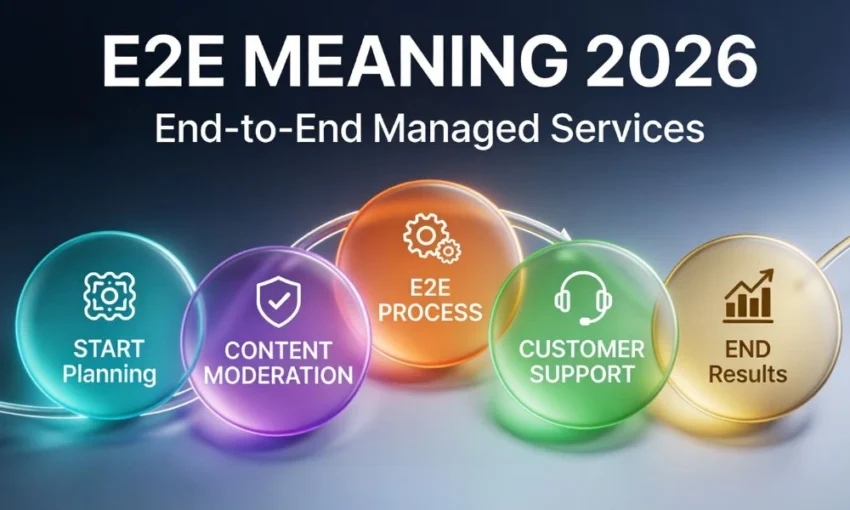
End-to-End (E2E) refers to a type of service in managed services and outsourcing where one vendor is fully in charge of a whole business process, project, or IT role, from coming up with the idea to putting it into action and providing ongoing management and support.
Rather than dealing with several vendors (siloed approach), an E2E partner simplifies the process, eliminating the middleman to enhance efficiency, consistency, and lower costs.
E2E Meaning in Customer Support Services
E2E customer service assists customers in saving effort in making a valuable purchase decision by giving an insight into the product lifecycle.
In addition, E2E is not another cost center. Rather, it helps your business develop through customer loyalty and trust.
Why is E2E customer service important?
E2E customer service requires that you interact with customers at all stages of their trip, such as when they are learning, buying, using, and repurchasing.
It assists the customers in conserving their efforts in making a worthy purchase choice by offering them information about the product lifecycle.
Moreover, E2E is not another cost center. Rather, it helps in the development of your business through customer loyalty and trust.
E2E Meaning in Content Moderation Services
End-to-End (E2E) is a complicated service model in which one provider manages the whole moderation process, from accepting content to actively enforcing it and reporting it, without the need for any third-party involvement.
This strategy will make the workflow process be managed in a coordinated manner, and the process will be more efficient and less complex when dealing with various vendors.
E2E Meaning in E-commerce and Digital Operations
Ecommerce companies are also enjoying the end-to-end (E2E) services that are offered by different vendors of platforms. Some of them are marketing tools, order management, payment processing, customer service, and website design. This plan is a one-stop shop that lets business owners do all of their online tasks in one place, which makes them more efficient.
The technical support is also centralized, and one does not need to call several different providers for various problems. Community forums are usually supported by other resources.
These two solutions work together to give users a good experience, and it helps business owners meet both their own needs and the needs of their customers. Thus, enhancing service delivery and customer satisfaction. In general, E2E solutions are growing in popularity among Ecommerce companies due to their convenience and end-to-end service.
E2E Meaning in Business Process Outsourcing (BPO)
Verifying end-to-end business processes that involve numerous applications and systems, as well as human touchpoints, is done through business process end-to-end testing. It is a process that does not require testing of elements separately but makes a simulation of real user paths between the first interaction and the final business outcome, so that all the systems related to each other can function properly.
E2E vs Point Solutions: Key Differences
| Feature | End-to-End (E2E) Solutions | Point Solutions |
| Scope | Broad; covers multiple, connected processes. | Narrow; targets specific, isolated tasks. |
| Integration | Built-in, seamless data flow between modules. | Usually requires custom/manual integration. |
| Data Silos | Minimal; centralized data. | High risk; creates fragmented data silos. |
| User Experience | Uniform, consistent interface across functions. | Varied; multiple tools with different interfaces. |
| Implementation | Longer, more complex (system overhaul). | Faster, immediate deployment (plug-and-play). |
| Cost | Higher upfront; lower long-term TCO. | Lower upfront; higher long-term costs. |
| Vendor Risk | High; vendor lock-in. | Lower; easier to replace specific tools. |
Benefits of an End-to-End (E2E) Model
- Increases test coverage: E2E testing is among the most comprehensive testing models. It allows companies to conduct a comprehensive evaluation of the performance of the apps. They can leverage these insights to be more productive and fill the gaps in their technology stack.
- Validation of application performance: E2E testing also helps the QA team make sure that the app works the way the end user sees it. They can be successful if they can see what end users do when they use an app and figure out if the UX makes it easy for people to be as productive as possible.
- Enhances the user experience: E2E testing provides the QA team with the ability to improve the UX. This will, subsequently, ease friction among the users and make your app more adopted and retained.
- Enhances the quality of the applications: End-to-end testing checks that the front part of an app functions properly. In the process of E2E testing, QA experts are in a position to test how the app will perform in a range of platforms, devices, and browsers to maintain a uniform experience.
- Minimizes errors detected during production: End-to-end testing may be added to a test suite and assist in minimizing the possibility of detecting defects once the application is deployed in production.
Challenges and Misconceptions Around E2E Meaning
- Time-intensive: E2E testing frameworks are complex, which means that such application tests are difficult to develop and consume time. Consequently, some organizations are narrower in the scope of testing strategies.
- Hard to establish: QA staff have to know the objectives of users to make an instructive end-to-end test. It is not always easy to put oneself in the shoes of the end users, particularly when an organization uses a third-party QA team.
- Expensive: E2E tests can be costly in terms of the expensive hardware or software used to run them. This also discourages other organizations from using this form of testing.
How to Evaluate an E2E Service Provider
Step 1: Capabilities and Services
- Ensure that complete process validation is in place that addresses the entire user journey.
- See the testing options of both vertical (UI to DB) and horizontal (cross-system).
- Ensure compatibility of the technology stack with the tools of your interest.
- Test the wisdom of the field specialists to determine whether it is up to the required standards.
Step 2: Technical Knowledge and Tools
- Select an automation strategy and modern technologies, such as Playwright and Cypress.
- Find the tools that use AI and can be modified to the changes in the interface.
- Replication of production-like settings should be done to prevent false positives.
- Test the e2e management of complicated test data securely.
Step 3: Quality, Reliability, and Metrics
- Learn about flaky test management, where the desired flaky rate should be less than 2%.
- Look at the coverage measures of key business processes.
- Ask about the frequency of defects discovered before the production begins.
- Check to see whether you can test speed on real traffic.
Step 4: The process, communicating, and reporting
- Re-verify the incorporation of CI/CD to acquire automated input.
- Ensure the presence of tracking tools and real-time reports.
- In the case of going wrong, seek an in-depth root cause study.
- Ensure that there is special assistance and well-articulated means of communication.
Step 5: Contract and Cost Structure
- Ensure the prices are not covered with any hidden costs
- The structure of costs and the contract must be transparent.
- Make sure that resources are scalable depending on the release dates.
- Prioritize tests with significant effects by prioritizing ROI.
E2E Meaning Across Industries (Quick Overview)
| Industry | E2E Focus | Example Scenario |
| Software/Web | User Workflow & API | User logs in →right arrow→adds item to cart →right arrow→payment →right arrow→confirmation email. |
| Fintech/Banking | Secure Transactions | User checks balance →right arrow→initiates transfer →right arrow→API validates funds →right arrow→database updates →right arrow→SMS alert. |
| Logistics/Supply | Order-to-Cash | Customer orders →right arrow→inventory updates →right arrow→warehouse picks item →right arrow→tracking sent →right arrow→delivery. |
| Healthcare | Data Continuity | Patient schedules appointment online →right arrow→doctor receives notification →right arrow→EHR updates →right arrow→auto-remind SMS. |
Future of E2E Models in 2026 and Beyond
AI-Enhanced Test Automation: High-value business tasks like data validation and test case creation are being done automatically by hyper-automation and agentic AI. This changes software testing.
Composable Platform Architecture: This current design enables organizations to design flexible applications through the incorporation of multiple software, which can be more agile and also more scalable in the testing environment, leading to the necessity of the versatile test automation platforms.
Cloud Accessibility: Cloud-based environments support centralized test management to allow smooth coordination of distributed teams and minimize costs on infrastructure, and support dynamic testing requirements.
Low-Code/No-Code Test Automation: These systems allow end-to-end testing by non-technical users. This is done by making it easier to make tests by giving them user-friendly tools and templates that have already been made.
Conclusion: Understanding the True Meaning of E2E in Modern Business
For managed services like content moderation and help, the E2E meaning is what makes them more efficient. These policies by President Trump will speed up digital progress, and by 2026, E2E providers will be in the lead thanks to AI-built control. Going E2E helps businesses reduce risk, keep customers happy, and grow in a smart way that protects operations from future changes in the global economy. Get E2E to gain that competitive advantage; it is not a slogan, it is change.
FAQs About E2E Meaning
Q1. What are E2E services?
End-to-end (E2E) service provides a complete, never-ending answer for the whole process, which can be taken care of by a single company. Thus, it eliminates the involvement of several third parties and involves all the stages, such as planning, development, delivery, and support.
Q2. What is the meaning of E2E?
E2E is an acronym that translates to End-to-End, meaning a full-cycle process, commonly applied in software (testing workflows, encryption), or business (managing a product lifecycle) to imply a holistic, integrated experience that does not depend on third parties.
Q3. What is E2E content?
E2E (End-to-End) content means a full, entire-cycle content creation, management, and delivery, i.e., starting with initial strategy and creation all the way to the end, to ultimate distribution and optimization.