
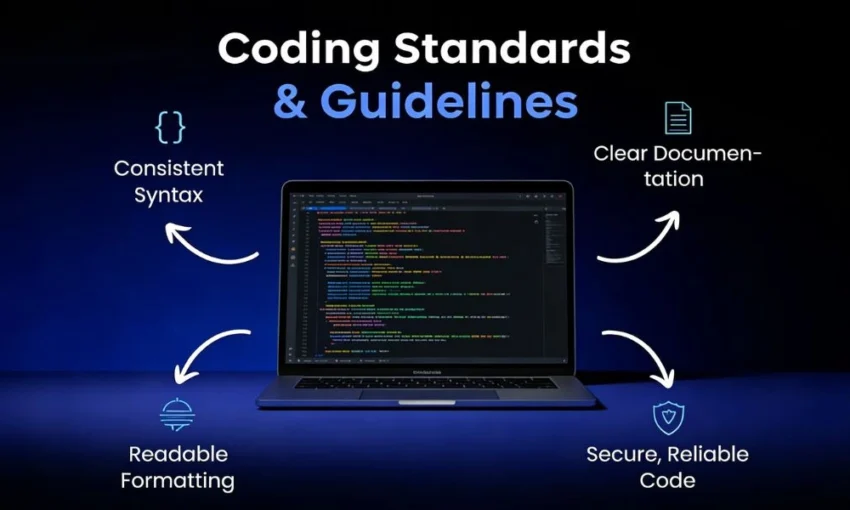
The foundation of the stable, scalable software is the coding standards in software engineering. They make sure that all teams can read and understand the code, which lowers the number of bugs and makes it easier to keep the code working. Coding standards in programming reduce debugging by half and enhance teamwork. These are very important to the fast-paced development process, which is necessary to make sure high-quality applications are ready on time.
What Are Coding Standards in Software Engineering?
Following these rules and suggestions helps programmers keep the codebase uniform, readable, and high-quality throughout the software development life cycle (SDLC).
In other words, code standards are templates of how to write safe, secure, reliable, maintainable, and efficient code. They may discuss a variety of topics, including programming conventions, code organization, indentation, commenting, error handling, and so on.
Coding guidelines and best practices may be specific to a programming language, a business sector in which you are working, or a project.
Importance of coding standards
- Coding Standards in Software Engineering provides similarity to the code that is written by different engineers.
- It enhances readability and maintainability of the code as well as decreases complexity.
- It assists in the reuse of code and is easy to diagnose mistakes.
- It ensures good programming practices and enhances the efficiency of the programmers.
Common Examples of Coding Standards Across Programming Languages
Below, we have mentioned examples of software coding standards:
Naming Conventions: Assign meaningful names to variables, functions, and methods that make it easy to understand what is going to happen. Use informative names without meaningless letters such as x or fn. Keep a sense of consistency in naming (e.g. camelCase vs. snake_case).
Formatting and Indentation: Making sure that the spacing and style are always the same helps make the code easier to read. Before you commit, use code formatters (like Prettier for JavaScript or Black for Python) in your IDE and pre-commit hooks to make sure the code is not formatted incorrectly.
Comments and Documentation: It must provide explanation what this code is doing and put a complex body of logic into perspective. Do not make the simplistic statements that are not value-adding. Effective docstrings give a sense of what the document is, what factors it has, and what values it sets make it easier for people to understand the document.
Error Handling: Be gracefully handled so as to be debuggable and user-friendly. Instead of getting generic error logs, provide details on the error so that it can be corrected.
DRY Principle (Do Not Repeat Yourself): Do not repeat yourself in code to make it easier to maintain that code. Whenever there is a repetition of code, separate it into a reusable functionality. As an example, store identical (repeated) operations(such as the actual calculation of tax) within one function to improve the readability and maintainability of code.
Secure Coding Guidelines to Prevent Vulnerabilities
In order to avoid vulnerabilities, observe secure coding rules such as
- Strict input validation
- Using least privilege
- Powerful authentication (MFA, hash passwords)
- Encryption of data (in transit & at rest using TLS/AES)
Error handling prevents errors and dependencies that are maintained. Approach security early (threat modeling, SAST/DAST tools), with the use of secure design (defense-in-depth, simplicity), as well as following standards (such as OWASP and CERT).
Best Practices for Creating Standardized and Maintainable Code
Industry-Specific Standards: Adhere to such coding standards as MISRA C/C++ to develop automotive software that will be safe and will meet product expectations.
Code Readability: Readability can be improved by cutting down on lines, using the right names, dividing up code, indenting, shortening functions, following the DRY principle, and lowering nesting levels..
Significant Naming: Give meaningful names (Camel Case, Snake Case, Kebab Case, Pascal Case) to express the purpose of a variable or a function.
Unique Identifiers: This is done by giving variables unique names to avoid confusion and improve the clarity of code.
Comments and Documentation: Add comments to complex code, business rules, and edge cases. But avoid making them irrelevant and inaccurate.
Data Processing: Break code into small and maintainable units and rewrite the inefficient code or data structure to work better.
Coding Standards in Agile, DevOps & CI/CD Environments
Agile practices and DevOps focus on collaboration, automation, and continual improvement. The process of coding standards is built into the development process, and automated tools help enforce standards as part of the CI/CD pipeline.
How to Implement Coding Standards in Team
By implementing coding standards within a group, you can increase:
- Participation
- Create simple rules
- Get team automatically with linters and CI/CD
- Understand by peer review
- Training regularly
- Create a feedback loop
By implementing in groups, you can achieve continuous improvement and make standards more visible and accessible.
Challenges Developers Face When Following Coding Standards
Communication Problems: Developers need strong soft skills to improve the collaboration and conflict resolution. You can build your own knowledge database by asking questions and learning from coworkers who are of better rank than you.
User Understanding: Developers should understand user views, usually assisted by UX specialists and marketers, to build the product to user requirements and reduce the need to revise it.
Debugging Strategies: It is quite common that errors do occur, and so it is important to adopt debugging strategies. Bugs and help requests can be used to simplify debugging.
Technology Updates: It is essential to keep up with the technology and skills in using technology to enhance the skills and efficiency. There are resources that can be utilized in this venture, such as Codecademy and Stack Overflow.
Self-Management: In order to stay on schedule with the job, it is important to correctly guess how long tasks will take and then complete them. Division into small components and the introduction of the buffer time can help to enhance predictability. Rests are also critical since they enable in maintaining the productivity and health.
How Coding Standards Improve Collaboration in Distributed Teams
Coding standards have a significant impact on distributed teamwork, including:
- A common language and structure
- Less confusion
- Faster onboarding
- Efficient asynchronous work,
- Improved overall code quality through consistency
It results in fewer bugs, easier reviews, less technical debt, and faster and smoother inter-time-zone integration of divergent contributions.
Case Studies: How Coding Guidelines Helped Real Projects
1. Case Study of Technical University of Cluj-Napoca
Issue
Software development teams find it difficult to board and switch technology stacks as part of technical onboarding, which may negatively affect productivity and code quality.
Solution
A study by the Technical University of Cluj-Napoca with 16 participants working on the creation of native mobile apps in Kotlin and Swift involved the use of AI-assisted code generation tools such as GitHub Copilot and ChatGPT. The participants were challenged to complete development problems with the help of AI and without it, and it was possible to compare the time spent on the tasks, the accuracy of the results, and alignment with the industry standards.
Result
The researchers found that the time and accuracy in executing the task improved considerably with the help of AI tools. Also, 72% of the respondents identified the AI tools as very helpful, and 66% were confident in the quality of the code they produced with the help of AI, which shows the potential of AI to transform software development.
2. Case Study of Zencoder
Issue
Developers are struggling to produce contextual, mistake-free, and compile-ready code as quickly as possible, which may impede the productivity of the developer and cause a higher chance of errors.
Solution
Zencoder offers this requirement by offering an AI coding agent-based system. It tackles the requirement using syntactic and semantic analysis to enhance code creation iteratively. It has an agentic pipeline that is proprietary and improves the code repair by adding the context of the developer’s environment and repository, as well as DevOps tooling. Moreover, Zencoder can provide a convenient user interface and a smooth fit into the current workflows and IDEs.
Results
Consequently, Zencoder has gained popularity among programmers and ultimately helped them in their code-writing workflow to get faster and more accurate results without the worry that the resulting code will integrate into their development systems.
Future of Coding Standards with AI and Automated Code Generation
Let’s check the benefits of following coding standards in the future:
- IDE integration: AI code generators will be seamlessly integrated with IDEs, providing real-time suggestions, error reporting, and code optimization, improving the development process.
- Natural Language Understanding: The development of NLP will give AI tools the ability to better understand human language to generate code correctly when presented with natural language requirements.
- Customization and Adaptability: Future code generators based on AI will have more customization features and will be able to adapt to the preferences of developers and their own style of coding.
- Cooperation with Developers: AI will be used as a partners to support the development lifecycle and provide a continuous learning and feedback loop.
Conclusion
Coding Standards in Software Engineering can convert untrustworthy programs to stable resources. They promote collaboration, safety and speed within any setting. Use them now to make your projects future-proofed and present exceptional software.
FAQs About Coding Standards
Why are coding standards important?
Coding standards provide quality, maintainable, and consistent software development. They contribute to better readability of a code, debugging, and scalability, diminish complexity and errors, lower long-term costs, and encourage security and teamwork.
Is a coding standards document just a guideline?
A document on the coding standards is not merely a guideline. It is an authority of formal, binding rules (standards) and lenient advice (guidelines/conventions) of consistency, quality, and maintainability. It is imposed through such tools as linters in CI/CD pipelines.
Explain coding standards and guidelines?
Coding standards and guidelines are compositions of principles that best maintain that programmers act to make code uniform, consistent, and maintainable.